Concrete and compaction
Batching, pumps, skips, vibrators and rollers - the plant that gets concrete and fill where they belong.
Last updated 2026-09-05
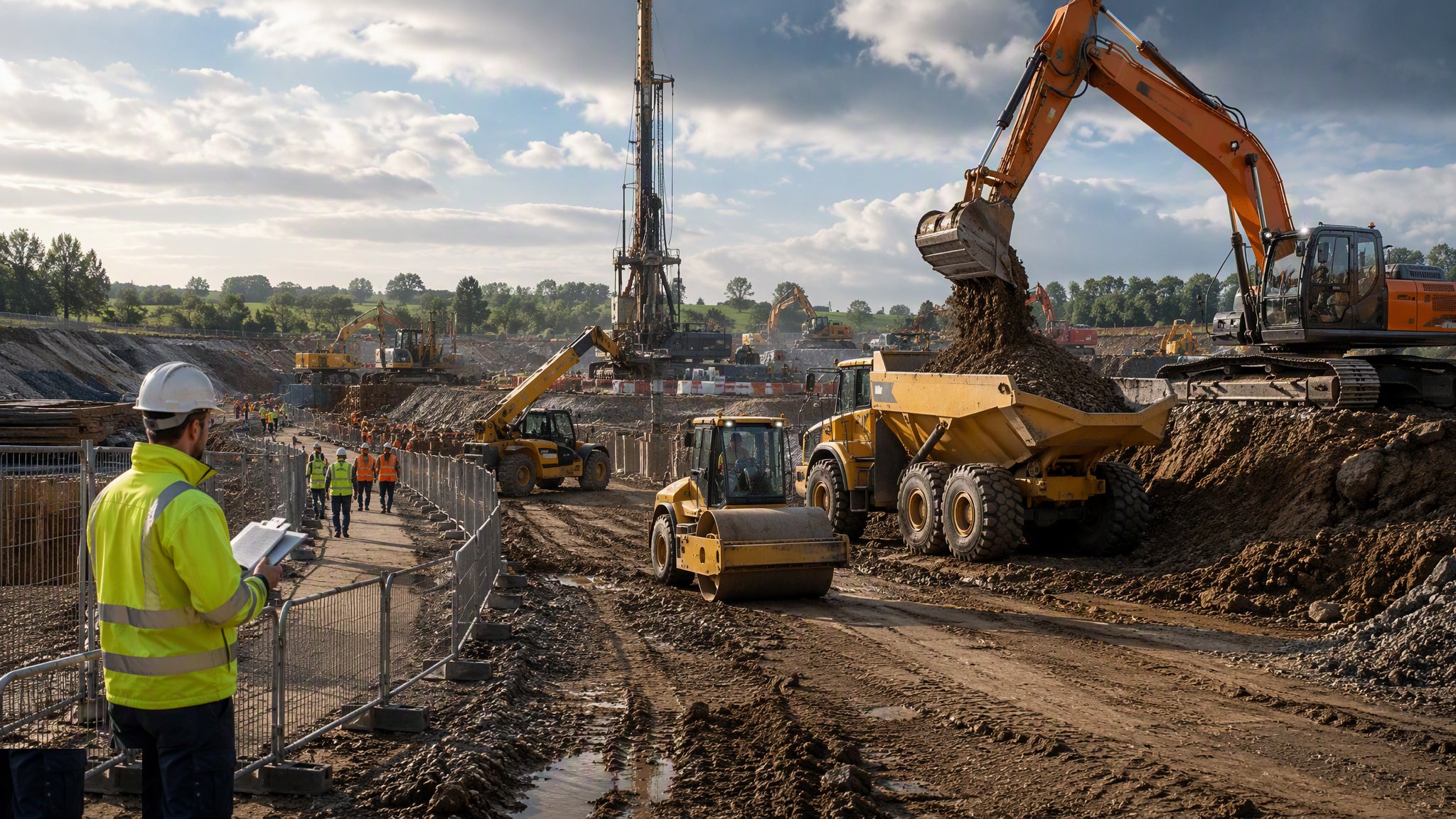
What is Concrete and compaction?
Concrete plant exists to solve one problem: concrete has a limited working life from the moment it is mixed, and it has to be in place and compacted before that life runs out. Everything in the family follows from that. Ready-mixed concrete is batched off site and delivered in truck mixers; site batching plant is used where volumes are very large, where the site is remote or where the mix has to be controlled locally. From the truck the concrete reaches the works by pump, by skip on the crane, by conveyor, by dumper or occasionally by chute, and once placed it is compacted by poker vibrators, beam and screed vibrators or shutter vibrators, then finished and cured.
The pump is the machine that changed concrete construction. A truck-mounted boom pump sets up on the road or the site, unfolds a boom that reaches over the works, and places concrete at a rate that no skip operation can approach - which is what makes large slab and raft pours in a single day possible. Static pumps with pipelines run concrete long distances horizontally and up tall buildings, and are the standard arrangement on high-rise work where a boom cannot reach. The crane and skip remains useful for small, awkward or intermittent placing, but on any project with real concrete volumes the pump sets the pour rate and therefore the pour sizes.
Compaction plant sits on both sides of this trade. In concrete, vibration removes entrapped air so the concrete is dense, strong and durable and the cover to reinforcement actually performs. Under-vibration leaves honeycombing and voids; over-vibration segregates the mix. In earthworks and pavements, rollers, plates and rammers compact fill and sub-base in layers, and the plant, layer thickness and number of passes are proved in a trial before production. Both operations share a characteristic that makes them dangerous to leave to habit: a poor result is buried and invisible, and shows up later as a defect nobody can fix cheaply.
How does Concrete and compaction work, step by step?
- 1
Step 1: Establish the pour and decide how to reach it
Planning starts from the pour: how much concrete, over what area, at what height, in how long, and through what access. That determines whether the concrete is placed by pump, by skip, by conveyor or by dumper, and it determines the pour size the project can actually achieve in a shift. Where the pump is on the public highway, the standing position, the permits and the traffic management are arranged in advance. On congested sites the placing method frequently drives the pour sequence rather than the other way round.
- 2
Step 2: Sort the supply and the delivery sequence
The mix is specified for the element, the exposure and the programme, and the supply is arranged so trucks arrive at the rate the placing method can absorb - too slow and the pour stalls, too fast and trucks queue and the concrete ages in the drum. Delivery routes, the standing area, the wash-out arrangement and the contingency for a breakdown or a traffic delay are all agreed before the pour. Large pours are rehearsed on paper hour by hour, with an agreed point at which the pour is stopped and a construction joint formed.
- 3
Step 3: Set up the pump on ground designed for it
A boom pump is supported on a small number of points while it works, and the ground under those points is assessed and, where necessary, designed by the temporary works designer with the mats or spreaders specified. Basements, culverts, drainage, vaults and recently backfilled trenches are the recurring hazards. Overhead lines are identified and stood off. Static pumps and their pipelines are secured along their whole route, with particular attention to bends and to vertical runs, because a pipeline under pressure that comes loose is dangerous well beyond the point of the failure.
- 4
Step 4: Confirm the formwork and reinforcement can take the pour
Formwork and falsework are designed by the temporary works designer for the pressures the pour will generate, and the rate of rise assumed in that design is a real constraint on how fast the concrete can be placed. The arrangement is inspected and signed off before concrete is called. Reinforcement, cover, cast-in items and the pour break positions are checked at the same time. A pour poured faster than the formwork design allowed is one of the classic causes of formwork collapse, and it happens because the pour rate is treated as a productivity target rather than a design parameter.
- 5
Step 5: Place in a planned sequence and compact properly
Concrete is placed in the sequence and the layer depths planned, worked into place rather than moved around with vibrators, and compacted with poker vibrators inserted and withdrawn in a systematic pattern so no area is missed. Beam and screed vibrators compact slabs; shutter vibrators serve where access is impossible. Compaction is where durability is decided, and it is systematically under-appreciated because a well-compacted pour and a poorly compacted one look identical once the shutters come off. Enough vibrators, enough spares and enough trained operatives are on hand before the first truck arrives.
- 6
Step 6: Finish, cure and protect
The surface is finished to the specification, whether tamped, floated, power floated or left as struck, at the right time in the concrete's set. Curing then begins immediately and continues for the period specified, because a slab left to dry in wind and sun in its first days will craze, dust and be less durable regardless of the strength on the cube results. Protection from rain, frost, traffic and following trades is arranged in advance. Concrete gets its worst damage in its first week, from the project itself.
- 7
Step 7: Compact fill and sub-base to a proven regime
On the earthworks side, rollers, plates and rammers compact material in layers, and the combination of plant, layer thickness, moisture content and pass count is proved in a trial area before production and then held to. Testing during placement confirms the result. Compaction next to structures, in trenches and around services is done with smaller plant to avoid damaging what is buried, and it is the place where compaction is most often skimped, which is why so many settlement defects appear along trench lines and beside foundations.
What are the benefits of Concrete and compaction?
- Pumps place concrete at rates that make large single-day pours possible
- Static pumps and pipelines deliver concrete to heights and distances no other method reaches
- Ready-mixed supply gives a controlled, tested and certified product without site mixing
- Site batching suits very large volumes, remote sites and specialist mixes
- Crane and skip remains flexible for small, awkward and intermittent placing
- Proper vibration turns a specified mix into the durable element the designer intended
What are the limitations of Concrete and compaction?
- Concrete has a limited working life, so a stalled pour becomes a defect quickly
- Pump set-up depends on ground and on a standing position that is often on the highway
- Pour rate is limited by the formwork design, not by how fast concrete can be supplied
- Compaction quality is invisible once the shutters are struck, so it relies on supervision
- Weather governs placing, finishing and curing in both hot and cold conditions
- Wash-out, waste concrete and pipeline cleaning all need planned containment
What is Concrete and compaction best suited for?
What plant does Concrete and compaction need?
- Truck mixers, or site batching plant with aggregate storage and testing facilities
- Truck-mounted boom pumps and static pumps with pipeline, supports and cleaning equipment
- Concrete skips, conveyors, dumpers and chutes for placing where pumping is not used
- Poker, beam, screed and shutter vibrators with spares on site
- Power floats, trowels, tampers and curing membranes, sheeting and blankets
- Rollers, plate compactors and rammers for fill, sub-base and confined compaction
How is Concrete and compaction quality-checked?
- Formwork and falsework designed by the temporary works designer, inspected and signed off before the pour
- Pour rate held to the rate of rise assumed in the formwork design
- Pump standing position and ground assessed, with mats or spreaders as specified
- Concrete sampled and tested as the specification requires, with delivery records checked at the gate
- Vibration carried out systematically with enough equipment and trained operatives, and supervised
- Compaction trial for fill establishing plant, layer thickness and pass count, with testing in production