Piling and ground engineering
The rigs and support plant that build foundations and treat ground - and the platform they all stand on.
Last updated 2026-09-05
What is Piling and ground engineering?
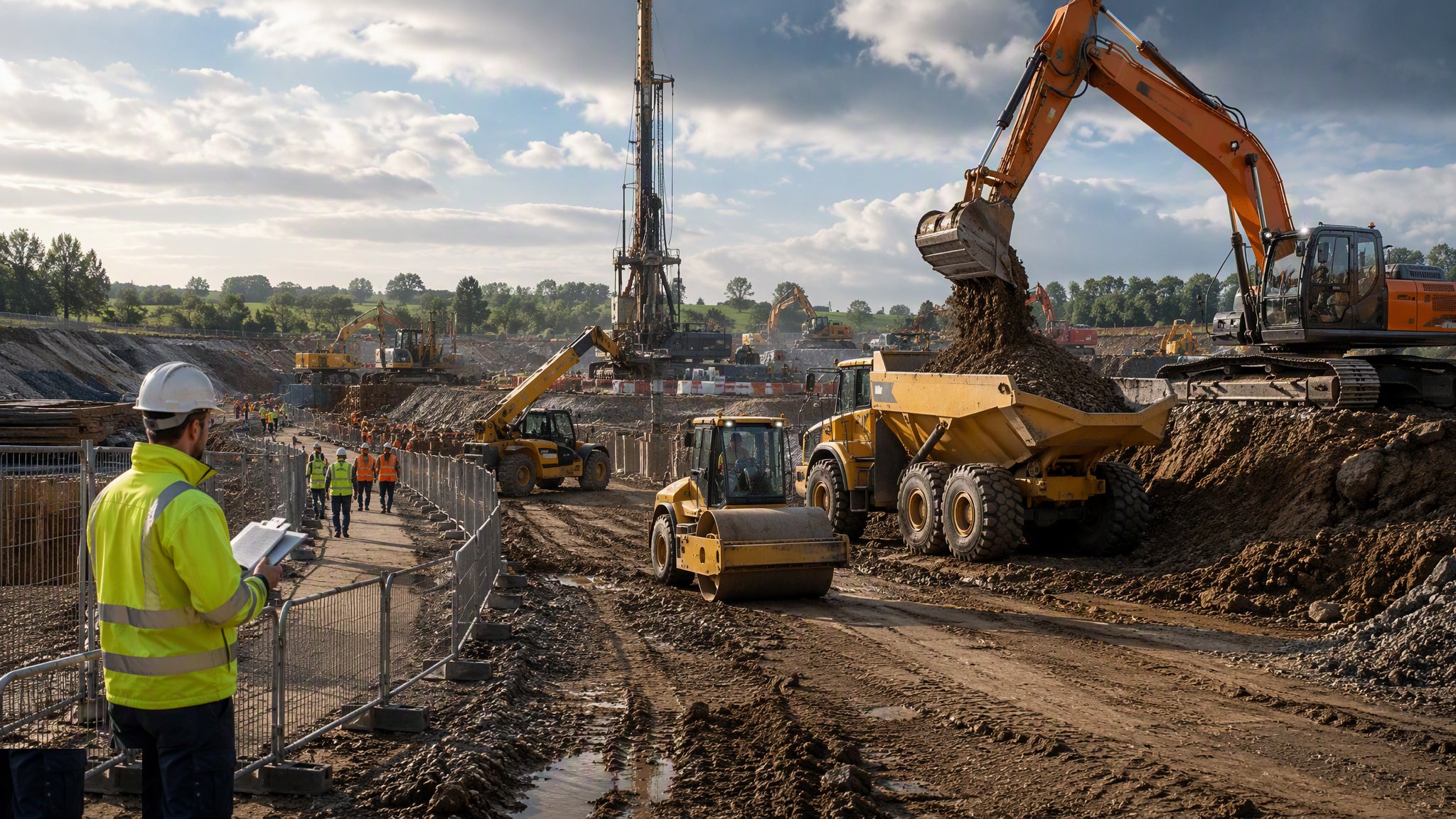
Piling and ground engineering plant is the heaviest, tallest and most top-loaded equipment that appears on an ordinary building project. A piling rig is a tracked base machine carrying a mast that may stand well above the machine, with an auger, a casing drive, a hammer or a vibrator at the top of it. Around it sits a supporting cast: service cranes, crawler cranes, concrete supply, grout and bentonite plant, desanding and recycling equipment, spoil handling, and the welfare and testing arrangements that a piling campaign needs. It is a plant-intensive trade and the plant arrives together as a spread rather than as individual machines.
The rig types follow the technique. Rotary bored rigs drill large diameter piles and can drill through obstructions and into rock. Continuous flight auger rigs drill and concrete in one continuous operation, and are quick and quiet in the right ground. Driven piling uses hammers or vibrators to install precast and steel sections, which is fast but noisy and generates vibration. Displacement rigs form piles with little or no spoil. Diaphragm wall and secant equipment builds retaining structures. Ground engineering brings its own machines: grouting, jet grouting, soil mixing, ground improvement rigs and anchoring plant, each with substantial support equipment of its own.
One thing dominates the whole trade and it is not the rig: it is the working platform. These machines are heavy, tall and carry their load high, and they stand on the softest ground the project has, usually next to an excavation. The platform is a designed structure specified by the temporary works designer on a proven formation, with defined build-up, gradients, stand-offs and reinforcement, certified in writing before any rig tracks on, inspected while the works proceed, and repaired and re-certified when tracked traffic damages it. Rig overturns are the characteristic serious accident of this trade, and they happen on platforms that were adequate on day one and were never looked at again.
How does Piling and ground engineering work, step by step?
- 1
Step 1: Let the ground choose the technique
The ground investigation, the loads and the constraints between them narrow the technique long before any rig is priced. Soil and rock profile, water table, obstructions, contamination, the proximity of neighbours and the sensitivity to noise and vibration all bear on it. A technique that is efficient in one ground condition is unusable in another, and the specialist contractor and the geotechnical designer settle this together. Selecting on rate alone, before the ground is understood, is how projects find themselves with a rig that cannot get through the made ground it has been sent to drill.
- 2
Step 2: Design, build and certify the working platform
The platform is the single most important temporary works item on a piling project. The temporary works designer specifies the formation, the build-up, any geogrid or reinforcement, the gradients, the drainage and the stand-off from every excavation, basement, culvert and service. It is constructed, tested and certified in writing before a rig arrives, and the certificate is a live document: the platform is inspected on a set frequency, after heavy rain and after any excavation nearby changes the geometry, and it is repaired and re-certified when it deteriorates. This is not paperwork; it is the control that keeps the rig upright.
- 3
Step 3: Locate services, obstructions and the things nobody drew
Before any rig position is used, buried services, old foundations, basements, tanks, wells, culverts, mine workings and archaeology are researched, scanned and where necessary proved with trial pits or probes. Overhead lines are identified and the mast height considered against them, because a piling mast is tall enough to reach lines that other plant passes safely beneath. Obstructions found during the works are reported and dealt with by the designer rather than drilled through on the assumption that they are unimportant.
- 4
Step 4: Mobilise the spread and lay it out
The rig arrives with a supporting spread: service crane, concrete or grout supply, spoil handling, bentonite mixing and recycling where the technique needs it, testing equipment, welfare and storage. Laying that out is a real planning exercise, because the support plant needs to reach the rig throughout the campaign as the rig works across the site. Access for concrete trucks, spoil removal and reinforcement delivery is planned along the same lines. A well-laid-out piling spread keeps the rig drilling; a poorly laid-out one leaves an expensive machine waiting for concrete.
- 5
Step 5: Erect the mast and set up under specialist control
Rigs are delivered in parts and assembled on site by the supplier's or specialist contractor's competent crews, with mast erection carried out under a lifting plan using a service crane. This is a hazardous operation with a clear exclusion, and it is not something the project's own people take part in. Once erected the machine is checked, its monitoring and recording systems are commissioned, and it is handed over for work. Moving the rig between working areas, and any change to the mast or tooling, is planned in the same way.
- 6
Step 6: Install the works and record what the rig did
Piles and ground treatment are installed to the design layout, with the rig recording depth, torque or energy, concrete or grout volumes and the other parameters the technique produces. Those records are the first quality document on the job and they are reviewed daily, not filed. A pile that took markedly more or less concrete than its neighbours, or refused short of design depth, is investigated at the time. Spoil, water, grout and bentonite returns are contained, treated and disposed of under the arrangements agreed for the site.
- 7
Step 7: Test, trim and hand over
Verification follows the specification: integrity testing, static or dynamic load testing, and testing of treated ground where ground improvement has been used, at the frequencies set before mobilisation rather than negotiated after a poor result. Piles are trimmed down to cut-off, which is a separate operation with its own dust, noise and hand-arm vibration issues, and the heads are prepared for the pile caps. Records, test results and as-built positions are handed over as a set, and any pile outside tolerance is referred to the designer rather than adjusted on site.
What are the benefits of Piling and ground engineering?
- Builds foundations and retaining structures in ground that could not otherwise be built on
- A wide range of techniques means there is usually one suited to the ground and the constraints
- Continuous flight auger and displacement methods are comparatively quiet and low in vibration
- Rig instrumentation records what happened in every pile, giving immediate quality evidence
- Ground engineering techniques can treat ground in place rather than excavating and replacing it
- Specialist spreads mobilise as a complete package with their own support plant and crews
What are the limitations of Piling and ground engineering?
- Rigs are tall, heavy and top-loaded, and rig overturn is the characteristic serious accident
- Everything depends on a designed, certified and continuously maintained working platform
- Obstructions in made ground can defeat a technique that was correct on paper
- Driven techniques generate noise and vibration that neighbours and buried assets limit
- Spoil, bentonite, grout and water returns need containment, treatment and disposal
- The plant spread needs space and access, and an idle rig waiting for concrete is expensive
What is Piling and ground engineering best suited for?
What plant does Piling and ground engineering need?
- Rotary bored, continuous flight auger, displacement and driven piling rigs
- Diaphragm wall, secant and grab equipment for retaining structures
- Grouting, jet grouting, soil mixing, ground improvement and anchoring plant
- Service and crawler cranes for mast erection, casing handling and reinforcement cages
- Concrete supply, grout and bentonite mixing, desanding and recycling plant
- Spoil handling, containment and water treatment, with testing and monitoring equipment
How is Piling and ground engineering quality-checked?
- Working platform designed by the temporary works designer, certified in writing and re-inspected through the works
- Services, obstructions and overhead lines located and proved before rig positions are used
- Mast erection, rig moves and tooling changes carried out by competent crews under a lifting plan
- Rig records - depth, torque or energy, and concrete or grout volumes - reviewed daily against expectation
- Integrity and load testing at the frequencies set in the specification before mobilisation
- As-built positions, tolerances and test results handed over as a complete record set