Earthmoving
Excavators, dozers, dumpers and rollers - the plant that moves, places and compacts bulk material.
Last updated 2026-09-05
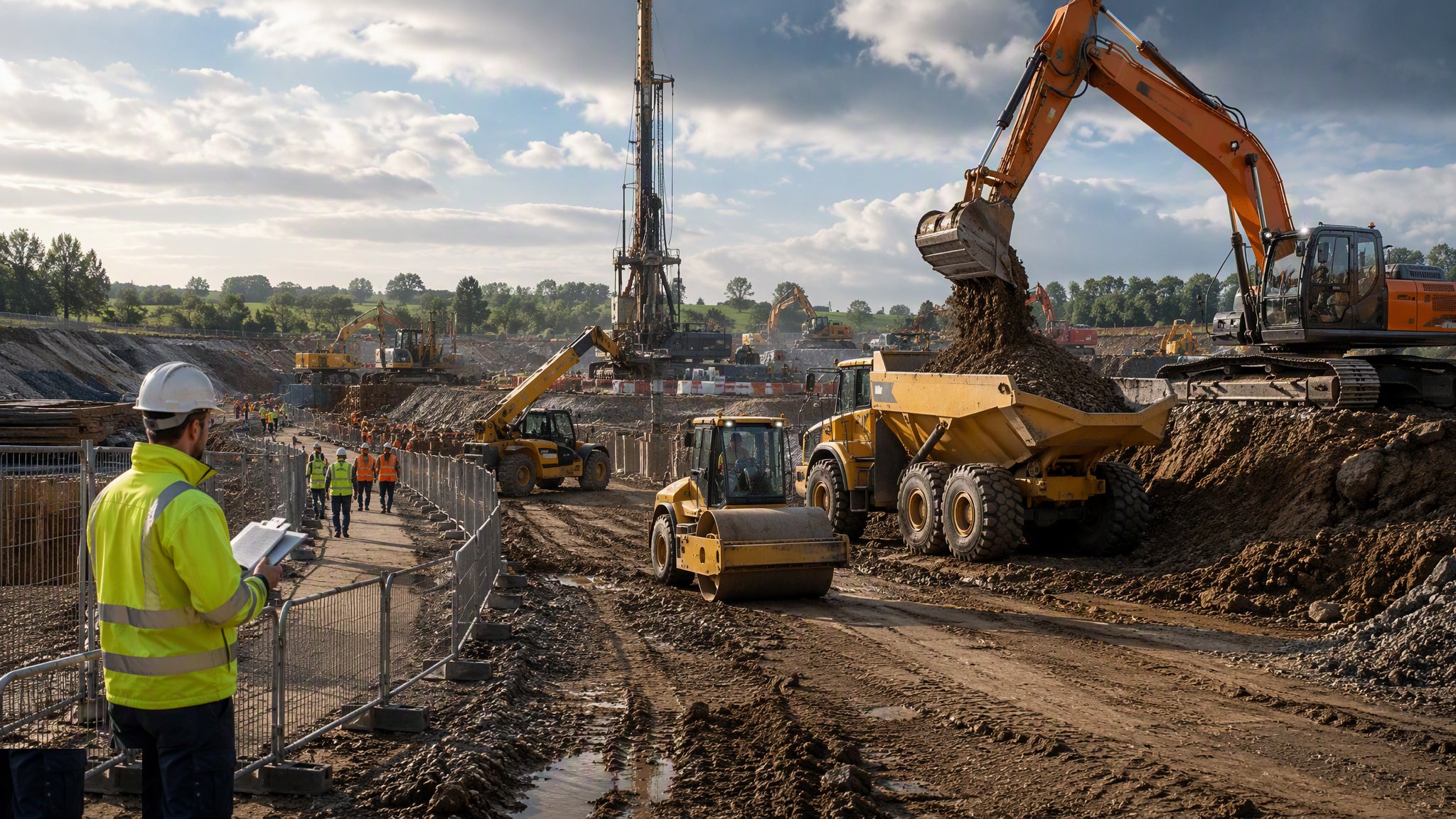
What is Earthmoving?
Earthmoving plant is the family that shifts ground. Excavators dig, load, grade, lift and, with the right attachment, break and demolish. Dozers push and spread. Loading shovels feed and stockpile. Dumpers and articulated haulers move material across a site or between sites. Graders and rollers place and compact it. On any project with a substantial earthworks element the productivity of the whole job comes down to how well these machines are matched to one another: an excavator that can load faster than the haulers can carry, or a compaction train that cannot keep up with the placing, wastes money in a way that is obvious on the ground and invisible in the programme.
The range is enormous. Mini and midi excavators work in gardens, basements and inside buildings; the machines used on bulk earthworks and quarrying are an order of magnitude larger. Attachments extend excavators far beyond digging - breakers, crushers and shears for demolition, augers and drilling masts for foundations, grabs and clamshells, compaction plates and trenching gear. Machine control systems using satellite positioning have changed the trade in the last decade, letting an operator cut to a designed surface without setting-out pegs and giving the project an as-built record of what was actually dug. On a large earthworks project that has removed a great deal of survey work and a great deal of rework.
Earthmoving hurts people in a small number of well-understood ways: machines striking people on foot, machines overturning, excavations collapsing on those inside them, and buried services being struck. The controls are correspondingly well understood. People and plant are segregated with a traffic management plan; excavations are supported or battered to a design and never entered on the strength of how they look; ground, platforms and haul routes are designed by the temporary works designer where the loads or the proximity to excavations demand it; services are traced and located before any ground is broken; and machines are operated by trained and authorised people with a banksman where visibility cannot be designed out.
How does Earthmoving work, step by step?
- 1
Step 1: Quantify the earthworks and set the balance
The starting point is the volume of material to be moved, its condition, where it comes from and where it goes. A cut-and-fill balance that keeps material on site avoids both disposal cost and import cost, and it drives the whole plant selection. The ground investigation says whether the material is suitable for reuse, whether it needs treating and whether it is contaminated. Getting this wrong is expensive in both directions, and it is the single largest commercial variable on an earthworks project.
- 2
Step 2: Match the fleet so nothing waits
Plant is selected as a system rather than as individual machines. The excavator size sets the loading rate, the number and size of haulers has to match that rate over the haul distance, and the placing and compaction plant has to keep up with what arrives. A well-matched fleet keeps every machine working; a mismatched one leaves expensive plant idling. Haul distance, gradients, site speed limits and the number of loading points all feed the calculation, and it is revisited when the site layout or the weather changes the cycle times.
- 3
Step 3: Locate services and clear the ground
Before anything breaks ground, records are obtained, the area is scanned and traced, and services are marked and proved. Trial holes are dug carefully by hand or by vacuum excavation where a service is expected. Overhead lines are identified and goalposts or exclusions set. Underground structures, tanks, wells, culverts, mine workings and old foundations are all part of the same exercise. Striking a live service with a bucket injures people and stops the project, and the time spent on this step is trivial against the cost of getting it wrong.
- 4
Step 4: Design the haul routes, platforms and excavation stand-offs
Haul routes are constructed and drained rather than worn into existence, with gradients, widths, passing places and crossing points set out and maintained. Where plant works close to an excavation, on made ground, on a slope or above a basement or culvert, the platform and the stand-off are designed by the temporary works designer. Excavation support or battering is designed and installed, and nobody enters an unsupported excavation on the basis that the ground looks stable. Routes and platforms are re-inspected as the site changes and after heavy rain.
- 5
Step 5: Excavate and haul to the design surface
Material is dug, loaded and hauled in the sequence the earthworks design sets, with the working faces kept safe and the machines positioned so the operator can see what is around them. Machine control makes cutting to a designed surface far more accurate and reduces the setting-out and checking effort, but the survey control it depends on is still established and verified conventionally. Material suitable for reuse is separated from material that is not, and contaminated material is segregated and handled under the arrangements agreed for it.
- 6
Step 6: Place and compact in controlled layers
Fill is placed in layers and compacted with the plant and the number of passes the specification requires, at a moisture content the material will actually compact at. Layer thickness, plant type and pass count are proved in a trial area and then held to. Testing during placement confirms the result rather than the intention. Compaction is where earthworks quality is won or lost, because a fill that was placed too thick or too wet will show up later as settlement under a slab, a road or a building, by which time it is somebody else's problem and a very expensive one.
- 7
Step 7: Trim, drain and protect the formation
The finished surface is trimmed to level, proof-rolled where the specification requires, and drained so water runs off rather than sits on it. Formations are protected from weather and from site traffic, because an accepted formation left open through a wet week is no longer an accepted formation. Where the earthworks are handing over to another trade, the condition at handover is recorded, and the responsibility for keeping it in that condition is made explicit rather than assumed.
What are the benefits of Earthmoving?
- Moves and places bulk material at a rate no other method approaches
- Excavator attachments cover digging, breaking, demolition, drilling, grabbing and compaction
- Machine control cuts to a designed surface accurately and produces an as-built record
- A balanced cut and fill keeps material on site, saving both disposal and import
- Machine sizes run from mini excavators for internal work to bulk earthworks plant
- Well-matched fleets keep every machine productive and cycle times predictable
What are the limitations of Earthmoving?
- People and plant sharing ground is the leading cause of fatal accidents in the trade
- Excavation collapse and buried service strikes remain the recurring serious risks
- Weather governs - wet material will not compact and wet routes fall apart
- Haul routes and working platforms are constructed works with a real cost and maintenance need
- Contaminated ground changes handling, testing and disposal entirely
- A mismatched fleet leaves expensive plant standing idle
What is Earthmoving best suited for?
What plant does Earthmoving need?
- Tracked and wheeled excavators from mini machines up to bulk earthmoving sizes
- Dozers, loading shovels and graders for pushing, feeding and trimming
- Site dumpers and articulated haulers matched to the loading rate and haul distance
- Rollers and compaction plant sized to the layer thickness and material
- Excavator attachments - breakers, crushers, shears, augers, grabs and compaction plates
- Machine control and survey equipment, with conventional control to verify it
How is Earthmoving quality-checked?
- Services traced, marked and proved before any ground is broken
- Excavation support or battering designed, installed and inspected, with no unsupported entry
- Haul routes, working platforms and stand-offs designed by the temporary works designer where required
- Compaction trial establishing layer thickness, plant and pass count before production filling
- Material suitability and in-situ testing during placement, against the specification
- Traffic management plan segregating people and plant, revised as the site layout changes
More construction plant and equipment methods
Next method
Lifting