Lifting
The whole family of lifting plant, and how a project decides which machine belongs where.
Last updated 2026-09-05
What is Lifting?
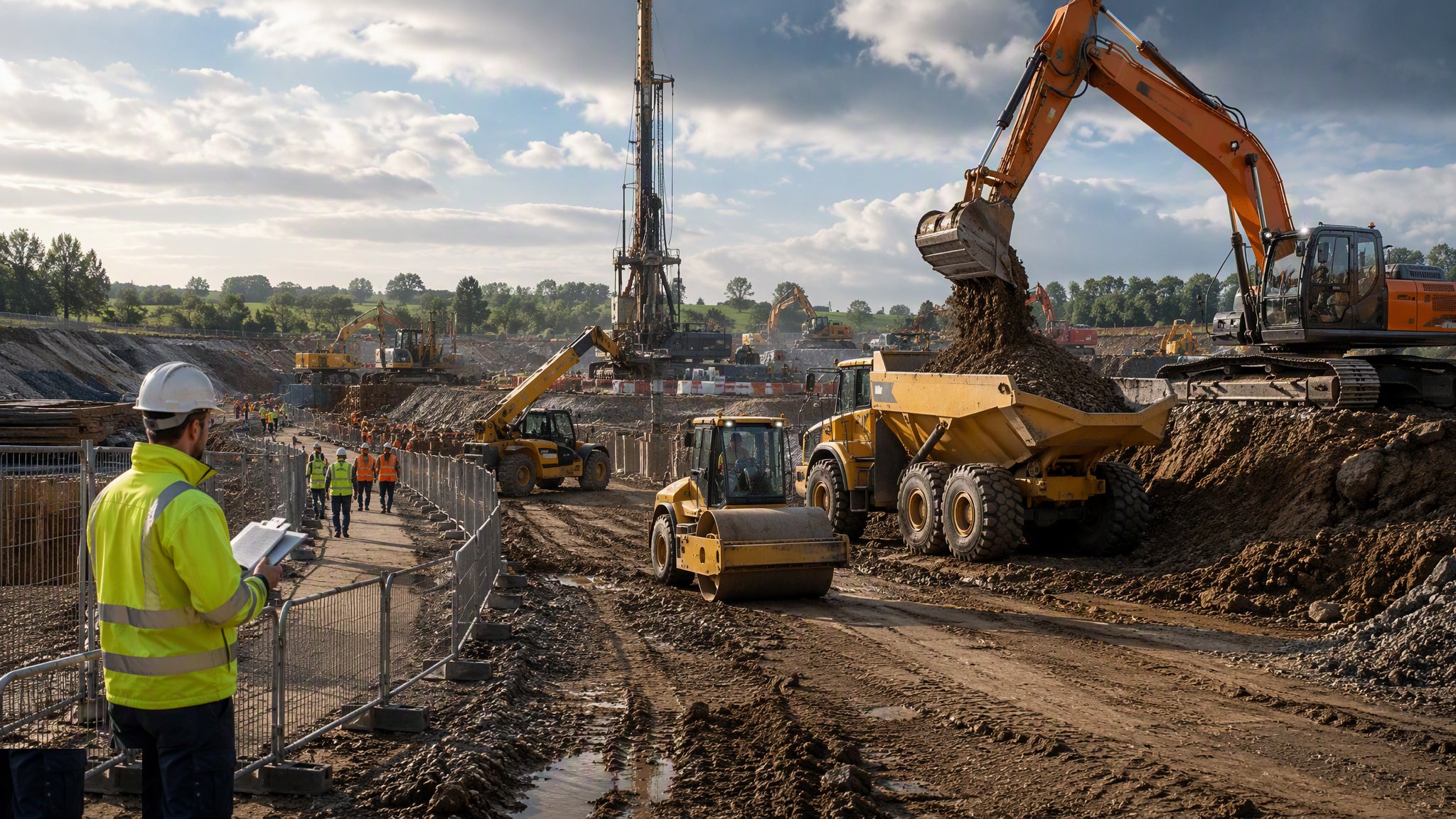
Lifting plant covers everything on a project that raises a load: tower cranes fixed beside a building, mobile cranes that drive on and off, crawler cranes on tracks, lorry loaders mounted on delivery vehicles, telehandlers placing pallets at height, spider cranes working indoors, gantries and runway beams, chain blocks and jacks. They are different machines with a common discipline. Every one of them is a lifting operation when it is used, every one needs planning by an appointed person appropriate to the complexity, and every one depends on lifting accessories that are themselves inspected and examined equipment rather than bits of kit hanging on a fence.
Choosing between them is a matter of matching four things: the load, the reach, the duration and the space available. A project with a long campaign of heavy repetitive lifting over a small footprint wants a tower crane. A project with a handful of defined lifts wants a mobile. A project with heavy loads, open ground and a long programme wants a crawler. A project delivering its own materials to the kerb wants a lorry loader. A project lifting inside a finished building wants compact and specialist equipment. Most real projects want several of these at once, in a sequence, and the value of thinking about lifting as one subject is that the sequence gets planned rather than assembled by accident.
The reason lifting is treated more formally than almost any other site activity is that the consequences of getting it wrong are severe and immediate. Loads fall on people, machines overturn, structures are overloaded, and it happens fast. The framework is consistent across the whole family: a competent appointed person plans the operation and its complexity determines how detailed that plan is; the machine and its accessories are inspected, maintained and thoroughly examined; operators, slingers and signallers are trained and authorised; the ground or structure supporting the machine is designed by the temporary works designer; and the plan is followed on the day, with the operation stopped when conditions differ from what was planned.
How does Lifting work, step by step?
- 1
Step 1: Build a lifting schedule for the whole project
The most useful thing a project can do about lifting is to list, early, everything that will have to be lifted: the frame, the facade, the plant, the modules, the deliveries and the awkward one-offs that always get forgotten. That schedule is what allows the right machines to be chosen and sequenced, and it exposes the lifts nothing on site can currently reach. Projects that do not do this end up hiring a crane in a hurry to solve a problem that was visible on the drawings twelve months earlier.
- 2
Step 2: Appoint the people before the plant
Lifting is a competence-led activity. A competent appointed person is appointed to plan the operations, with crane supervisors, operators, slingers and signallers identified and their training and authorisation recorded. On a large project this is a structure rather than a name on a form, with clear authority to stop work. Where lifting operations are carried out by subcontractors, the interfaces between their appointed persons and the project's are agreed rather than assumed, because the gaps between organisations are where lifting incidents happen.
- 3
Step 3: Match the machine to load, reach, duration and space
Selection follows from four questions: what the loads are, how far the machine has to reach, how long the lifting goes on for, and how much room there is to stand and to set up. Duration is the one most often underweighted - a machine that is cheap per lift but slow to set up is expensive on a project with a hundred small lifts, and the reverse is true for a project with three big ones. The answer is often more than one machine, and the point of asking the question properly is to find that out before rather than after.
- 4
Step 4: Sort the ground and the supporting structure
Whatever the machine, something carries it. Tower crane bases, mobile crane pads, crawler platforms, mast bases and the floors under a spider crane are all designed by the temporary works designer, checked by the structural engineer where the permanent works are involved, and signed off before the machine arrives. Stand-off from excavations, basements, culverts and services is part of the same design. This is the step whose omission most reliably produces an overturned machine, and it is not a step that can be caught up later.
- 5
Step 5: Plan each operation to its complexity
Routine repetitive lifts are covered by a generic plan; anything unusual, heavy, close to structures or people, involving two machines, or over a road, railway or occupied building is planned individually by the appointed person. The plan covers the machine, the position, the load, the accessories, the people, the sequence, the communications, the exclusion and the conditions under which the lift will stop. It is briefed to everyone taking part rather than filed, and the briefing is the point at which the people doing the work get to say it will not work.
- 6
Step 6: Control the accessories and the records
Slings, chains, shackles, beams, clamps, magnets and vacuum lifters are lifting equipment in their own right. They are marked, registered, stored properly, inspected before use, taken out of service when damaged and thoroughly examined at the required intervals with the records held on site. The informal pile of slings in a container is where this control fails. Bespoke lifting frames and spreader beams are designed, marked and examined equipment too, and are not fabricated on site to suit the day.
- 7
Step 7: Stop when the plan does not match the day
The most important control in lifting is the willingness to stop. Wind rises, a load turns out heavier than declared, the ground is softer than expected, the machine cannot be positioned where the plan says, or people cannot be kept out of the area. In each case the operation stops and the appointed person reconsiders, rather than the crew adjusting on the spot. That authority is given explicitly to the crane supervisor and the operator when the operation is briefed, and it is the difference between a project that has near misses and one that has incidents.
What are the benefits of Lifting?
- A single lifting strategy lets the right machine be chosen for each phase rather than improvised
- The family covers everything from a lorry loader at the kerb to heavy crawler lifting
- Planning by an appointed person scales from generic plans to individually engineered operations
- Shared discipline on accessories, competence and records applies across every machine
- An early lifting schedule exposes the lifts that nothing on site can currently reach
- Well-sequenced plant reduces the total number of machines a project has to hire
What are the limitations of Lifting?
- Consequences of failure are severe and immediate, so the process is necessarily formal
- Every machine depends on ground or structure designed by the temporary works designer
- Competent appointed persons, operators and slingers are a limited resource with lead time
- Wind and weather stop lifting regardless of how well planned it is
- Interfaces between different organisations' lifting arrangements are a recurring weak point
- Accessories are easily neglected, and a good crane with a bad sling is still a bad lift
What is Lifting best suited for?
What plant does Lifting need?
- Tower, mobile and crawler cranes according to the phase and the loads
- Lorry loaders on delivery vehicles for kerbside offloading
- Telehandlers and forklifts for placing loads within their reach
- Spider cranes, gantries, runway beams, chain blocks and jacks for confined and heavy work
- Lifting accessories - slings, chains, shackles, beams, clamps and vacuum lifters, all registered
- Designed bases, pads and platforms with mats, spreaders and packing
How is Lifting quality-checked?
- Competent appointed person named, with supervisors, operators, slingers and signallers recorded
- Lifting operations planned to their complexity and briefed to everyone taking part
- Machines and accessories inspected, maintained and thoroughly examined, with records on site
- Supporting ground and structure designed by the temporary works designer and signed off
- Interfaces between contractors' lifting arrangements agreed in writing
- Explicit authority to stop the lift when conditions differ from the plan