Compact and specialist lifting
Spider cranes, gantries, jacking and skidding - for the lifts that happen inside, underground or at the limits of weight.
Last updated 2026-09-05
What is Compact and specialist lifting?
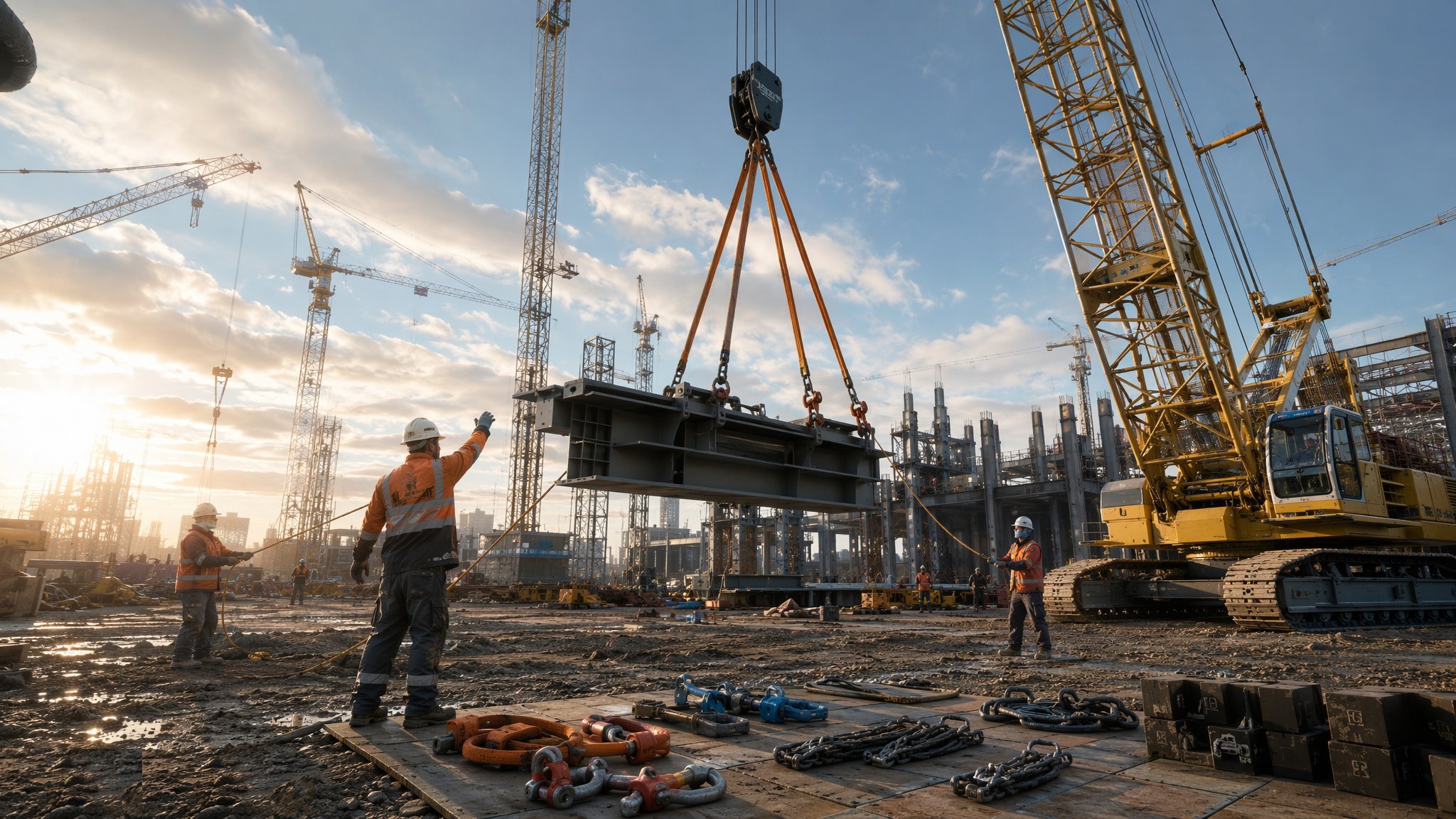
Not every lift can be reached by a crane parked outside. A large proportion of construction lifting happens inside finished buildings, in basements and plant rooms, in listed interiors, on upper floors and in tunnels, and a second category involves loads so heavy that no conventional crane is the sensible answer. Compact and specialist lifting covers both. It includes spider cranes and other tracked mini cranes that pass through a standard door opening and set up inside a room, gantries and portal frames erected over the work, monorails and runway beams, chain and hydraulic hoists, and the jacking, skidding and sliding systems used to move very heavy items short distances with great precision.
Spider cranes and mini cranes solve the access problem. They are small, often electrically powered so they can run indoors without exhaust, light enough to be considered against a floor loading, and they deploy legs to stabilise themselves once in position. Typical work is glazing into an atrium, plant into a basement, stone and artwork in a heritage interior, and lifting inside a building where the frame is already closed. Because they work on finished or partly finished floors, the question is rarely whether the crane can lift the load and almost always whether the structure below can take the machine - which is a question for the structural engineer and the temporary works designer, answered on paper before the machine is brought in.
At the other end, jacking, skidding and strand systems move loads that conventional lifting cannot reach: bridge decks, transformers, vessels, turbines, heavy plant and complete structures. These operations proceed slowly and in controlled increments, often over hours or days, with the load monitored throughout, and they are engineered by specialist contractors as a bespoke design rather than selected from a hire list. Everything here is planned by the appointed person, the equipment is assembled and inspected by competent specialists, and the supporting structure or ground is designed by the temporary works designer. What unites the family is that the constraint is space or weight rather than reach, and the answer is engineering rather than a bigger crane.
How does Compact and specialist lifting work, step by step?
- 1
Step 1: Identify the lifts a crane will never reach
Early in the project the team walks the lifting schedule and separates out the loads that cannot be handled by the site crane: anything landing inside the building envelope, below ground, in a plant room, on a completed floor, in a heritage interior or beyond conventional crane capacity. These are the lifts that get forgotten and then improvised. Identifying them early lets the openings, the routes, the temporary works and the sequence be arranged around them, because a plant room that has been closed up is far more expensive to get equipment into than one that was left open a fortnight longer.
- 2
Step 2: Plan the route the machine and the load will take
Compact lifting is usually an access problem before it is a lifting problem. The route is surveyed for door and corridor widths, headroom, turning points, thresholds, lift car dimensions, ramp gradients and the floors and stairs that have to be crossed. Where the equipment cannot get in as a unit it is broken down and rebuilt inside, which has to be planned. Protection of finished surfaces along the route is agreed at the same time, because the second cost of specialist internal lifting is usually the damage done getting there.
- 3
Step 3: Have the structure checked before the machine goes on it
A mini crane, a gantry leg or a jacking point concentrates its load into a small area of a floor that was designed for something quite different. The structural engineer and the temporary works designer assess the slab, the beam or the ground beneath, and specify any spreading, propping or back-propping needed. This is the step most often skipped and the one that causes the most damage. It applies just as much to gantries and runway beams fixed to an existing structure, where the fixings and the member they hang from both need checking.
- 4
Step 4: Select the system that matches the constraint
The appointed person and the specialist contractor pick the arrangement from what is actually constraining the lift. A spider crane suits an internal lift with room to deploy. A gantry or portal suits repeated lifting in a fixed position, such as over a plant room or a shaft. A runway beam and hoist suits maintenance lifting that has to be repeatable for the life of the building. Jacking, skidding and strand systems suit very heavy loads moving short distances. Choosing on availability rather than on the constraint is how projects end up with the wrong machine in a room it cannot get out of.
- 5
Step 5: Set up, stabilise and control the area
The equipment is set up in accordance with the plan, on the spreading the design requires, and stabilised before anything is lifted. Working indoors changes the control measures rather than removing them: the area below and around the load is cleared and controlled, other trades are excluded, and where the operation crosses a floor edge or a shaft the edge protection arrangement is confirmed. Power supply, ventilation and lighting are all arranged in advance, because internal lifting frequently happens in spaces that have neither.
- 6
Step 6: Move the load in controlled increments
Specialist heavy movement is deliberately slow. Loads are jacked, skidded or slid a controlled distance at a time, with the position, the load in each unit and the behaviour of the supporting structure monitored between increments, and with hold points where the operation can be stopped and reviewed. The sequence, the monitoring and the acceptance criteria come from the specialist designer. On the largest operations the whole move may be rehearsed on paper step by step, and the project supplies the possession, the exclusion and the time that the sequence needs.
- 7
Step 7: Leave the building as it was found
When the lift is complete the equipment is removed by the route it came in, spreading and protection is lifted, and any fixings made into the permanent structure are removed or made good as agreed with the structural engineer. Where a runway beam or padeye is to remain for future maintenance, it is handed over as permanent lifting equipment with its own records rather than being left behind informally. Finishes disturbed along the route are repaired, and any monitoring of the structure is closed out.
What are the benefits of Compact and specialist lifting?
- Reaches lifts inside buildings, basements, plant rooms and heritage interiors that site cranes cannot
- Compact machines pass through standard openings and work in occupied and finished spaces
- Electric and low-emission options suit enclosed and sensitive environments
- Gantries and runway beams give repeatable lifting in a fixed position, including for future maintenance
- Jacking and skidding systems move loads beyond the reach of conventional cranes
- Movement is slow, incremental and monitored, which suits precision placing
What are the limitations of Compact and specialist lifting?
- Access route usually governs - width, headroom, thresholds and lift car size decide what can get in
- Floors and existing structure often need checking and spreading before the machine is allowed on
- Reach and working envelope are modest, so positioning is critical
- Bespoke jacking and skidding operations are engineered schemes with long lead times
- Working in finished areas brings protection, permit and out-of-hours constraints
- Specialist equipment and crews are a limited market, so availability drives the programme
What is Compact and specialist lifting best suited for?
What plant does Compact and specialist lifting need?
- Spider and mini cranes, often electrically powered, with deployable stabilising legs
- Gantries, portal frames, runway beams and monorails with their fixings
- Chain blocks, lever hoists, hydraulic and strand jacks
- Skidding tracks, slide bearings, rollers and turntables for heavy movement
- Load spreading - steel plates, timber grillages, mats and back-propping
- Load monitoring, survey and levelling equipment for incremental moves
How is Compact and specialist lifting quality-checked?
- Structural check of every floor, beam and fixing the equipment will bear on, with spreading specified
- Access route surveyed and the equipment confirmed to fit before it is ordered
- Lift or move planned by the appointed person, with the specialist designer's sequence and hold points
- Equipment inspection and thorough examination records current and held on site
- Load, position and structural behaviour monitored between increments on heavy moves
- Temporary fixings removed and made good, or handed over with records where they remain