Tower cranes
The fixed hub of a vertical project - once the crane position is set, the whole logistics plan follows it.
Last updated 2026-09-05
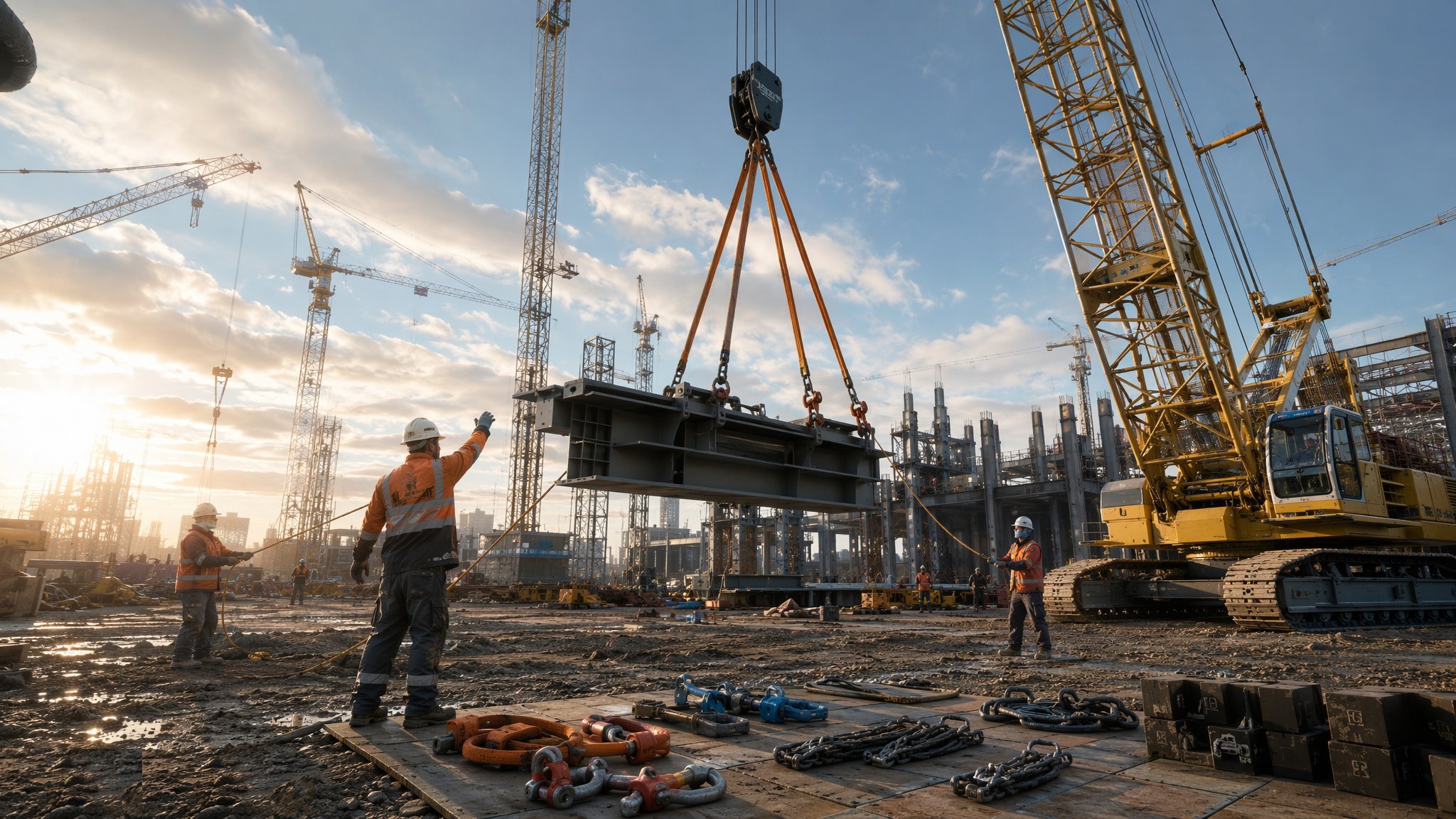
What is Tower cranes?
A tower crane is a fixed lifting machine that stands beside or inside a building and grows with it. A vertical mast carries a slewing assembly at the top, and from that assembly a jib reaches out over the working area. On most projects the jib runs somewhere between 40 and 80 m, and the mast is built up in sections as the structure rises. Everything about the machine is deliberate and semi-permanent. It arrives on a convoy of vehicles, takes days to erect, and stays for months. That permanence is exactly why it suits tall and dense projects: it does not need to set up and pack down for every lift, it reaches the whole footprint from one position, and it can work above the building rather than around it.
Two broad arrangements cover most of the market. A saddle jib crane, sometimes called a hammerhead, has a horizontal jib with a trolley that runs in and out along it, and the counter-jib swings out behind. It is simple, productive and the usual choice on open sites. A luffing jib crane raises and lowers its jib instead, so it can pull its reach in and work in a tighter slew radius. That is what makes it the answer where oversailing is constrained - where the crane would otherwise swing over a neighbour's airspace, a railway, a live road or an adjacent occupied building. Oversailing rights are a legal and commercial matter agreed long before the crane is ordered, and on congested urban projects they routinely decide which machine can be used at all.
The crane cannot be treated as a piece of hired plant that simply turns up. Its base and its ties into the permanent structure are designed by the temporary works designer, working with the crane supplier and the structural engineer, and the ground or foundation beneath it is designed for the loads the machine imposes in service and while it is being erected and climbed. As the building rises the crane is climbed, either by adding mast sections from the base or by jacking up inside the structure, and that operation is carried out by the supplier's specialist erection teams. Every lift is planned by an appointed person. What the crane really governs, though, is the project: the position of the crane sets the location of the gate, the unloading area, the material laydown and the sequence of the frame, so it is fixed early and rarely moved.
How does Tower cranes work, step by step?
- 1
Step 1: Fix the crane position with the logistics plan
Crane position is one of the first decisions on a vertical project and one of the hardest to reverse. The team works backwards from what has to be lifted, where it can be delivered and where it can be landed. The chosen position has to cover the working area, keep the load path clear of occupied areas and public routes, sit clear of the permanent works or in a hole that can be left until last, and be reachable by the vehicles that will erect it. On congested urban projects the crane usually ends up dictating the gate, the unloading bay and the whole delivery sequence rather than the other way round.
- 2
Step 2: Resolve oversailing and the neighbours
A tower crane jib sweeps a large circle, and much of that circle is often over land the project does not control. Oversailing agreements with neighbouring owners are negotiated in advance, and where they cannot be obtained the crane has to be arranged so it does not need them. That is the point at which a luffing jib crane earns its cost, because it can bring its jib in rather than parking it over somebody else's roof. Railways, live highways, waterways and airports each bring their own approvals and their own lead times, and those approvals are secured before the machine is ordered.
- 3
Step 3: Design the base and the ground beneath it
The base is a designed structure. It may be a cast concrete block, a set of pad foundations, a grillage on piles or a fixing frame cast into the permanent works, and the choice depends on the machine, the ground and how long the crane will stand. The temporary works designer sets the arrangement and the structural engineer confirms that anything the permanent works has to carry can carry it. The ground investigation feeds this directly. Where the crane stands on made ground or close to a basement excavation the design becomes a genuine engineering problem rather than a formality, and it is signed off in writing before anything is delivered.
- 4
Step 4: Design the ties into the permanent structure
A free-standing tower crane can only reach a certain height before it has to be tied back to the building. The tie arrangement is designed by the temporary works designer, checked against the frame that will actually exist at the time each tie is installed, and coordinated with the structural engineer because the frame has to be strong enough at that stage of construction. This is a frequent source of programme conflict on concrete frames, where the crane wants a tie at a level the frame has not yet gained strength to provide. It is resolved on paper in advance, not by argument on the day.
- 5
Step 5: Erect the crane under a planned operation
Erection is a major lifting operation in its own right, carried out by the supplier's specialist teams using a mobile crane, over a road closure or a possession where one is needed, and planned by an appointed person. It usually takes several days and it needs a large clear area for the mobile crane, the trailers and the components. Weather governs it, and the plan carries the decision points about when to stop. The project's job is to give the erection team the space, the ground, the exclusion and the time the plan asks for, and to schedule it where it does the least damage to the programme.
- 6
Step 6: Climb the crane as the building rises
The crane keeps pace with the structure. An external crane is climbed by inserting further mast sections through a climbing frame at or near the base; an internal crane is jacked up through the building and re-supported on the floors below. Both are specialist operations by trained erection crews under a lifting plan, and both need the structure around them to be complete and strong enough at that point. Climbs are planned into the programme early because each one takes the crane out of production for a day or more, and a climb that slips takes the frame with it.
- 7
Step 7: Run, inspect and eventually dismantle
In service the crane is operated by licensed operators, directed by trained slingers and signallers, and every lift is planned by the appointed person, with the non-routine and heavier lifts planned individually. The machine is subject to a regime of daily checks, periodic inspections and thorough examinations by competent people, and the records are kept on site. Dismantling is planned with the same rigour as erection, and needs the same clear area - which is why the space for it is protected in the logistics plan rather than being built over as soon as the frame tops out.
What are the benefits of Tower cranes?
- Covers a whole building footprint from one fixed position with no set-up time between lifts
- Works above the building rather than around it, so it does not consume ground-level space all day
- Grows with the structure, staying useful from substructure to roof
- Handles the heavy repetitive lifting that drives a frame programme - steel, precast, formwork and rebar
- A luffing jib arrangement allows work on sites where oversailing rights cannot be obtained
- Frees the ground and the gate for deliveries instead of tying them up with crane set-ups
What are the limitations of Tower cranes?
- Slow and expensive to bring to site, needing a large clear area and often a road closure for erection and dismantling
- The base, the ties and the ground beneath all need designing by the temporary works designer, with lead time
- Fixed in position, so a change to the building or the logistics plan is costly to accommodate
- Wind stops work, and the machine has to be left in a safe condition whenever it is out of use
- Oversailing, aviation, railway and highway approvals can take months and can rule the crane out entirely
- Climbing operations take the crane out of production and have to be sequenced with the frame
What is Tower cranes best suited for?
What plant does Tower cranes need?
- Tower crane in saddle jib or luffing jib arrangement, with mast sections and ballast
- Mobile crane and low-loaders for erection, climbing and dismantling
- Designed base - concrete block, pad foundations, piled grillage or cast-in fixing frame
- Tie assemblies and their fixings into the permanent structure
- Lifting accessories issued and inspected under the lifting equipment regime
- Anemometer, load monitoring and zoning or anti-collision systems where cranes overlap
How is Tower cranes quality-checked?
- Base, ties and supporting ground designed and signed off by the temporary works designer before delivery
- Erection, climbing and dismantling carried out by the supplier's specialist teams under a lifting plan
- Every lift planned by the appointed person, with heavier and non-routine lifts planned individually
- Thorough examination, inspection and maintenance records held on site and current
- Operators, slingers and signallers trained, assessed and recorded as competent
- Anti-collision and zoning settings checked whenever a neighbouring crane or a constraint changes
More craneage and lifting operations methods
Next method
Mobile cranes