Crawler cranes
Tracked, very heavy lifting - and the only common crane that can travel with a load on the hook.
Last updated 2026-09-05
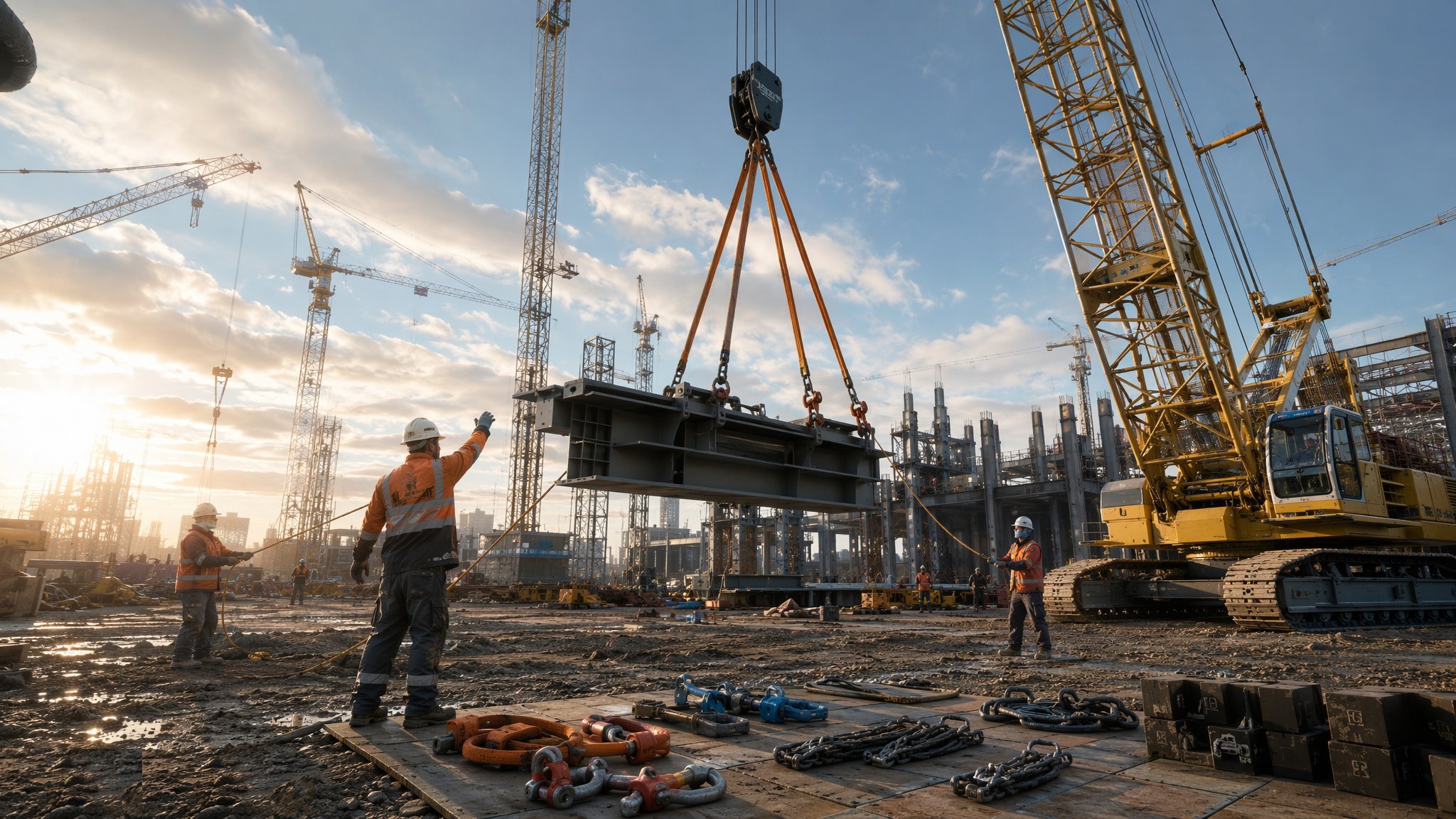
What is Crawler cranes?
A crawler crane runs on tracks rather than wheels and stands on its own undercarriage rather than on outriggers. That single difference changes what it is good for. Spreading its weight over two long tracks lets it work on prepared ground that would defeat a wheeled machine, and it allows the crane to travel across the site while holding a load, which no ordinary mobile crane can do. Crawler cranes cover an enormous range, from compact machines used for piling support up to the very large lattice-boom units used on power, process and offshore-related projects, and they are the standard heavy lifting machine wherever a project has room and time.
Nothing about a crawler crane is quick. It cannot drive to site: it arrives on many loads, and the boom, the counterweight, the tracks and on the largest machines a superlift arrangement are all assembled on site by specialist crews, which needs a significant clear assembly area and days rather than hours. That assembly area is a real planning constraint and is often the reason a crawler is ruled out on a tight urban project. In exchange the project gets a machine that can stay for months, work continuously, handle the heaviest loads on site and reach heights that mobile cranes cannot approach without a great deal of assembly of their own.
The ground is the governing issue. Because the crane travels, the whole route matters and not just a standing position, so the crawler working platform is designed by the temporary works designer as a piece of engineering: a specified build-up on a proven formation, often with geogrid, with defined gradients, defined stand-offs from excavations and basements, and a maintenance and re-inspection regime because tracked plant chews up its own platform. Timber or steel mats are used under the tracks where the design calls for them. Every lift is planned by the appointed person, the machine is assembled and inspected by competent specialists, and travelling with a load is itself a planned operation rather than a convenience.
How does Crawler cranes work, step by step?
- 1
Step 1: Establish whether the project can house the machine
Before a crawler is selected the team checks the things that most often rule it out: is there a clear area big enough to assemble it, can the delivery vehicles reach that area, is there room to lay down the boom sections, and will the ground carry both the crane and the assembly crane. On open infrastructure, industrial and energy projects the answer is usually yes. On a constrained city centre plot it is usually no, and the project ends up with a tower crane or a large mobile instead. Establishing this early avoids designing a lifting strategy around a machine that cannot get in.
- 2
Step 2: Design the working platform and the travel route
The crawler platform is a designed structure, not a layer of stone. The temporary works designer specifies the build-up, the formation it sits on, any reinforcement beneath it, the gradients the machine can climb and cross, and the stand-off from every excavation, basement, culvert and buried service the route passes. Because the crane travels, the whole route is designed and not only the working positions. The platform is certified in writing before the crane arrives, inspected while the works run, and repaired and re-certified when track traffic ruts it - platform failure under tracked plant is a recurring cause of serious incidents.
- 3
Step 3: Deliver and assemble under a lifting plan
The crane arrives on many vehicles over a planned sequence of days, and is built up by the supplier's specialist erection crew with an assist crane. Boom and jib sections, counterweight, track frames and any superlift are placed under a lifting plan of their own. The project provides the laydown, the ground, the exclusion, the traffic management for the deliveries and the time. Weather governs the operation, and the erection plan carries the criteria for stopping. Getting this into the programme honestly is important, because a crawler assembly compressed into an optimistic window is a bad start.
- 4
Step 4: Configure the crane for the work it will do
A crawler is set up in a configuration - boom length, jib arrangement, counterweight and any superlift - that is chosen for the lifts it will actually perform. Changing that configuration later is a planned operation, not a quick adjustment, so the appointed person looks across the whole campaign of lifts and picks an arrangement that covers them. Where a project has a small number of exceptional lifts and a great deal of routine ones, it is often cheaper to configure for the routine work and bring in a separate machine for the exceptions.
- 5
Step 5: Lift, and travel with the load where the plan allows it
In service the crane works like any other, with trained slingers and signallers and lifts planned by the appointed person. Its distinguishing capability is that it can pick a load and track with it to another position, which suits erecting long runs of steel, walking precast units along a viaduct or feeding a piling operation. Travelling with a load is planned in its own right: the route, the gradients, the ground condition and the load position are all covered, and the platform along that route is the same certified structure as at the standing positions.
- 6
Step 6: Keep the platform and the machine under inspection
A long crawler campaign is a maintenance regime as much as a lifting operation. The platform is walked and inspected on a set frequency and after heavy rain, ruts and soft spots are repaired, and drainage is kept working so water does not sit under the tracks. The machine itself is subject to daily checks, periodic inspections and thorough examinations by competent people. Where the crane stands close to an excavation that is being deepened as the project proceeds, the stand-off is re-checked against the current geometry rather than the geometry at the time the platform was built.
- 7
Step 7: Dismantle and reinstate
Dismantling needs the same assembly area, the same assist crane and the same planning as erection, and the area has to be protected in the logistics plan so it is not built over in the meantime. Once the crane leaves, the platform is broken out or incorporated as the design allows, the formation is inspected, and any ground disturbed by the works is reinstated. On projects where the platform sits over the permanent works, the removal sequence is agreed at design stage rather than left to the end.
What are the benefits of Crawler cranes?
- Handles the heaviest lifting on a project and reaches heights beyond ordinary mobile plant
- Can travel with a load on the hook, which suits long runs of steel, precast and modules
- Tracks spread the load over a large area rather than through a few support points
- Stays for months and works continuously, so there is no repeated set-up cost
- Configurable with different boom and jib arrangements to suit a campaign of lifts
- The standard heavy machine on infrastructure, energy and process projects with room to work
What are the limitations of Crawler cranes?
- Arrives on many loads and needs days and a large clear area to assemble and dismantle
- Demands a designed, certified and continuously maintained working platform along the whole route
- Cannot travel on the public highway, so delivery and assembly logistics are significant
- Rarely viable on constrained urban sites with no assembly space
- Reconfiguring boom or counterweight is a planned operation, not an adjustment
- Tracked movement damages surfacing, drainage and anything shallow buried along the route
What is Crawler cranes best suited for?
What plant does Crawler cranes need?
- Lattice or telescopic crawler crane in the configuration set for the campaign
- Assist crane, low-loaders and trailers for delivery, assembly and dismantling
- Designed and certified crawler working platform, with geogrid or reinforcement where specified
- Timber or steel mats and packing where the platform design requires them
- Boom, jib, counterweight and superlift components with their laydown area
- Inspected lifting accessories, tag lines, anemometer and exclusion equipment
How is Crawler cranes quality-checked?
- Working platform and travel route designed by the temporary works designer and certified in writing
- Platform inspected on a set frequency, after heavy rain and after any rutting, then re-certified
- Assembly and dismantling carried out by specialist crews under their own lifting plans
- Configuration recorded and any change re-planned by the appointed person
- Travelling with a load planned as a distinct operation with the route condition confirmed
- Machine examination, inspection and maintenance records current and held on site