Goods-only hoists
Simpler and cheaper vertical transport where no one rides - materials up, people never.
Last updated 2026-09-05
What is Goods-only hoists?
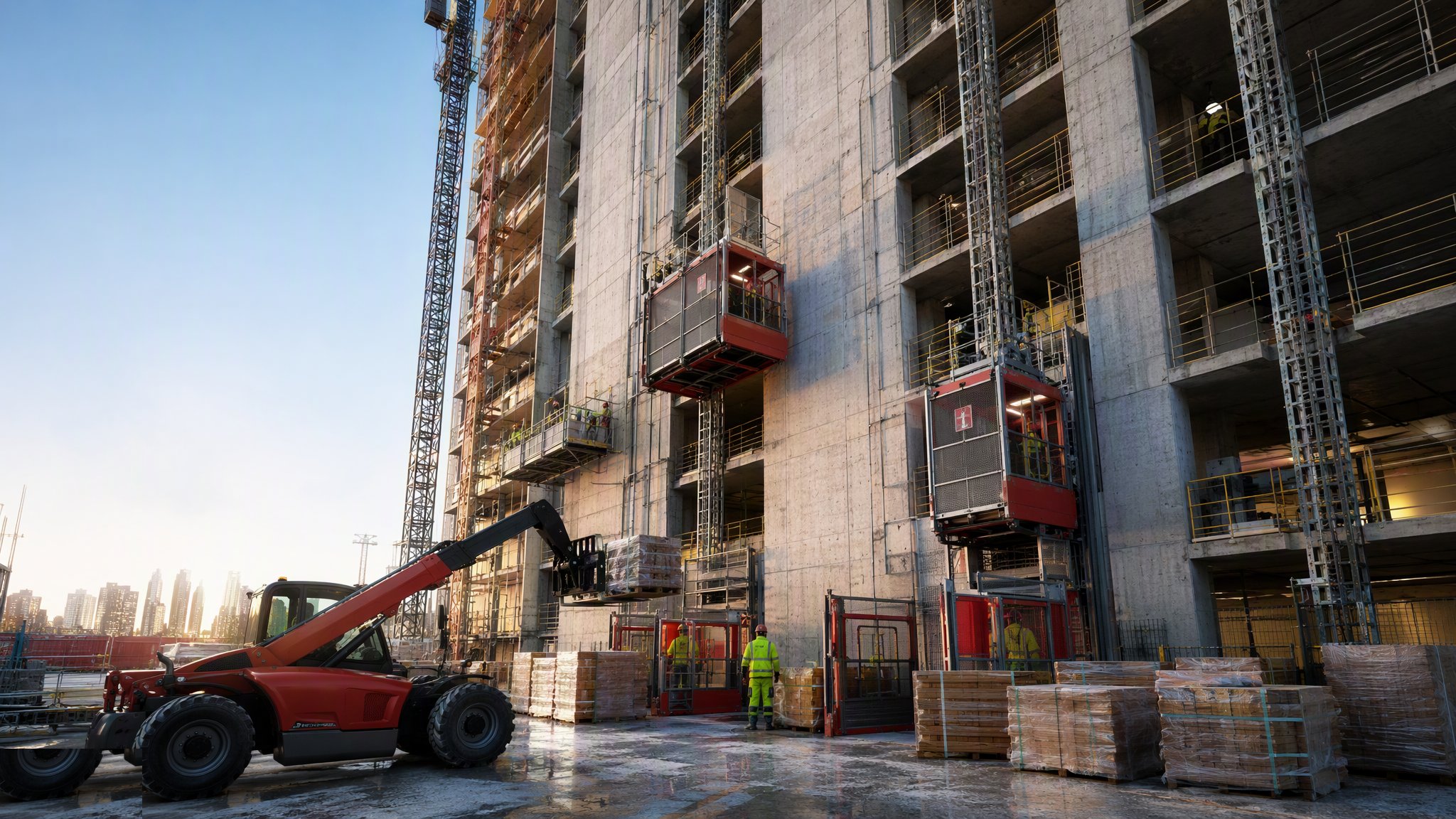
A goods-only hoist does one job: it takes materials up the outside of a building and brings waste and equipment back down. Because it never carries people, it is a simpler machine than a passenger hoist and a considerably cheaper one, both to hire and to erect. It appears on projects in a range of forms, from a light scaffold-mounted hoist lifting a wheelbarrow load at a time on a housing project, to a substantial rack and pinion goods hoist serving a full-height building alongside a passenger hoist. The economics are attractive wherever the material demand is real but the workforce can reach the floors by other means.
The distinction between goods-only and passenger hoists is absolute and it is the single most important thing about this machine. A goods hoist is not built, examined or controlled for carrying people, and the practice of riding on one, or of reaching into the car or the enclosure while it is moving, is the source of the serious injuries associated with them. That is why goods hoists are fully enclosed along their travel, gated and interlocked at every landing, controlled from a position where the operator can see what is happening, and signed unambiguously. On a well-run project nobody has to be told twice, because the physical arrangement makes riding impossible rather than merely forbidden.
Everything else follows the same pattern as a passenger hoist. The base and the tie arrangement into the structure or the scaffold are designed by the temporary works designer, the hoist is erected, extended and dismantled by competent specialists, and it is thoroughly examined before use and at intervals with the records kept on site. Where a goods hoist is mounted on a scaffold, the scaffold design has to include it explicitly, because a hoist bolted to a scaffold that was designed without it is a common and dangerous shortcut. In logistics terms the goods hoist sits between the loading bay at ground level and the trolleys and pallet trucks on the floors, and it works well only when all three parts of that chain have been thought about together.
How does Goods-only hoists work, step by step?
- 1
Step 1: Decide whether goods-only is the right answer
The question is simple: can the workforce reach the working floors without a hoist. On low-rise projects, on housing, and where the permanent lifts or stairs are usable, the answer is often yes, and a goods-only hoist then carries the material demand at a fraction of the cost of a passenger machine. On tall projects the usual arrangement is both, with the goods hoist taking the material flow so the passenger hoist is not tied up with pallets at shift change. The decision is made from the material volumes and the workforce numbers, not from the hire rate alone.
- 2
Step 2: Choose the type and the mounting
Light scaffold-mounted hoists suit small loads, low rise and short durations, and are erected on to a scaffold that has been designed to carry them. Rack and pinion goods hoists on their own mast suit real material volumes and full building heights, and are founded and tied like a passenger hoist. Transport platforms occupy the middle ground. The choice follows the load size, the height and the duration, and it is made early because a scaffold that has to carry a hoist is a different scaffold from one that does not.
- 3
Step 3: Design the base, the ties and the supporting structure
Whatever the mounting, something has to carry the hoist. On a mast machine that means a designed base and designed ties into the permanent structure. On a scaffold-mounted machine it means a scaffold designed explicitly for the hoist, with the additional ties, bracing and loading the design requires. The temporary works designer produces the arrangement, the structural engineer confirms whatever the permanent works has to take, and the design is signed off before erection. Retrofitting a hoist to an existing scaffold without going back to the designer is one of the most common failures in this trade.
- 4
Step 4: Enclose the travel and gate every landing
Because the hoist carries goods and not people, the whole point of the installation is that nobody can be in it or reach into it. The travel path is enclosed for its full height, every landing has an interlocked gate that cannot be opened unless the car is present, edge protection runs either side of each landing, and the ground level enclosure is secured. Where materials are loaded and unloaded, the arrangement lets that happen from outside the car. This is designed in at the start rather than added after the first near miss.
- 5
Step 5: Erect, examine and hand over
Erection and any extension is carried out by the supplier's competent teams, following the sequence for the machine, with the project providing the exclusion, the power, the access and the crane where one is needed. Before first use the installation is thoroughly examined by a competent person and handed over with records, and the same happens after any significant alteration. Signage goes up at the same time: what the hoist may carry, the loading limits, and the fact that no one rides. Controls are positioned so the operator can see the landing being served.
- 6
Step 6: Run it as part of the material chain
A goods hoist only performs if the ground level and the floor level work with it. Materials arrive at a loading bay, are broken down to loads the hoist can take, are moved to the hoist, lifted, and then distributed on the floor by trolley or pallet truck. Any weak link in that chain turns the hoist into a queue. Loads are restrained, oversize items are given their own arrangement rather than being forced in, and waste comes back down the same route rather than accumulating on the floors.
- 7
Step 7: Inspect, maintain and remove
The hoist, its enclosure, its gates and its interlocks are inspected on a set frequency and after any interference by other trades, and the machine is maintained and thoroughly examined at the required intervals. Damage to the enclosure is treated as an immediate defect rather than cosmetic, because the enclosure is the safeguard. At the end of its use it is dismantled by specialist teams, ties and fixings are removed and made good, and the facade or scaffold behind it is completed to the agreed detail.
What are the benefits of Goods-only hoists?
- Considerably cheaper to hire, erect and run than a passenger hoist
- Takes routine material movement off both the crane and the passenger hoist
- Available in light scaffold-mounted forms that suit low-rise and housing projects
- Simple installation with a shorter erection and dismantling operation
- Keeps waste moving down as well as materials up, which helps housekeeping
- Frees the passenger hoist for people at shift change, cutting queues
What are the limitations of Goods-only hoists?
- Never carries people, so the project still needs another way to move the workforce
- Car and opening sizes limit what can go up, and oversize items need a separate route
- Scaffold-mounted machines require the scaffold to have been designed for them
- Still needs base and tie design, examination, inspection and a specialist erection team
- Only as useful as the loading bay and floor distribution either side of it
- The enclosure and interlocks are safety-critical and are easily damaged by other trades
What is Goods-only hoists best suited for?
What plant does Goods-only hoists need?
- Rack and pinion goods hoist on its own mast, or a scaffold-mounted hoist or transport platform
- Designed base and mast ties, or a scaffold designed to carry the hoist
- Full-height enclosure, interlocked landing gates and edge protection at each level
- Loading bay equipment, trolleys, pallet trucks and load restraint
- Power supply and distribution sized for the hoist
- Signage covering loading limits, permitted materials and the no-riding rule
How is Goods-only hoists quality-checked?
- Base, ties or supporting scaffold designed by the temporary works designer and signed off before erection
- Erection, alteration and dismantling by competent specialist teams only
- Thorough examination before first use, at intervals and after alteration, with records on site
- Enclosure, gates and interlocks inspected on a set frequency and after any interference
- Loading limits displayed, loads restrained and oversize items given a separate route
- The no-riding rule enforced physically by the enclosure, not by signage alone