Telehandlers, forklifts and loading bays
Horizontal distribution and the loading bay - the pinch point of every congested project.
Last updated 2026-09-05
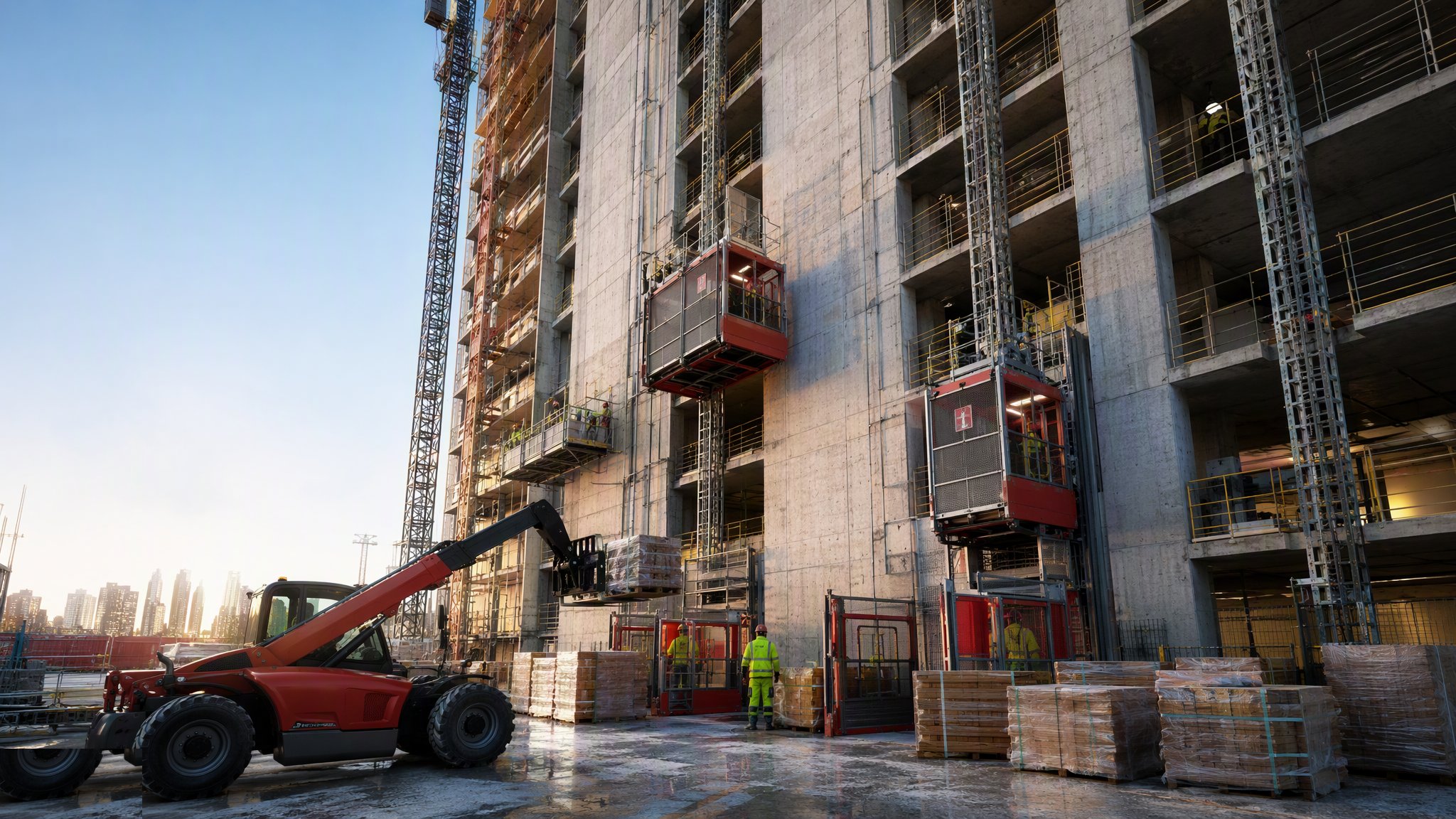
What is Telehandlers, forklifts and loading bays?
Cranes and hoists move things vertically. Almost everything else on a project is moved by telehandlers, forklifts, pallet trucks and people, and that horizontal movement is where most of the daily material handling actually happens. A telehandler is the general workhorse: a rough-terrain machine with a telescopic boom that can pick a pallet from a lorry, carry it across a site, place it on a scaffold or a floor edge, and then swap the forks for a bucket or a lifting jib and do something else entirely. On a housing or industrial project it is often the only material handling plant on site and it runs from first delivery to final snagging.
Forklifts sit alongside for hard-standing work, and pallet trucks and trolleys take over inside the building for floor-level distribution. What ties the whole family together is the loading bay - the point where a delivery vehicle meets the project. On a congested urban site that bay is the single most contested piece of ground on the job. There is usually room for one vehicle, sometimes two, and every trade wants it. Deliveries are booked into it, unloaded into it, broken down in it and cleared from it, and if any one of those steps stalls the whole delivery sequence backs out into the street. Most projects that feel chaotic are actually projects whose loading bay was never designed.
Plant of this kind kills and injures people on sites regularly, and almost always in the same way: a machine and a person occupying the same ground. The controls are unglamorous and they work - segregated routes for vehicles and pedestrians, controlled crossing points, banksmen where reversing cannot be designed out, trained and authorised operators, and a traffic management plan that is drawn, briefed and kept current as the site changes. Where a telehandler is used to place a load at height, that is a lifting operation planned by the appointed person like any other, and where it works on made ground or near an excavation, the ground and the stand-off are matters for the temporary works designer.
How does Telehandlers, forklifts and loading bays work, step by step?
- 1
Step 1: Design the loading bay before the first delivery
The loading bay is designed, not assumed. The team establishes what vehicles will come, how they will get in and out without reversing on to a public road, where they will stand, where the load will be broken down, and how the material will leave the bay. Its size, surfacing, overhead clearance and drainage are all specified. On congested urban projects the bay is the constraint that governs the whole logistics strategy, and where there is no room for one, the answer is usually an off-site consolidation arrangement with timed deliveries rather than hoping for the best.
- 2
Step 2: Separate people from plant
The traffic management plan sets segregated routes for vehicles and for people, with controlled crossings, and it is drawn on a plan that everyone is briefed against. Reversing is designed out wherever possible with one-way circulation and turning areas, and where it cannot be, a trained banksman controls it. Routes are lit, marked and kept clear, and the plan is revised every time the site layout changes, which on an active project is often. Almost every serious plant injury on a building site comes down to this control failing, and it usually fails because the plan was drawn once and never updated.
- 3
Step 3: Book deliveries and manage the gate
Deliveries are booked into slots so the bay is used by one trade at a time and vehicles are not queuing on the public highway. The booking system is managed by a named person, and it covers what is arriving, who is receiving it, how long it will take to unload and where it is going. This is administration rather than engineering and it is the highest-value thing a logistics manager does on a congested project. It also keeps neighbours and the highway authority on side, which matters for the whole duration.
- 4
Step 4: Choose the machine for the ground and the task
A rough-terrain telehandler suits open, uneven and muddy sites and reaches to a first or second floor edge. An industrial forklift suits hard standing and repetitive pallet work. Compact machines suit tight and internal spaces, and electric machines suit enclosed or occupied buildings. Attachments extend the range, but each one changes what the machine can do and needs to be matched to the machine and used within the arrangement the supplier sets out. The choice is made from the ground condition, the loads and the space rather than from what happens to be on hire.
- 5
Step 5: Treat placing at height as a lifting operation
When a telehandler is used to place a load on to a scaffold, a floor edge or a roof, that is lifting and it is planned by the appointed person like any other lift, with the ground checked, the machine positioned as the plan requires, the load attached with inspected accessories where a jib or hook is used, and people kept out from under it. Where the machine is being used to lift people, that requires a purpose-designed platform arrangement and a plan of its own. Improvised arrangements to get somebody up to a height are a recurring cause of fatal accidents.
- 6
Step 6: Get the ground right and keep it right
Telehandlers and forklifts spend their lives on ground that is being built. Routes and standing areas are surfaced and drained, made ground and backfilled trenches are identified, and stand-off from excavations, basements and shallow services is set by the temporary works designer. Gradients, cross-falls and ramps are checked against what the machine can handle loaded. Routes are maintained through the project, because ruts, standing water and a rotting edge to an excavation are how a machine ends up on its side.
- 7
Step 7: Extend the chain into the building
Material handling does not end at the building line. Once a pallet reaches a floor it still has to get to the work, and that is the part most projects under-plan. Pallet trucks, trolleys, floor protection, clear routes and defined storage areas on each floor turn a delivery into installed work rather than into a pile by the hoist. Waste travels the same route in reverse. Getting this right is a large part of why some projects look tidy and finish on time and others do not.
What are the benefits of Telehandlers, forklifts and loading bays?
- One versatile machine covers pallets, bulk material, placing at height and attachment work
- Rough-terrain machines work on ground that would defeat wheeled forklifts
- Reaches first and second floor edges without tying up a crane
- Compact and electric variants extend the family into tight and enclosed spaces
- A well-run loading bay converts deliveries into installed work instead of into piles of stock
- Booked delivery slots keep vehicles off the public highway and neighbours on side
What are the limitations of Telehandlers, forklifts and loading bays?
- The loading bay is usually the hardest constraint on a congested project and cannot be conjured up
- People and plant sharing ground is the leading cause of serious site injury
- Needs maintained, drained and surfaced routes - rutted ground quickly becomes dangerous
- Placing loads at height is a lifting operation and needs planning like one
- Attachments change what the machine can do and must be matched to it
- Diesel machines are unsuitable for enclosed and occupied spaces without ventilation
What is Telehandlers, forklifts and loading bays best suited for?
What plant does Telehandlers, forklifts and loading bays need?
- Rough-terrain and compact telehandlers with forks, buckets, jibs and other matched attachments
- Industrial and rough-terrain forklifts for hard standing
- Pallet trucks, trolleys and floor protection for internal distribution
- Loading bay with surfacing, drainage, edge protection and vehicle restraint
- Traffic management equipment - barriers, signage, lighting and crossing points
- Inspected lifting accessories where a jib or hook attachment is used
How is Telehandlers, forklifts and loading bays quality-checked?
- Traffic management plan drawn, briefed and revised whenever the site layout changes
- Segregated pedestrian and vehicle routes maintained, lit and kept clear
- Operators trained, assessed and authorised for the specific machine and attachments
- Routes and standing areas designed by the temporary works designer where ground is made or excavations are near
- Placing at height planned as a lifting operation by the appointed person
- Delivery booking system operated by a named person, with the bay cleared between slots