Mast climbing work platforms
A platform that climbs a mast to put the work at waist height - the productive answer on tall repetitive elevations.
Last updated 2026-09-05
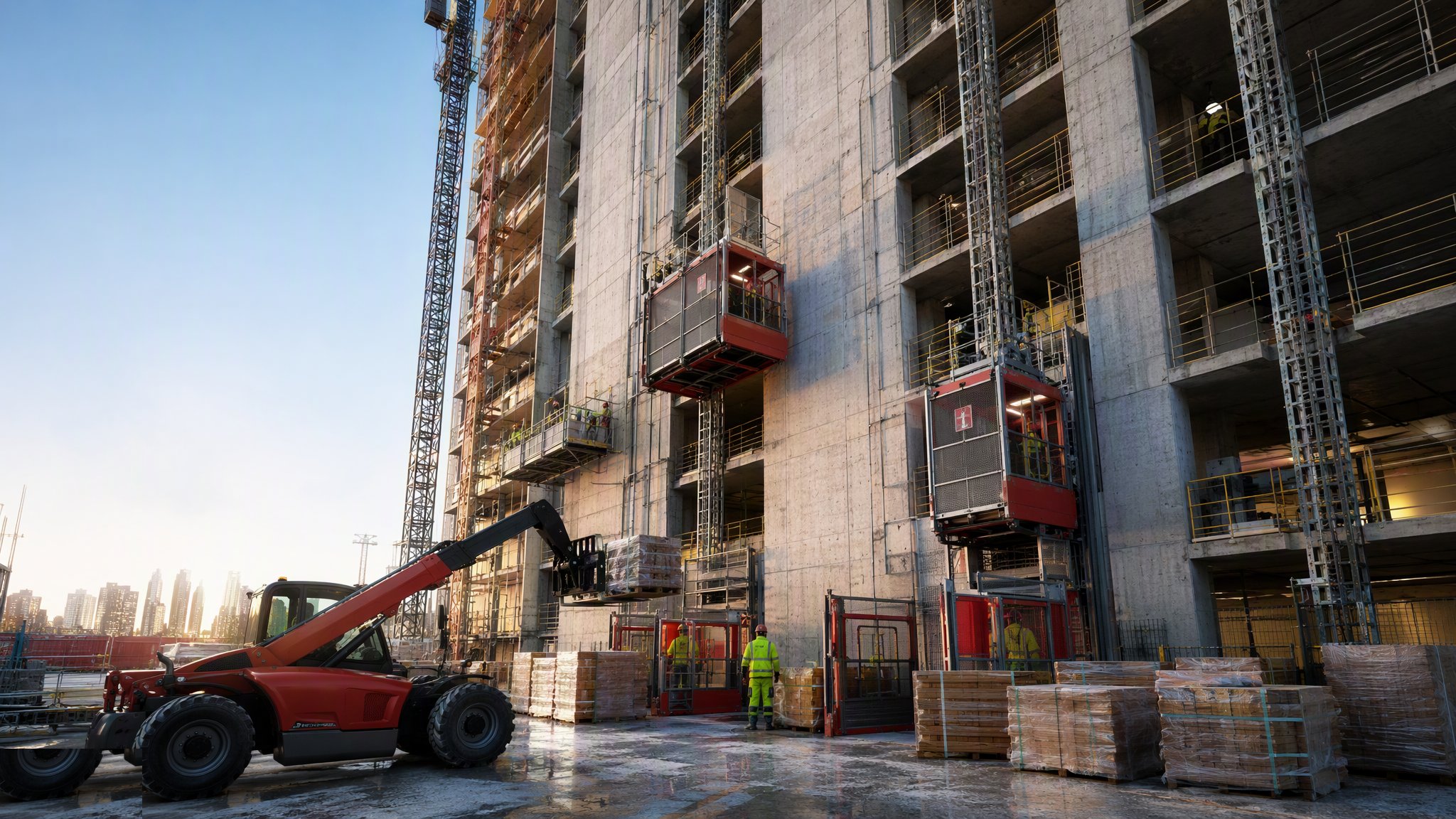
What is Mast climbing work platforms?
A mast climbing work platform is a working deck that runs up and down one or two masts fixed alongside a building. Unlike a scaffold, which puts the operative on whichever lift happens to be nearest the work, a mast climber can be driven to any height, so the work is always presented at the most comfortable level. On a tall repetitive elevation - brickwork, cladding, rainscreen, render, curtain walling, window replacement - that difference is worth a great deal. Operatives stop reaching above their heads and bending to their ankles, materials sit on the deck beside them at the same level, and productivity on the facade rises accordingly.
The platform is a modular deck that can be extended to run a long length of elevation, and it is fed from below by the same masts, so materials go up with the platform rather than being carried out along a scaffold. That is the second saving: pallets of brick, cladding panels and glazing units land on the deck and travel with the workforce. Because the deck is continuously adjustable, an installer can work at the natural height for every course or panel and then raise the platform, which is why mast climbers beat scaffold on tall, repetitive, materials-heavy elevations while losing to scaffold on short, irregular or heavily interrupted ones.
What decides whether a mast climber can be used is nearly always the building and the ground rather than the trade. The masts have to be founded on ground or a structure designed for them by the temporary works designer, and they have to be tied into the facade at intervals, which means the facade has to be able to take the ties and the tie positions have to be capable of being made good afterwards. The platform is erected, climbed, altered and dismantled by the supplier's competent specialists, thoroughly examined before use and inspected at intervals. Balconies, setbacks, plan changes and projecting features all interrupt the mast line, and a facade with too many of them will end up on scaffold instead.
How does Mast climbing work platforms work, step by step?
- 1
Step 1: Test the elevation against the method
Mast climbers pay on elevations that are tall, broadly flat and repetitive, with a real quantity of material to install. They struggle where the facade steps in and out, where balconies and projections interrupt the mast line, where the elevation is short, and where the work is patchy rather than continuous. The team assesses each elevation on its own terms, and it is common for a building to end up with mast climbers on two elevations and scaffold on the others. That mixed answer is usually the right one and it is cheaper than forcing a single system on to the whole project.
- 2
Step 2: Establish the ground and the base
Each mast puts a substantial load into a small footprint, and the base is designed by the temporary works designer for the ground or the structure it stands on. On soft ground, over a basement, on a podium slab or on a suspended deck this becomes an engineering exercise with spreading, mats or propping specified. Stand-off from excavations, services, drainage and vaults is established at the same time. The base area also has to stay clear and available for the whole duration, which on a congested site is a planning matter as much as a technical one.
- 3
Step 3: Design the ties into the facade
The masts are tied back into the building at intervals, and those ties transfer real load into the facade or the frame behind it. The temporary works designer sets the arrangement and the structural engineer confirms that the element receiving the tie can take it - a point that matters most in refurbishment, where the existing facade may be weaker than it looks. The tie positions are agreed with the facade designer so the holes can be made good in a way that does not compromise the finished weathering line, and the sequence for removing them is planned at the same time.
- 4
Step 4: Erect and commission with the supplier's teams
The masts, the deck sections and the drive units are erected by the supplier's trained crews, generally with a crane or telehandler for the base and initial sections. The platform is then thoroughly examined before first use and handed over with records and a briefing on its loading rules. Extensions as the building rises, and any change to the deck configuration to suit a different elevation, are further specialist operations. Site labour does not alter the platform, which is the single most important rule in this trade.
- 5
Step 5: Load the deck and work the elevation
In service the deck is loaded with the materials for the run being installed, within the limits and distributed as the loading rules require rather than concentrated at one end or at the outboard edge. The operatives raise and lower the platform to keep the work at a comfortable height and progress along and up the elevation. Edge protection, the gap between the deck and the building, and the arrangement at each end of the platform all have to be maintained as the deck moves, and they are checked as part of the daily routine rather than assumed to be as they were on day one.
- 6
Step 6: Manage weather, loading and the trades below
Wind stops mast climber work, and the platform has to be left in the condition the plan requires when it does. Loading discipline is the other daily issue: the deck is a working platform and a materials store at the same time, and it is easy to overload or unbalance it. Below the platform, the ground area is controlled against falling materials and against people wandering under the deck, and the base area is kept clear so the machine can be reached and inspected. Where the platform passes occupied floors or an operating building, the interface is planned.
- 7
Step 7: Dismantle, make good and hand back the facade
At the end of the works the platform is dismantled by specialist teams, working down and removing masts and ties. Every tie position is made good to the detail agreed with the facade designer, which on a rainscreen or a sealed facade is a genuine weathering detail and not a filler job. The base is broken out, the ground reinstated, and any damage to the facade recorded and repaired. Because the last part of the elevation to be finished is the part the masts were standing against, that sequence is planned in from the start.
What are the benefits of Mast climbing work platforms?
- Puts the work at a comfortable height continuously, which raises facade productivity and cuts strain
- Carries materials up with the workforce, so pallets land beside the work rather than being barrowed out
- Long decks cover a whole elevation in a single run, suiting repetitive facade trades
- Uses far less material than a full scaffold on a tall elevation, with a quicker erection
- Leaves the ground around the building clearer than a scaffold does
- Adjustable height suits panelised and modular facades where every course lands differently
What are the limitations of Mast climbing work platforms?
- Suits flat repetitive elevations - balconies, setbacks and projections interrupt the mast line
- Base loads are concentrated, so the ground or supporting structure needs design and often spreading
- Ties transfer load into the facade and leave positions that must be made good properly
- Only serves the elevation it stands on, so a building may need several systems
- Wind stops work, and the platform has to be left as the plan requires
- Erection, alteration and dismantling are specialist operations - site labour must not modify the deck
What is Mast climbing work platforms best suited for?
What plant does Mast climbing work platforms need?
- Single or twin mast climbing platform with modular deck sections and drive units
- Designed mast bases with spreading, mats or propping where required
- Tie assemblies and their fixings into the facade or frame
- Crane or telehandler for erection, extension and dismantling
- Power supply and distribution to the platform
- Edge protection, deck infill, loading signage and anemometer
How is Mast climbing work platforms quality-checked?
- Base and tie design by the temporary works designer, with the structural engineer confirming the facade can take the ties
- Erection, alteration, extension and dismantling by the supplier's competent teams only
- Thorough examination before first use and inspection at the required intervals, records on site
- Deck loading rules briefed and enforced, including distribution as well as total load
- Daily checks on edge protection, deck gaps and the arrangement at the platform ends
- Tie positions made good to the facade designer's detail and recorded on completion