Passenger/goods hoists
The primary vertical transport once the frame rises - people and materials up the outside of the building.
Last updated 2026-09-05
What is Passenger/goods hoists?
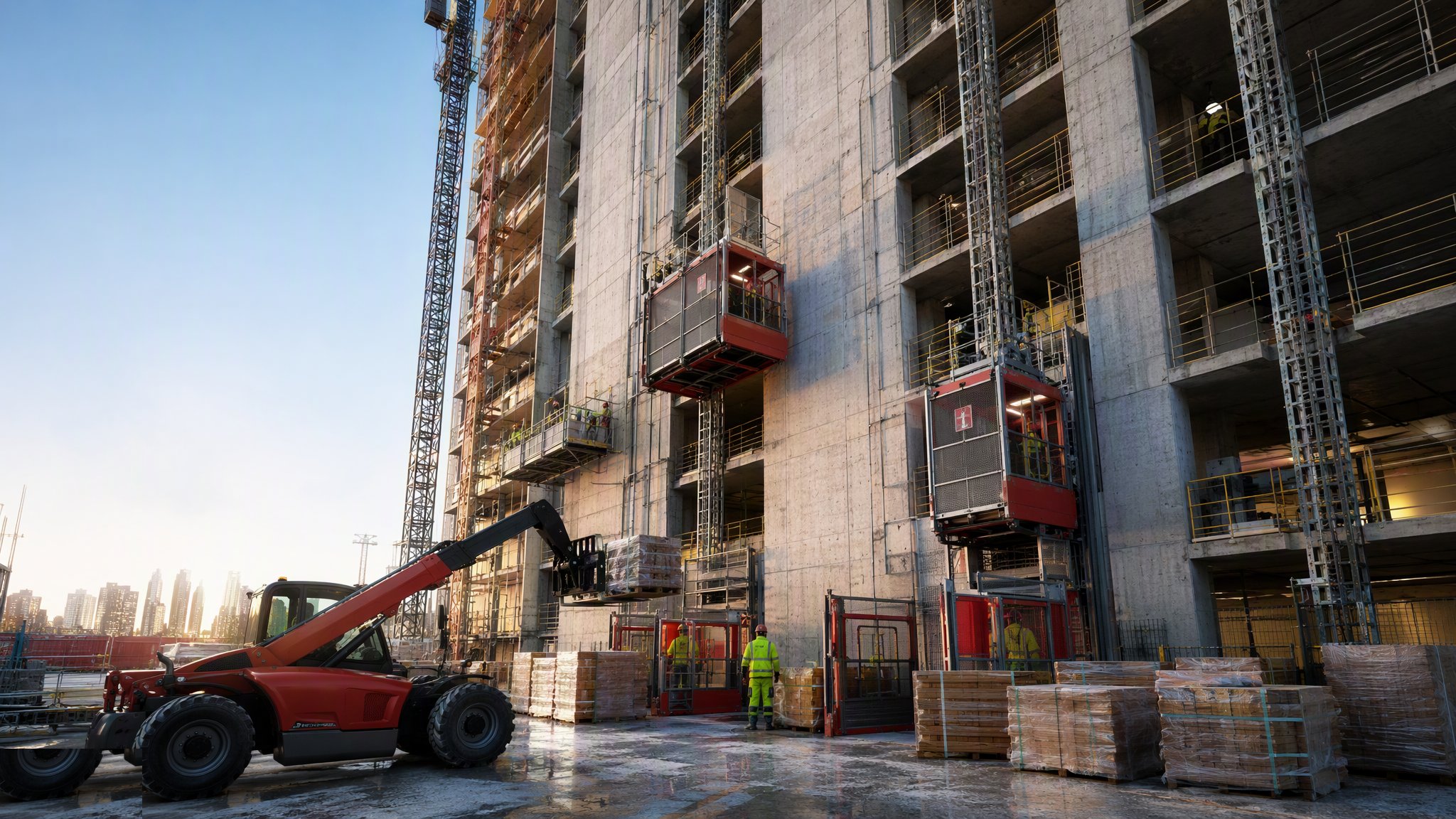
A passenger and goods hoist is a car running up a mast fixed to the outside of a building, carrying both people and materials. Once a frame passes a few storeys it becomes the single most important piece of logistics plant on the project. Everything the trades need has to reach the working floors, and stairs stop being a realistic way to move people and materials long before the building is finished. A hoist turns that problem into a scheduled service. On a busy project it runs all day, moves hundreds of people and a continuous stream of materials, and its capacity and cycle time become a direct constraint on how many operatives the project can usefully employ.
The machine is a mast made of bolted sections, a car or twin cars driven by rack and pinion, ties back to the structure, a base enclosure and a landing gate at every floor served. It is erected by the supplier's specialist teams, extended as the building rises, and it grows to serve the full height of the project. The masts commonly run to 100 m and beyond on tall projects. Layout is a real design exercise. The hoist has to reach a part of the facade where a landing can be formed, it has to be tied into a structure strong enough to take it, and it has to sit where the facade can eventually be completed behind it - which is why hoist position and the sequence of removing it are argued about from the first logistics plan onward.
None of it is casual. The base slab or foundation and the tie arrangement into the permanent structure are designed by the temporary works designer with the structural engineer, and the erection, extension, inspection and dismantling of the hoist are carried out by competent specialists, not by the project's own labour. In service the hoist needs a trained and authorised operator or a controlled call system, disciplined loading, proper landing gates and edge protection at every level, and a management regime that decides who gets it and when. On most projects the real failure of a hoist is not mechanical: it is that nobody planned the demand, so the trades queue.
How does Passenger/goods hoists work, step by step?
- 1
Step 1: Work out the demand before choosing the hoist
Hoist selection starts with the peak workforce and the material flow, not with what the supplier has available. The team estimates how many operatives need to reach the working floors at the start of a shift, how long they can reasonably wait, and what volume of material has to be moved daily. That drives whether the project needs a single car or twin cars, how large the car needs to be, and whether a separate goods-only hoist should sit alongside. Getting this wrong is expensive in a way that does not show up in the hire cost - it shows up as trades standing in a queue every morning.
- 2
Step 2: Fix the position with the facade and the frame
The hoist has to stand where landings can be formed, where the structure can carry the ties, where the base can be founded and where the facade can eventually be closed after the hoist leaves. On most projects the position is a negotiation between logistics, the facade designer and the structural engineer, and it is settled early because moving it later is a major operation. The sequence for taking the hoist down and completing the facade behind it is agreed at the same time, since a hoist that cannot be removed until the building is finished creates a hole nobody planned to close.
- 3
Step 3: Design the base and the ties
The hoist base sits on a slab or foundation designed for it, and the mast is tied back into the permanent structure at intervals through a tie arrangement designed by the temporary works designer and checked by the structural engineer against the frame that will exist when each tie is installed. On concrete frames this brings the same timing problem as tower crane ties, and it is resolved in advance. The design covers the loads the mast puts into the building, including under wind, and it is signed off in writing before erection begins.
- 4
Step 4: Erect and extend with specialist teams
The hoist is erected by the supplier's trained crews, usually with a crane for the base and initial mast, and it is extended in stages as the frame rises. Each extension is a planned operation that takes the hoist out of service, so it is scheduled deliberately rather than squeezed in. Before the hoist is used it is thoroughly examined and handed over with records. The project provides the ground, the exclusion, the power supply and the access the erection team needs, and does not put its own people on to the mast.
- 5
Step 5: Form the landings and the gates
Every floor the hoist serves needs a landing: a platform or opening in the facade line with a gate that is interlocked so it cannot be opened when the car is not there, with edge protection either side, with a level and clear approach, and with lighting. Landings are a temporary works item in their own right and are frequently the weak point, because they get formed early, then get modified by other trades, then get left with a gap. They are inspected on the same regime as the hoist itself.
- 6
Step 6: Run the hoist as a managed service
In service the hoist is operated by trained and authorised people, loaded within its limits with materials restrained, and run to a published schedule that the project manages: peak times for people, booked slots for materials, and a rule about what is allowed to travel. Long loads, gas, hazardous materials and anything that will not fit inside the car need their own arrangement. Someone owns the schedule, and on a busy project that person spends real time on it. Breakdowns are treated as a project emergency because the whole workforce depends on the machine.
- 7
Step 7: Maintain, inspect and eventually remove
The hoist is maintained by the supplier, inspected at set intervals and thoroughly examined by a competent person, with all records held on site. When the project no longer needs it, it is dismantled by specialist teams working down the mast, the ties are removed, and the fixings and the facade behind them are made good to the agreed detail. The last floors are then served by the permanent lifts under a builder's-use arrangement, which is planned in advance with the lift installer rather than assumed.
What are the benefits of Passenger/goods hoists?
- Moves people and materials to the working floors, removing the stairs as a bottleneck
- Becomes the backbone of site logistics on any project above a few storeys
- Twin cars and large car sizes give real capacity at shift changes
- Extends with the building, serving the full height of tall projects
- Keeps material handling off the crane, freeing it for the frame
- Provides a controlled, weather-protected route for the workforce
What are the limitations of Passenger/goods hoists?
- Occupies a section of facade and delays its completion until the hoist is removed
- Base and ties need designing by the temporary works designer and checking against the frame
- Extensions and maintenance take the hoist out of service at points in the programme
- Capacity is finite, and an under-sized hoist puts the whole workforce in a queue
- High winds stop it, which affects everyone on the project at once
- Erection, extension and dismantling are specialist operations with their own crane and access needs
What is Passenger/goods hoists best suited for?
What plant does Passenger/goods hoists need?
- Rack and pinion hoist with single or twin cars and bolted mast sections
- Designed base slab or foundation and the mast tie assemblies
- Interlocked landing gates, landing platforms and edge protection at every level served
- Mobile crane for erection of the base and initial mast, and for dismantling
- Power supply, distribution and standby arrangements sized for the hoist
- Signage, loading restraint equipment and communications between landings
How is Passenger/goods hoists quality-checked?
- Base and tie design by the temporary works designer, checked by the structural engineer, signed off before erection
- Erection, extension and dismantling by the supplier's competent specialist teams only
- Thorough examination before first use and at the required intervals, with records held on site
- Landings, gates and interlocks inspected on a set frequency and after any change by other trades
- Operators trained and authorised, with loading rules displayed and enforced
- Maintenance regime in place, with a documented response for breakdowns
More hoists, mast climbers and material handling methods
Next method
Goods-only hoists