Stick-built erection
Assembled piece by piece in position rather than as modules - more site labour and a longer programme, but far more tolerant of transport and access limits.
Last updated 2026-09-07
What is Stick-built erection?
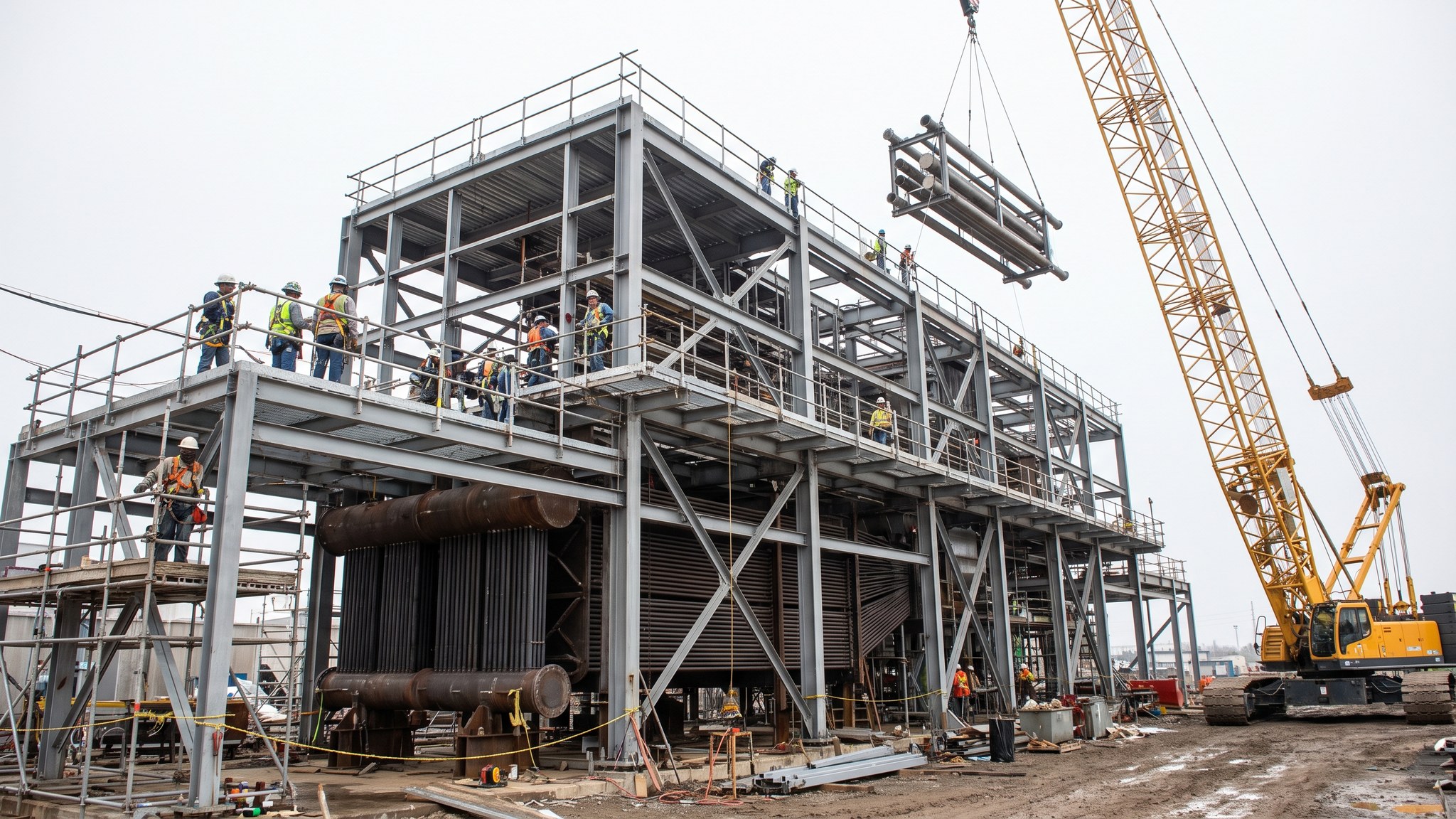
Stick-built erection means the unit is assembled on site from individual components rather than delivered as large pre-assembled modules. Panels, sections, headers, supports and pipework arrive separately, are lifted into position one at a time and are joined in place. It is the older way of building a boiler or a heat recovery unit and it remains the right answer on a great many projects, because what governs the choice is rarely the unit itself - it is whether the roads, the bridges, the port, the site entrance and the crane positions can accept large modules at all.
The advantage is tolerance. A stick-built approach can be delivered on ordinary transport, through ordinary access, with ordinary cranes. It does not need a heavy haulage route, a quayside, a laydown area sized for module assembly or a crane capable of the largest single lift. It also spreads the delivery of components over a longer period, which suits a supply chain that cannot produce large modules and a site that cannot store them. Where a project is remote, constrained, or working within a live station, stick-building is often the only method that will physically work.
The cost is time and labour. Every joint made on site is a joint that could have been made in a shop, and site conditions are worse in every respect: weather, access, light, position and inspection are all harder. Welding volume goes up, the programme lengthens, the site workforce peaks higher and supervision and quality control have to be spread across many more work faces. Most projects therefore end up somewhere between the two extremes, modularising what the access allows and stick-building the rest, and the split is settled early with the plant supplier because it drives the whole erection method.
How does Stick-built erection work, step by step?
- 1
Step 1: Survey the route and the site before choosing the method
The decision between modular and stick-built is made on evidence, not preference. The team surveys the delivery route from the port or the works to the site gate, checking road widths, bridge capacities, headroom, turning radii and any restrictions along the way, then assesses the site itself for laydown, assembly area and crane standing. Where large modules cannot be delivered, cannot be turned into the site or cannot be lifted from any available crane position, stick-building follows. That assessment is done early enough to be built into the contract.
- 2
Step 2: Agree the erection split with the plant supplier
The plant supplier fabricates to suit the erection method, so the split between shop work and site work has to be fixed before fabrication starts. The parties agree what arrives as sub-assemblies, what arrives loose, how components are marked and packed, and in what sequence they are delivered. Delivery sequence is critical on a stick-built job because the site assembles in erection order and has nowhere to put components that arrive out of turn. A delivery schedule tied to the erection programme is agreed and then managed weekly.
- 3
Step 3: Plan the erection sequence and the temporary works
Stick-building means partially complete structures standing for long periods, so temporary support, bracing and stability during erection are designed rather than assumed. The erection sequence is set out step by step, with the temporary works that each step depends on identified alongside it. Crane positions, radii and capacities are worked out for the heaviest individual component rather than for a module, which is usually what makes ordinary cranage sufficient.
- 4
Step 4: Establish site fabrication and welding facilities
Because so much joining happens on site, the project sets up proper facilities for it: covered fabrication and preparation areas, consumable stores with controlled conditions, welder qualification and testing arrangements, heat treatment equipment and a non-destructive examination capability that can keep pace. Weld traceability is set up from the start, with every joint numbered, allocated to a welder and tracked through examination and acceptance. On a stick-built job this system is the backbone of the quality record.
- 5
Step 5: Erect the supporting structure and set the datum
The structure goes up first and is surveyed, because everything that follows is positioned from it. On a stick-built unit the accumulation of small errors is a genuine risk: each component is set from the last, and a drift that would not matter once matters greatly by the fiftieth piece. Independent survey control is established outside the working area and every few stages of erection are checked back against it rather than against the previous piece.
- 6
Step 6: Assemble the unit piece by piece in erection sequence
Components are lifted, positioned, temporarily supported, aligned and then joined. Alignment is checked before joining rather than after, and temporary supports stay in place until the permanent arrangement can carry the load. Work fronts multiply as the unit rises, so co-ordination between trades sharing the same access becomes the daily management task. Protection of completed work from adjacent activity - grinding, welding, painting - is planned rather than left to good intentions.
- 7
Step 7: Manage the workforce, access and supervision peak
A stick-built job needs a much larger site workforce than a modular one, and it needs it for longer. Welfare, access, transport, training and supervision all have to be scaled for that peak, and the supervision ratio is the number that usually gets underestimated. Many work faces spread across a tall structure need supervisors and inspectors who can actually reach them, which in practice means designing the access to suit the inspection regime as well as the work.
- 8
Step 8: Inspect, clean and turn over as work completes
Inspection keeps pace with erection rather than following it, because access closes behind the work. Weld records, alignment checks, support settings and cleanliness records are completed and signed off area by area as they are finished. Internal cleaning and steam blowing remain specialist operations executed by the plant supplier and the commissioning team under the operator's permit-to-work system. Completed systems are turned over to commissioning individually, which lets the commissioning team start while erection continues elsewhere.
What are the benefits of Stick-built erection?
- Tolerant of restricted delivery routes, low bridges, tight site entrances and limited laydown
- Needs only ordinary cranage sized for individual components rather than for large modules
- Components can be delivered progressively, which suits a constrained supply chain and a small site
- Works inside live stations and congested sites where module assembly space does not exist
- Lower transport risk, since no single abnormal load carries a critical part of the plant
- Erection can start earlier because it does not wait for complete modules to be assembled
What are the limitations of Stick-built erection?
- Far more joining work done on site, in worse conditions, with more welding and more examination
- Longer erection programme and a higher, longer site workforce peak
- Supervision and quality control must be spread across many simultaneous work faces
- Weather exposure affects a much larger share of the work
- Accumulated setting-out error is a real risk and needs independent survey control throughout
- Temporary support and stability of partially erected structures becomes a substantial designed scope
What is Stick-built erection best suited for?
What plant does Stick-built erection need?
- Conventional crawler and mobile cranes sized for individual components
- Chain blocks, winches, jacking and pulling equipment for positioning within the structure
- Covered site fabrication, preparation and consumable storage facilities
- Welding plant, heat treatment equipment and on-site non-destructive examination capability
- Extensive access scaffold, platforms and hoists serving many simultaneous work faces
- Survey equipment and independent control stations for repeated checks against datum
How is Stick-built erection quality-checked?
- Transport route and site access survey completed and recorded before the erection method is fixed
- Shop and site split, component marking and delivery sequence agreed with the plant supplier
- Erection sequence and temporary works designed, checked and approved before erection starts
- Weld traceability system operating from the first joint, with welder qualifications and examination results tracked
- Erected work checked back to independent survey control at defined stages, not against the previous piece
- Area by area inspection and turnover records completed as access closes, not retrospectively