Blast freezing cells
Small, high powered rooms that drive product temperature down fast, with very high air movement and a plant load out of all proportion to their size.
Last updated 2026-09-06
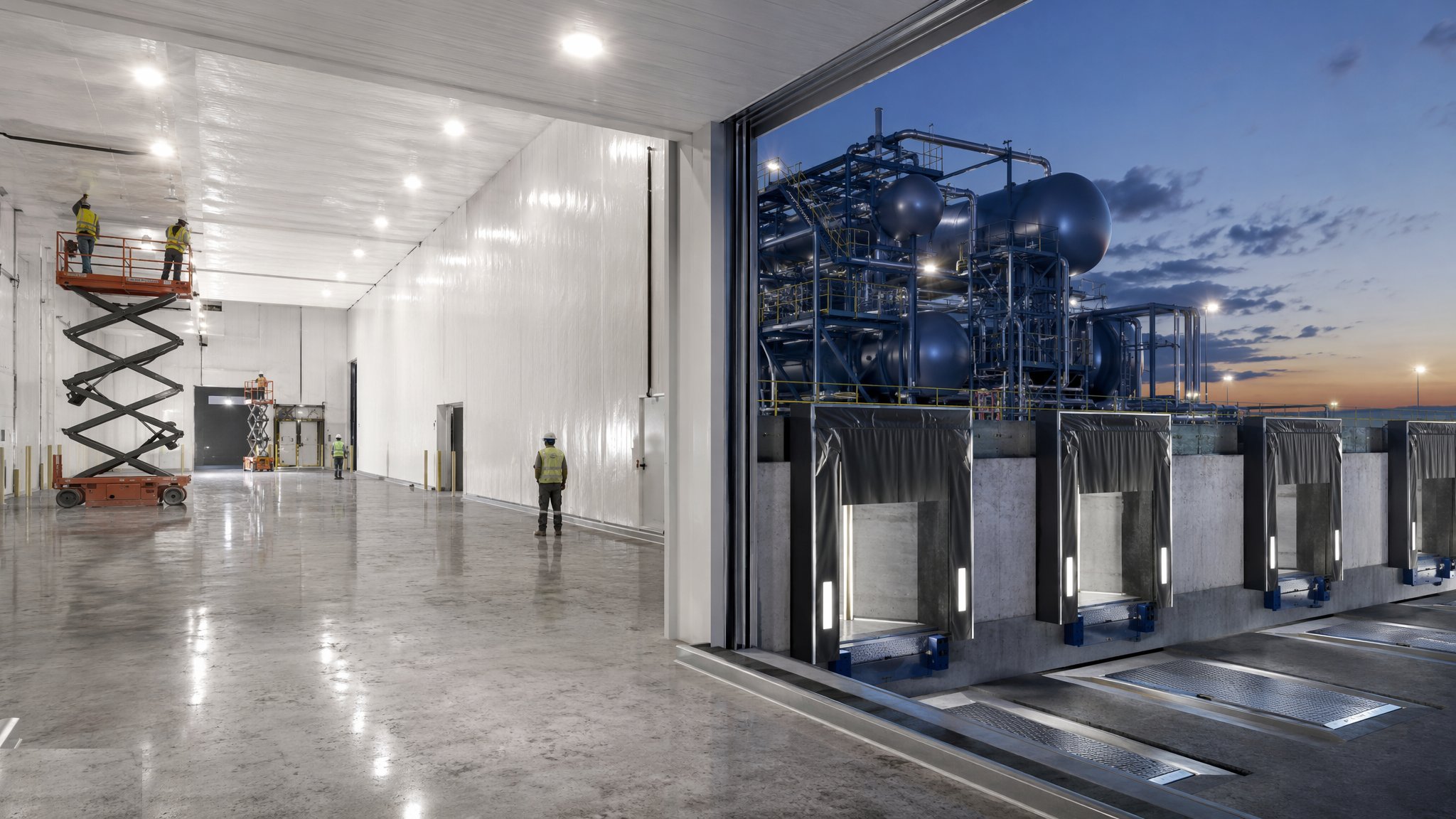
What is Blast freezing cells?
A blast freezing cell is not a store. It is a process room whose job is to take warm product and pull its temperature down as quickly as the product allows, after which the frozen goods move on to a bulk freezer store. Because the work is done fast, the cell is small and the refrigeration duty is enormous relative to the floor area. A bulk freezer store holds a steady temperature against a slow heat gain through the envelope. A blast cell removes a large quantity of heat from product in a matter of hours, over and over again, and that changes almost every design assumption. Sizing, plant, air movement, structure and services all follow from the process rather than from the storage volume.
The defining feature inside the cell is air movement. Product freezes quickly only if cold air is driven hard and evenly across every surface of it, so the cell is built around a directed air path with large fans, high air velocities and racks or trolleys positioned so that air reaches every item. That has consequences the construction team feels directly. The internal environment is far more aggressive than a store, panels and finishes take a beating, everything inside has to be fixed to resist continuous air pressure and vibration, and the air path has to be preserved by the physical layout rather than left to chance. Trolleys, rails, baffles and the clear space around the coolers are part of the engineering, not loose fit out.
The other consequence is cycling. A blast cell is loaded warm, run hard, emptied and loaded again, so it swings through a large temperature range repeatedly rather than sitting still. Thermal movement is therefore constant, and joints, seals, floors and fixings that would be adequate in a static store are worked far harder. The insulated envelope, the vapour barrier and the floor build-up all have to accommodate that cycling. Doors are large, heavy and used constantly. The refrigeration plant is designed, installed and commissioned by the refrigeration specialist under its own regime, and the construction team provides the structure to carry heavy plant and heavy fans, the drainage, the power and the sealed box, then supports the specialist through a commissioning process that is genuinely a process commissioning rather than a simple pull-down.
How does Blast freezing cells work, step by step?
- 1
Step 1: Define the process before the room
A blast cell is designed backwards from the product. What is being frozen, in what form, on what carrier, in what batch size, and how quickly the temperature has to fall all come first. From those the designer and the refrigeration specialist fix the duty, the air flow arrangement and the cell dimensions. The construction team needs the outcome of that work early because it drives the structure, the plant space, the power supply and the drainage, and none of those can be added cheaply later. A blast cell designed as if it were a small freezer store will not perform, however well it is built.
- 2
Step 2: Provide structure for a very heavy plant load
The refrigeration equipment, the fans and their supports weigh far more per square metre than anything in a bulk store, and they impose dynamic loads as well as static ones. Steelwork, platforms and hanging arrangements are designed for those loads and for the vibration that comes with continuous high volume air movement. Plant access, lifting routes and maintenance space are planned into the structure rather than found afterwards. On most projects the plant sits outside or above the cell on a dedicated platform, and the interface between that platform and the insulated envelope is one of the more difficult details on the project.
- 3
Step 3: Build a small envelope to a large standard
The envelope of a blast cell is built to the same principles as a freezer store but is worked harder. Panels are erected plumb and tight, joints fully closed, and the vapour barrier is sealed continuously on the warm side. Because the cell is small, the ratio of junctions and corners to floor area is high, so a much larger share of the envelope is detail rather than plain panel. Every one of those junctions has to be right. On most projects the cell is built inside a larger conditioned space, which reduces the vapour drive across the envelope but does not remove the need for a continuous barrier.
- 4
Step 4: Deal with the floor and the ground
The cell operates below freezing, so the ground beneath it can freeze in the same way it would under a bulk store, and the designer specifies protection accordingly. The floor also has to take heavy loaded trolleys running in and out many times a day, so it is a trafficked industrial floor as well as an insulated one. Drainage from the cell has to handle the water shed during defrost cycles and cleaning, and it has to be routed and protected so it cannot freeze. Falls, gullies and channel positions are coordinated with the trolley routes so that drainage does not sit where wheels run.
- 5
Step 5: Set out the air path and fix everything against it
The performance of the cell depends on air reaching every surface of the product, so the internal layout is engineering. Coolers, fans, baffles, plenums, trolley positions and rails are set out to the design, and the clear space around them is protected. Everything inside is fixed to resist continuous air pressure and vibration, including light fittings, cable containment, detection heads and internal protection. Fixings that would be adequate in a static room work loose in a blast cell, so the specification for internal fixings is checked rather than assumed.
- 6
Step 6: Install heavy, frequently used doors
Blast cell doors are large enough to admit loaded trolleys or racks, insulated, and used many times a day under a large temperature difference. Frames are built into properly formed openings with thermal breaks, heated where the designer specifies it, and protected against impact from trolleys. Door hardware, seals and hinges are selected for the cycle count rather than for a storage duty. Internal release hardware, alarms and the arrangements for anyone working inside are installed and proved before the cell is used, because a blast cell is a room people enter and leave repeatedly during a shift.
- 7
Step 7: Coordinate services through a congested envelope
A small room with a very large plant load has a lot of services crossing its envelope in a short length of wall. Refrigeration pipework, drainage, power, controls, detection and any suppression all pass through. On most projects those crossings are grouped and designed as a single detailed arrangement so that the vapour barrier and the insulation can be carried through properly. Every crossing is a thermal bridge candidate and every one is recorded. Congestion is the reason blast cell envelopes fail more often than bulk store envelopes, and the answer is coordination before installation rather than remedial sealing afterwards.
- 8
Step 8: Commission the process, not just the temperature
Commissioning a blast cell means proving that it performs its process, not simply that it reaches a temperature. The refrigeration specialist commissions the plant under its own regime. The cell is then pulled down in stages, air flow and distribution are checked against the design, and trial loads are run so the operator and the designer can confirm the cell achieves the pull-down the process requires with the product in it. Faults in air distribution show up only under load, which is why trial running with representative product is part of the handover rather than an optional extra.
What are the benefits of Blast freezing cells?
- Freezes product quickly, which protects quality in a way that slow freezing in a bulk store cannot
- Concentrates the heavy refrigeration duty into a small room rather than oversizing the whole store
- Lets a bulk freezer store be designed for holding rather than for freezing, which keeps the large room simpler
- Batch operation gives the operator control over throughput and scheduling
- A small footprint means the specialist construction cost is contained even though the duty is high
- Can be added alongside an existing store as a discrete room with its own plant
What are the limitations of Blast freezing cells?
- Plant load, power demand and structural load are all far higher per square metre than a bulk store
- Repeated temperature cycling works joints, seals, fixings and floors much harder than static storage
- Very high air movement damages finishes and loosens fixings that would survive elsewhere
- A high ratio of junctions to floor area means a large share of the envelope is difficult detail
- Services congestion around a small envelope makes vapour sealing and thermal breaks harder to achieve
- Performance depends on air reaching the product, so a layout change by the operator can undo the design
What is Blast freezing cells best suited for?
What plant does Blast freezing cells need?
- Mobile access equipment suited to working in a small, congested room
- Lifting equipment for heavy plant and fan assemblies onto platforms
- Steel erection plant for the plant support structure and access platforms
- Concrete and floor finishing equipment for a trafficked insulated floor
- Sealing and thermal break materials with tools suited to congested penetrations
- Air flow measurement, data logging and thermal imaging equipment for commissioning
How is Blast freezing cells quality-checked?
- Plant support structure checked against the design loads including the dynamic load from fans
- Vapour barrier continuity inspected at every junction, with a high proportion of the envelope treated as detail
- Grouped service crossings recorded individually on a register, each sealed and thermally broken
- Internal fixings specified and checked for continuous air pressure and vibration, not storage conditions
- Floor drainage falls and freeze protection checked against the trolley routes before finishing
- Air distribution measured against the design and a trial load run before handover