Multi-temperature and convertible boxes
Rooms built so the operator can switch them between chill and frozen duty as the business changes, at the price of building for the harder duty from day one.
Last updated 2026-09-06
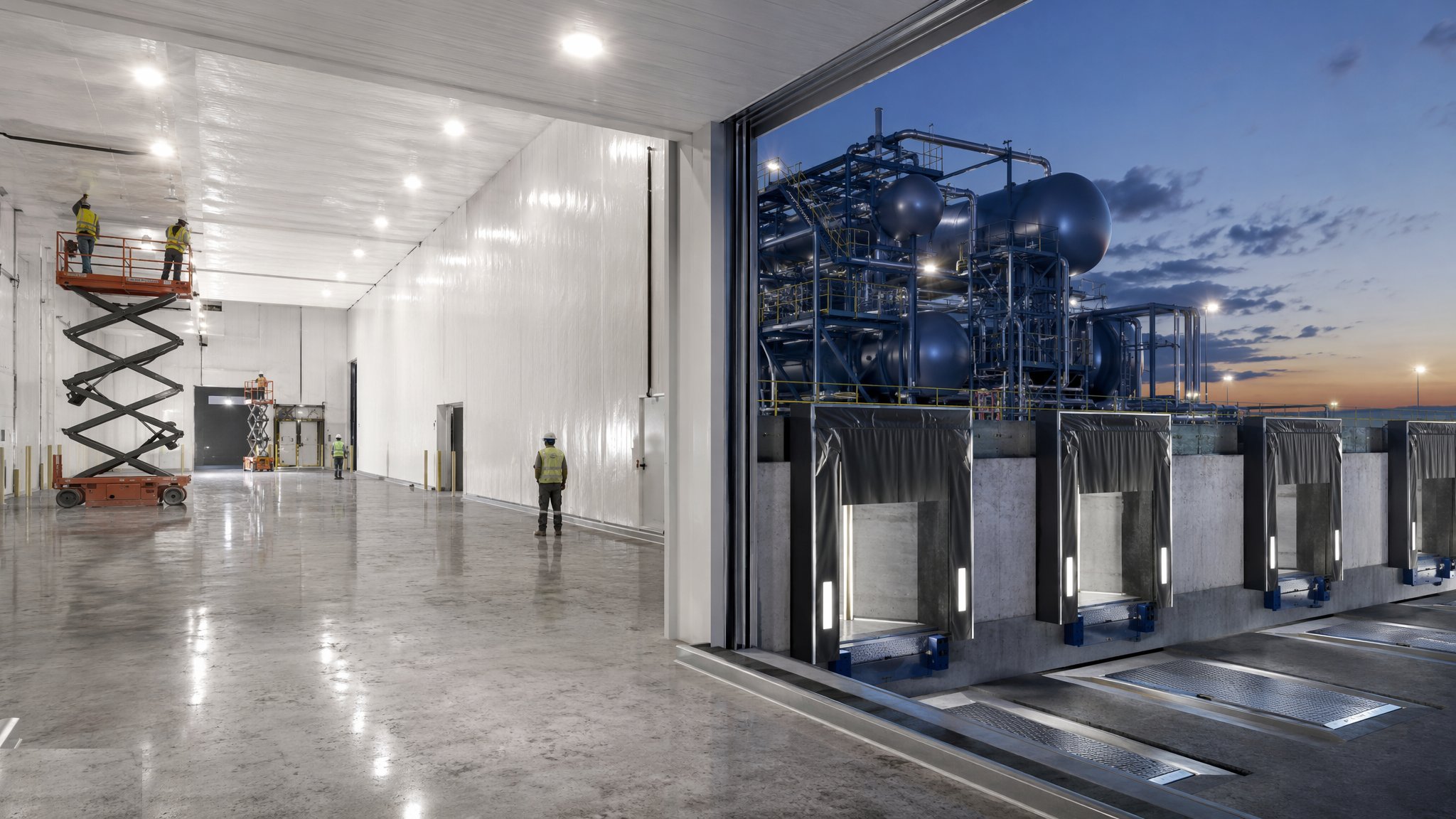
What is Multi-temperature and convertible boxes?
A multi-temperature or convertible box is a room designed to be run at more than one duty over its life. On most projects that means a room that can be operated as a chill store and later switched to frozen, or a suite of rooms whose individual duties can be reallocated as the product mix changes. The commercial driver is straightforward. A distribution operator rarely knows what proportion of chilled to frozen volume it will need in ten years, and a building that can be reconfigured is worth more than one that cannot. The construction consequence is equally straightforward. The room has to be built for the hardest duty it might ever be asked to perform, whether or not it is ever asked to perform it.
That is the flexibility premium and it falls mainly on the floor. If a room might one day run below freezing, the floor build-up has to include the protection that stops the ground beneath from freezing and heaving, because that build-up is buried and cannot be added later. It is by far the largest single cost of convertibility and the one most often left out of an early budget. The envelope follows the same logic. Insulation, vapour barrier detailing, thermal breaks, door types and frame heating are all specified for the colder duty from the outset. A room built to chill standards cannot be converted to frozen duty without effectively rebuilding it, so the decision to make a room convertible is made at design stage and cannot be deferred.
The other half of convertibility is controls and plant. The refrigeration system has to be capable of both duties and has to be arranged so that changing a room over is a controlled, documented operation rather than an improvisation. That is the province of the refrigeration specialist, who designs, installs and commissions the plant under its own regime. What the construction team provides is a box that will tolerate both duties, capacity in the plant space and distribution routes to allow the change, and monitoring that lets the operator prove the new duty is being held. On most projects the conversion procedure itself is written down at handover, including the staged pull-down that any change to a colder duty demands.
How does Multi-temperature and convertible boxes work, step by step?
- 1
Step 1: Agree the duty envelope with the operator and the designer
Convertibility has to be defined before it can be designed. Which rooms may change duty, between which bands, how often, and how quickly the change has to be achievable are all commercial questions with construction consequences. The designer converts that into the duty the envelope and the floor must be built for, which is always the coldest duty in the range. On most projects the answer is that a subset of rooms is made convertible and the rest are fixed, because making every room convertible is expensive and rarely needed.
- 2
Step 2: Build the floor for the coldest duty from day one
The floor build-up is the part that cannot be retrofitted, so it is built for frozen duty even if the room opens as a chill store. That means the vapour and moisture barrier, the heave protection selected by the designer, the insulation and the wearing slab all follow the frozen specification. Any under slab system is installed, tested, photographed and recorded before covering, and monitoring points are provided so that the operator can prove the protection is working when the room is later run cold. The deeper build-up affects levels, docks and drainage across the building and has to be coordinated early.
- 3
Step 3: Specify the envelope for the harder case
Insulation performance, panel selection, junction details, thermal breaks and perimeter details are all specified for the coldest duty. Building the envelope to chill standards and hoping to upgrade it later does not work, because the critical elements are buried within the construction. The vapour barrier is installed and sealed to the frozen standard throughout, and every penetration is treated as if the room were already running below freezing. On most projects this is a small proportional cost against the value of the flexibility, provided it is decided at design stage.
- 4
Step 4: Provide doors, airlocks and access that suit both duties
Doors, frames and door protection are selected for the colder duty, including frame heating where the designer specifies it and the arrangement of any lobby or airlock. A doorway that works for a chill room will frost and eventually fail when the room is run frozen. Where a lobby is needed for frozen duty, the space for it is provided in the layout from the start even if it is not fitted out immediately, because finding that space later usually means losing racking.
- 5
Step 5: Arrange plant, distribution and capacity for the change
The refrigeration specialist designs and installs a system capable of serving the rooms at either duty, with the distribution arranged so a room can be reallocated without rebuilding the pipework. The construction team provides the plant space, the structural support, the power capacity and the routes for that arrangement, and provides spare capacity in containment and risers where the designer calls for it. Plant, pipework and charging are entirely the responsibility of the refrigeration specialist under its own regime and its own safety arrangements.
- 6
Step 6: Install controls and monitoring that support reallocation
The control system has to know what duty each room is set to, hold it, alarm on deviation and record the history. Monitoring is provided within the room, at the doors and, where the design requires it, below the slab so that the heave protection can be verified when the room runs cold. Set points, alarms and the identity of each room are configured so that a change of duty is a documented act with a clear before and after, not an adjustment someone makes on a panel.
- 7
Step 7: Commission at the opening duty and record the conversion procedure
The room is commissioned at whatever duty it opens on, with the same staged pull-down and the same envelope proving as a fixed room of that type. In addition, the conversion procedure is written down and handed over: the sequence for changing duty, the checks to be made before and after, the staged pull-down required when moving to a colder band, and the records to be kept. Handover documentation that omits this is the most common reason a convertible room is never actually converted.
- 8
Step 8: Prove the box under the colder duty where the client asks for it
Where the client wants certainty, the room is taken down to its coldest duty during commissioning, held, imaged and logged, then returned to its opening duty. That trial finds the thermal bridges and vapour leaks that only appear at the colder band, at a point when they can still be corrected and while the room is empty. It costs programme time and it is the only way to demonstrate that the flexibility that has been paid for actually exists.
What are the benefits of Multi-temperature and convertible boxes?
- The operator can reallocate rooms as the product mix changes without rebuilding
- Protects the value of the building against a shift in chilled to frozen volumes
- Allows a phased business to open on chill duty and move to frozen later
- Building the envelope and floor to the harder duty tends to produce a better built room overall
- Suits third party logistics operators whose customers and product mix change with each contract
- Avoids the far larger cost of converting a room that was never designed for it
What are the limitations of Multi-temperature and convertible boxes?
- The room must be built for the coldest duty from the start, so the saving of a chill only build is lost
- The floor build-up carries almost all of the premium and cannot be retrofitted at any sensible cost
- Running a convertible room at chill duty means carrying insulation and details it does not currently need
- Conversion is a staged, documented operation, not a change of set point, and takes the room out of use
- Plant and distribution have to be arranged for both duties, which constrains the refrigeration design
- The flexibility is often never used, so the premium has to be justified commercially rather than assumed
What is Multi-temperature and convertible boxes best suited for?
What plant does Multi-temperature and convertible boxes need?
- The full plant list for the coldest duty the room is designed to reach
- Testing and recording equipment for under slab systems before covering
- Concrete plant and floor finishing equipment for the deeper build-up
- Panel erection and handling equipment for a frozen specification envelope
- Controls and monitoring installation equipment, including below slab instrumentation
- Data logging and thermal imaging equipment for commissioning at more than one duty
How is Multi-temperature and convertible boxes quality-checked?
- Design duty range recorded and every element checked against the coldest case, not the opening case
- Under slab heave protection installed, tested, photographed and recorded even where the room opens on chill duty
- Vapour barrier and thermal breaks inspected to the frozen standard throughout
- Monitoring points, including below slab where specified, installed and their positions recorded as built
- Conversion procedure written, agreed and included in the handover documentation
- Where required, a trial at the coldest duty logged and thermally imaged before the room is put into service