Elevated and approach lighting
Lights mounted above ground on frangible fittings designed to break away cleanly if an aircraft ever reaches them.
Last updated 2026-09-05
What is Elevated and approach lighting?
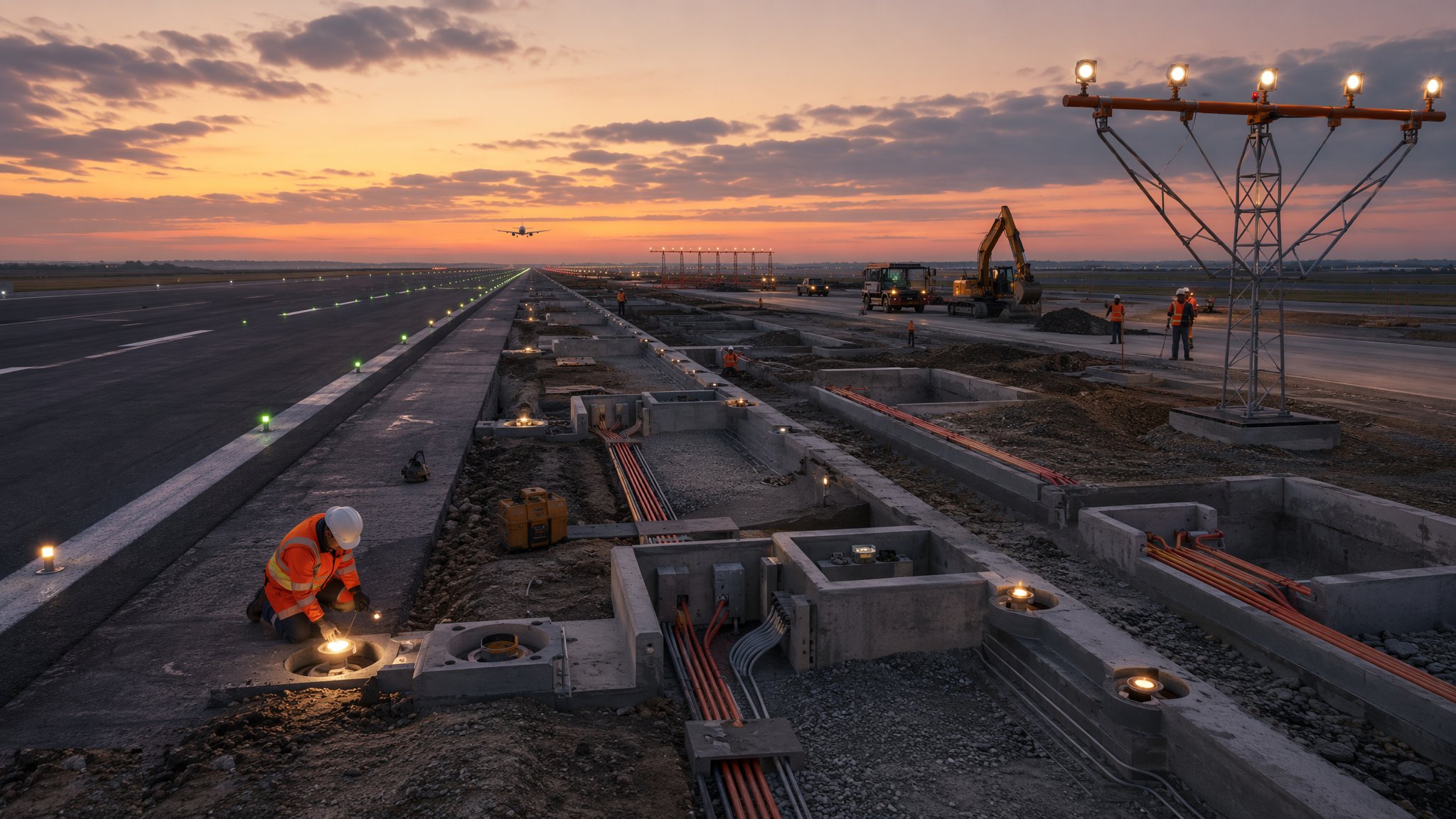
Elevated lighting is everything mounted above the surface rather than set into it: edge lighting alongside pavements, signage, and the approach lighting that extends beyond the end of a runway. Wherever a fitting stands above ground in an area an aircraft could reach, it is mounted frangibly - designed so that the fitting or its mounting fails and breaks away cleanly on impact rather than resisting and damaging the aircraft. Frangibility is not an accessory; it is the defining requirement of the whole family of fittings, and it is why an elevated airfield light is not the same thing as an external light anywhere else.
Approach lighting is the demanding end of this work. It extends out from the runway end, often beyond the airport boundary, and where the ground falls away or crosses water, roads or rail, the lights are carried on structures. Those structures have to hold the fittings in the position the design requires, survive weather and loading, and still present a frangible arrangement to an aircraft. They also have to be maintainable, which on a tall structure over difficult ground is a genuine design problem rather than an afterthought. Access provision designed in at the start is what keeps the installation maintainable for its life.
Where these lights go, how they are arranged and what they are required to achieve are decided by the designer with the airport operator and the aviation regulator. Nothing about the siting or the setting of an approach lighting installation is determined on site by a contractor. The construction role is to install the bases, structures, ducts and cabling to the design, allow the specialists to install and connect the fittings, and provide safe permanent access for maintenance. The connection into the series circuit remains high-voltage specialist work under the operator's permit system.
How does Elevated and approach lighting work, step by step?
- 1
Step 1: The designer fixes the arrangement and the regulator agrees it
The layout, extent and configuration of edge and approach lighting are design matters settled between the designer, the airport operator and the aviation regulator. They follow from how the runway is used and in what conditions. The contractor builds to that design and refers any conflict back rather than adjusting it. On approach installations the design also determines what land, wayleaves or third-party agreements are needed, since the lighting frequently extends beyond the airport boundary.
- 2
Step 2: Install foundations and bases to the setting-out
Each fitting or structure needs a foundation designed for its loading and its ground conditions, positioned by survey from the design. Bases carry the frangible coupling or mounting arrangement, and their level and orientation are set carefully because they determine how the fitting sits. Ducts and draw ropes are built into the foundation so the cabling can be pulled without further excavation. On most projects the foundations are installed well ahead of the fittings so that the specialists arrive to a completed civils front.
- 3
Step 3: Erect approach structures where the ground demands them
Beyond the runway end the ground may fall away, or cross water, a road, a railway or third-party land, and the lights then have to be carried on structures that hold them where the design requires. These are engineered structures with foundations, corrosion protection and, where they are over water or a live route, significant temporary works to build them. They are designed to present a frangible arrangement despite their size, and how that is achieved is part of the design rather than a site decision.
- 4
Step 4: Mount the fittings frangibly
Every elevated fitting in an area an aircraft could reach is installed on its frangible coupling or mounting exactly as the manufacturer specifies, with the correct components and the correct tightening. Substituting a fixing, adding a bracket, over-tightening a coupling or bolting through a frangible element defeats the entire purpose, and it is a defect however solid the result looks. Damaged frangible components are replaced, never repaired. On most projects this is the single item the operator inspects most closely.
- 5
Step 5: Install cabling and connect under permit
Primary cabling runs in ducts to each base, where the fitting is connected to the series circuit through its isolating transformer by qualified airfield lighting specialists under the airport operator's permit-to-work. The circuit is isolated by the operator before the work begins. Terminations, seals and chamber details are made to the manufacturer's requirements, because approach and edge installations sit outdoors in wet ground for decades and water ingress is the usual cause of trouble.
- 6
Step 6: Design in the access that maintenance will need
These fittings need cleaning, lamp changes, seal replacement and inspection for their whole life, and on approach structures that means working at height over ground that may be water, marsh, a road or a railway. Permanent access - walkways, ladders, platforms, anchor points, and a safe route to reach the structure at all - is designed in and built as part of the works. Retrofitting access later is expensive and often impossible. On most projects the operator's maintenance team is consulted on this before the design is fixed.
- 7
Step 7: Prove the installation and return it to service
The specialists test and prove each circuit and fitting, and the airport operator returns the installation to service and confirms its status on the control and monitoring system. Where the installation supports approach operations, what may be used and in what conditions is determined by the operator and the aviation regulator. The construction team's completion is the civils, the structures, the access and the records; the operational acceptance is not theirs to give.
- 8
Step 8: Maintain frangibility and vegetation over the life of the asset
An approach lighting installation degrades quietly. Frangible couplings corrode or get replaced with the wrong part, structures rust, access decays and vegetation grows up around and in front of the lights. Routine inspection covers all of it, and vegetation management beyond the airport boundary is a standing task the operator has to arrange with landowners. Records of the original components matter, because the correct frangible part has to be identifiable years later by someone who was not there.
What are the benefits of Elevated and approach lighting?
- Frangible mounting means an elevated fitting breaks away cleanly rather than resisting an impact
- Above-ground fittings are far easier and cheaper to inspect, clean and maintain than inset lights
- Edge and approach lighting can usually be worked on without closing the pavement itself
- Structures allow lighting to be carried across ground that falls away, water, roads and railways
- Components are standardised and replaceable, so maintenance is predictable
- Damage from a strike is normally limited to the fitting and its coupling
What are the limitations of Elevated and approach lighting?
- Frangible components are easily defeated by the wrong fixing, bracket or tightening
- Approach installations often extend beyond the airport boundary, needing land agreements and access rights
- Structures over water, road or rail bring major temporary works and third-party constraints
- Working at height for routine maintenance unless permanent access is designed in from the outset
- Exposed outdoor installations suffer corrosion, water ingress and weather damage over time
- Vegetation growth beyond the boundary is a continuing obligation that depends on third parties
What is Elevated and approach lighting best suited for?
What plant does Elevated and approach lighting need?
- Piling or foundation plant sized to the base and the ground conditions
- Frangible couplings, mountings and manufacturer-specified fixings held as controlled components
- Steel or aluminium approach structures with corrosion protection and designed access
- Mobile elevating work platforms or designed permanent access for installation and maintenance
- Ducting, draw ropes, chambers and specialist terminations for the primary cabling
- Survey equipment for position and level, working to the design setting-out
How is Elevated and approach lighting quality-checked?
- Layout and configuration taken from the designer, operator and aviation regulator, never varied on site
- Foundations and bases positioned by survey, with level and orientation checked before fitting
- Frangible couplings installed with the correct components and tightening, and inspected as a specific item
- Cabling connected, tested and proved by qualified specialists under the operator's permit-to-work
- Permanent maintenance access built and demonstrated before completion
- Component records handed over so the correct frangible parts can be identified for future replacement