Instrument landing systems
Ground equipment that gives an aircraft approach guidance - sited, calibrated and flight-checked entirely by specialists.
Last updated 2026-09-05
What is Instrument landing systems?
An instrument landing system is ground-based equipment that provides an approaching aircraft with guidance to the runway. It consists of transmitting equipment and antenna arrays positioned on the airfield, together with their equipment buildings, power supplies and monitoring. For a construction team the important point is what the system is not: it is not an item to be installed to a general specification and then commissioned like a building service. Its siting, its configuration, its calibration and its acceptance are the domain of the aviation regulator and the appointed navigation aid specialists, and no part of that belongs to the contractor.
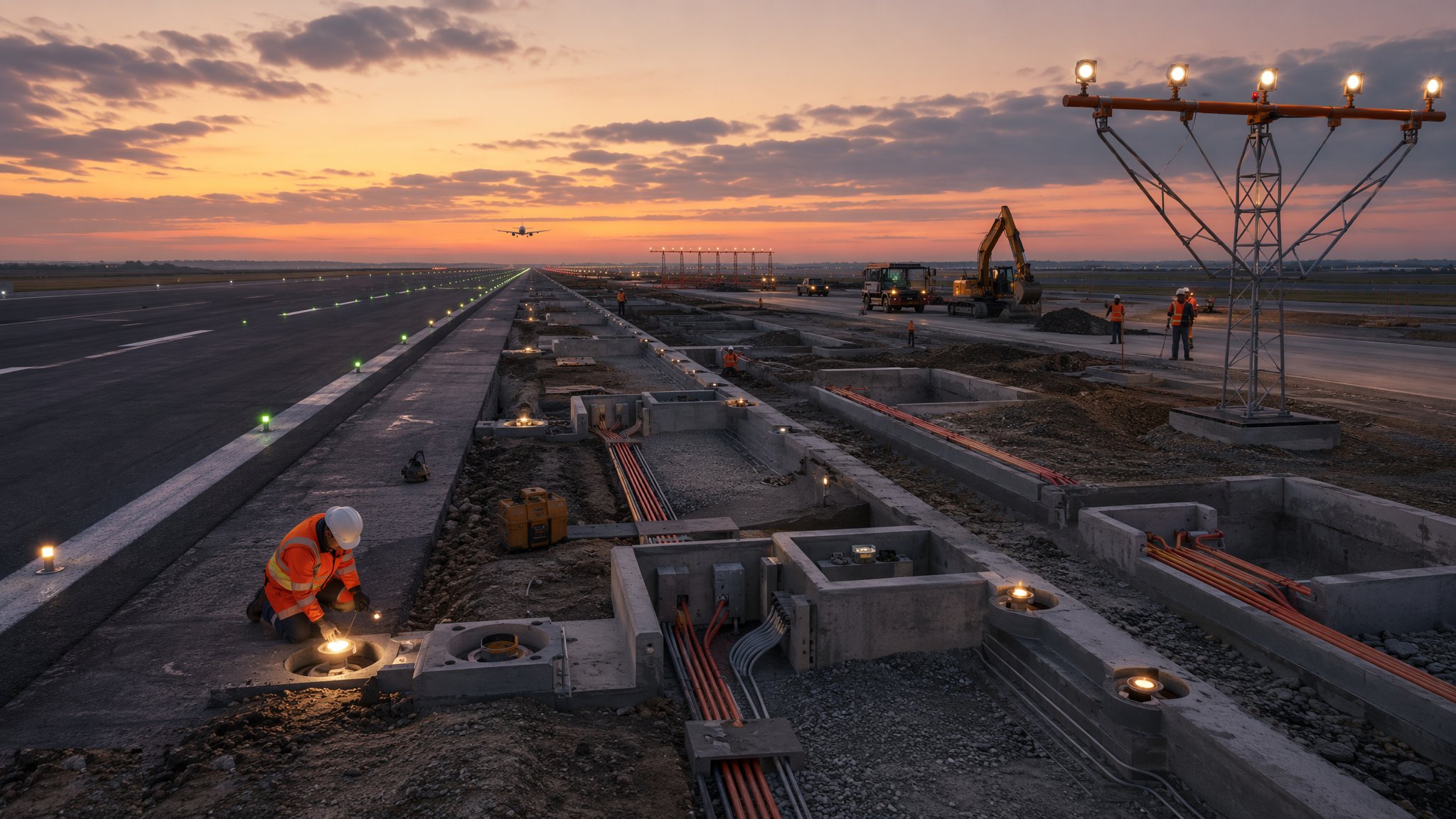
What does belong to the contractor is the civils and the environment around the equipment. Foundations, equipment buildings, access roads, power supplies, ducting, cabling containment, drainage and fencing are all conventional construction, built to the specialists' requirements. The demanding part is that the ground around a navigation aid matters to the equipment. Areas around the antennas are protected: the operator and the regulator define zones within which the ground profile, surfacing, fencing, vehicles, plant, stockpiles and even vegetation are controlled, because objects and surfaces in those areas can affect the guidance the system transmits. The extent of those areas and the rules within them are stated by the operator and the regulator, and they are absolute.
That protection is a live constraint during construction and for the whole life of the airfield. A crane in the wrong place, a spoil heap left overnight, a parked lorry or a temporary hoarding can all be significant. On most projects the operator will require certain works near a system to happen only when it is out of service, and taking it out of service has operational consequences that the airport plans well ahead. After any work, the specialists test the equipment and it is flight-checked from the air before it is returned to service. Nothing about that flight check is a construction activity, and the system is not usable until the regulator and the operator say it is.
How does Instrument landing systems work, step by step?
- 1
Step 1: The regulator and specialists determine siting and configuration
Where the equipment goes, how it is configured and what it is required to achieve are determined by the aviation regulator, the airport operator and the appointed navigation aid specialists. These decisions are made from the runway geometry, the terrain and the operations the airport intends to support, and they are not open to variation by a construction contractor. The project receives the positions and the requirements and builds to them. Any physical conflict discovered on site is referred back to the specialists.
- 2
Step 2: Build foundations, buildings and services to the specialists' requirements
The civils scope is conventional: foundations for the antenna structures, an equipment building or cabin, a resilient power supply with standby provision, earthing, ducting, cabling containment, access road, drainage and security fencing. It is built to the requirements the specialists set, including details such as earthing arrangements and cable segregation that the specialists specify for their own reasons. Everything is surveyed and recorded as installed, since later excavation near a navigation aid is heavily restricted.
- 3
Step 3: Respect the protected areas throughout construction
The airport operator defines areas around the equipment that are protected, and states what is and is not permitted within them. In practice that means no plant, vehicles, stockpiles, temporary structures, hoardings or spoil in those areas without specific permission, and it applies overnight and at weekends as much as during working hours. On most projects the protected areas are marked on the ground and treated exactly like any other airside boundary: owned by a named person, inspected daily, and any breach reported as an incident.
- 4
Step 4: Plan works near a live system with the operator
Where work has to happen close to an operating system, the operator decides whether it can proceed with the system live or whether the system must be taken out of service. Taking it out of service affects what operations the airport can support, so it is planned well ahead and often combined with other work in the same area. Cranes and tall plant near a system are permitted individually. The rule on most projects is simple: nothing goes into or above a protected area without the operator's written agreement for that specific activity.
- 5
Step 5: Specialists install and configure the equipment
The transmitting equipment, antennas, monitoring and control are installed and configured by the appointed navigation aid specialists. Their work includes the calibration and alignment of the system, which is theirs alone and is carried out to procedures held by them and the regulator. The construction team's involvement ends at providing the completed civils, the power supply, the containment and safe access. Nothing about the equipment settings is adjusted or interfered with by anyone else.
- 6
Step 6: Ground testing precedes any flight check
Before the system is checked from the air it is tested on the ground by the specialists, who confirm that the equipment and its monitoring are functioning as required. Ground testing is also where any effect from new construction in the vicinity would first show. If the results are not as expected, the cause is investigated by the specialists, and construction in the area may be part of that investigation - which is another reason the protected areas are taken so seriously during the works.
- 7
Step 7: Flight checking before return to service
The system is checked from the air by a specially equipped aircraft flying the approach and recording what the equipment actually transmits. The flight check is arranged by the operator, carried out by the appointed organisation and assessed against the regulator's requirements. It is a specialist aviation activity, not a construction handover, and the construction team's role is limited to keeping the protected areas clear and providing whatever access is asked for. The system returns to service only when the operator and the regulator accept the results.
- 8
Step 8: Protect the areas for the life of the airfield
The protection does not end at handover. The operator manages the protected areas permanently, controlling vehicle parking, storage, vegetation, surfacing changes and any future construction within them. Periodic re-checking, including further flight checks, is arranged by the operator on a routine cycle and after any significant change nearby. Any future project on the airfield inherits these constraints, and on most projects they are recorded clearly in the handover information so the next team does not have to rediscover them.
What are the benefits of Instrument landing systems?
- Provides approach guidance that allows the airport to operate in conditions it otherwise could not
- Long-established technology with mature specialist support, spares and procedures
- Ground and flight checking give an independent confirmation of performance before service
- Monitoring reports equipment status continuously to the operator
- Civils, buildings and power supplies are conventional construction and can be built by a general contractor
- Protected areas, once established and respected, keep performance stable over the long term
What are the limitations of Instrument landing systems?
- Siting, configuration, calibration and acceptance are entirely outside the contractor's control
- Protected areas around the equipment constrain plant, storage, cranes and future construction permanently
- Work nearby may require the system to be taken out of service, which affects airport operations
- Flight checking has to be arranged and scheduled, and it sits on the critical path to service
- Any unexplained result during testing can put nearby construction activity under investigation
- Constraints are inherited by every future project on the airfield and must be carried in the records
What is Instrument landing systems best suited for?
What plant does Instrument landing systems need?
- Conventional foundation and civils plant, working outside the protected areas
- Equipment buildings or cabins with resilient power supplies and standby generation
- Ducting, containment, earthing systems and cabling to the specialists' requirements
- Access roads, drainage and security fencing serving the installation
- Appointed navigation aid specialists with their own installation and calibration equipment
- Flight check aircraft and organisation arranged by the airport operator
How is Instrument landing systems quality-checked?
- Positions and requirements issued by the specialists and the regulator, built to without variation
- Protected areas marked, owned by a named person, inspected daily and breaches reported as incidents
- Written operator agreement obtained for any plant, storage or crane activity near the installation
- Civils, earthing and containment inspected against the specialists' requirements and recorded as installed
- Ground testing completed by the specialists before any flight check is arranged
- Return to service authorised by the operator and the aviation regulator, with constraints recorded in the handover information