Series-circuit AGL with constant current regulators
Airfield lights are wired in series from constant current regulators, so one failed fitting does not take out a whole string.
Last updated 2026-09-05
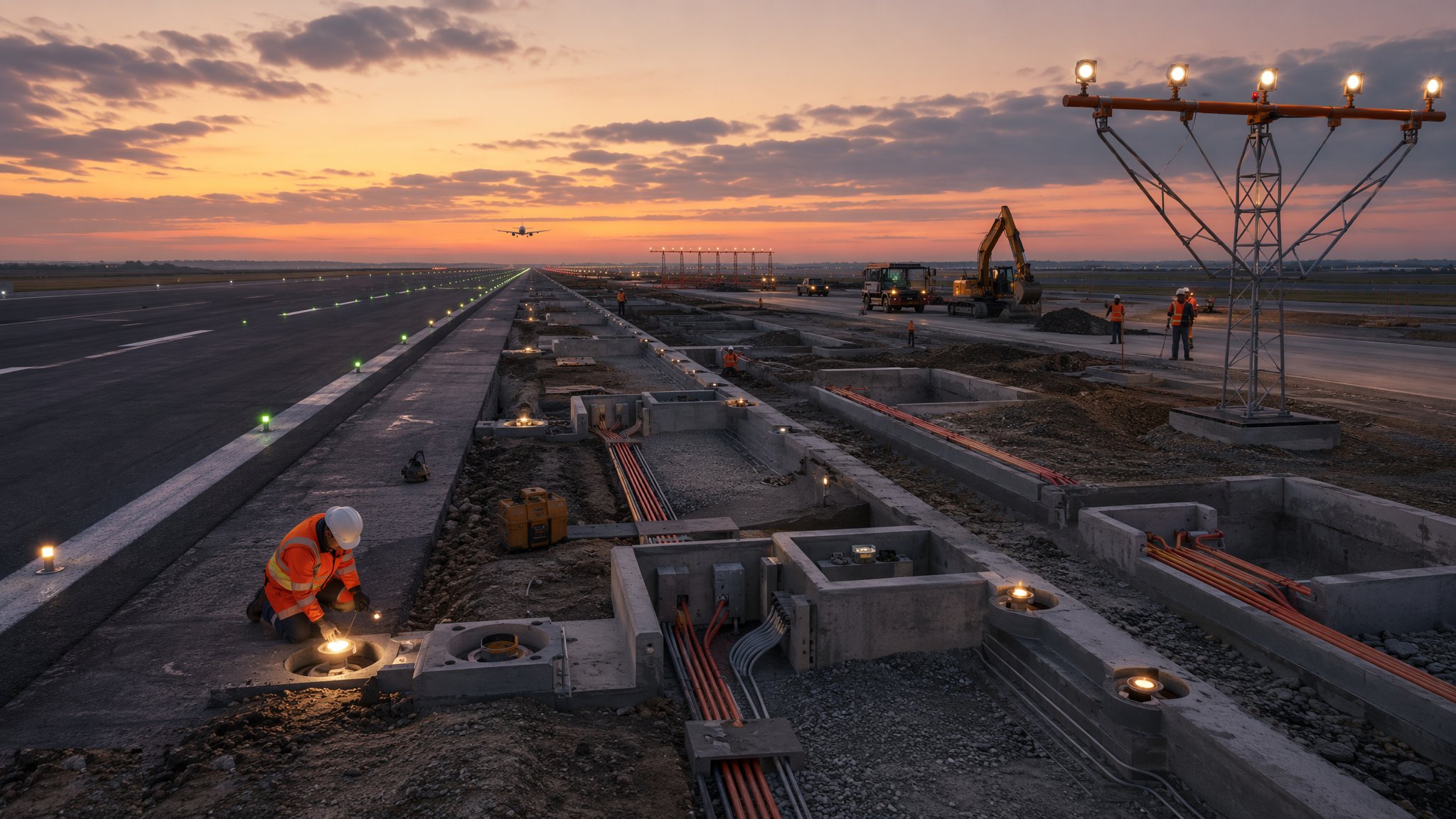
What is Series-circuit AGL with constant current regulators?
Airfield ground lighting is not wired like building lighting. The fittings on a given circuit are connected in series, in a loop, and fed from a constant current regulator in a substation or lighting building. The regulator holds the current in the loop steady rather than holding the voltage steady, and each light is connected to that loop through its own isolating transformer. The reason is reliability over distance. A single loop can run for kilometres and feed a great many fittings, and because the transformers isolate each light from the loop, one failed lamp or fitting does not open the circuit and black out the whole string. That behaviour is the entire point of the arrangement, and it is why the technique has been used on airfields for decades.
The regulator also gives the operator control of brightness. Air traffic control selects the setting appropriate to the conditions and the time of day, and the regulator changes the current in the loop to suit, so every light on that circuit changes together. Circuits are arranged so that a single failure does not remove a critical function, commonly by splitting a run across more than one circuit so that any loss is distributed rather than concentrated. How circuits are grouped, which functions are duplicated and what is required in different operating conditions are decided by the airport operator, the designer and the aviation regulator, and they are not matters a contractor determines on site.
The safety position needs stating plainly and without detail. A series lighting circuit is high-voltage series circuitry and it is lethal. An open series circuit under load is more dangerous still. It is isolated, proved dead, worked on and re-energised only by qualified airfield lighting specialists, working under the airport operator's permit-to-work system, with the regulator locked off and the circuit earthed as their own procedures require. Nobody else touches it - not the civils contractor, not the electrician who wired the terminal, not maintenance staff who are not authorised for this specific work. The procedures, the test methods and the electrical values involved belong to those specialists and to the operator, and they are deliberately not set out here.
How does Series-circuit AGL with constant current regulators work, step by step?
- 1
Step 1: The designer sets the circuit arrangement
What lights sit on which circuit, how the circuits are grouped and what redundancy is provided are design decisions taken by the designer with the airport operator and agreed with the aviation regulator. The arrangement reflects which lighting functions are critical, what has to remain available if a circuit is lost, and how the airfield is operated in poor visibility. On most projects this is fixed early, because it determines the number of regulators, the size of the lighting building and the whole duct and cable layout beneath the pavement.
- 2
Step 2: Regulators are installed and fed from a resilient supply
Constant current regulators are housed in a substation or dedicated lighting building, fed from a supply arranged for resilience so that lighting survives a loss of the incoming mains. Standby generation and uninterruptible supplies are provided to the extent the operator and the regulator require. The building itself is a controlled electrical environment with its own access restrictions, and entry to it is managed under the operator's permit system rather than by whoever holds a site key.
- 3
Step 3: The primary loop is installed in ducts and troughs
The primary series cable runs in ducts, troughs and direct-buried routes beneath and beside the pavement, installed by the civils contractor to the design and proved before surfacing. Draw ropes are left, routes are surveyed as installed, and chambers are positioned where they can be reached for maintenance without a pavement closure wherever the design allows. The civils work is conventional; the cabling into the circuit is not, and the boundary between the two is defined in the contract before either starts.
- 4
Step 4: Each fitting is connected through an isolating transformer
Every light is connected to the series loop through its own isolating transformer, housed in the fitting's base or a nearby chamber. This is what allows a lamp to fail without opening the loop. It also means the fitting itself is separated from the primary circuit, which is central to how the specialists work on individual lights. The transformers, connectors and terminations are specialist components installed by the lighting contractor to the manufacturer's requirements.
- 5
Step 5: Air traffic control selects the brightness
The operator controls lighting through a control and monitoring system, with air traffic control selecting the setting appropriate to the conditions. The regulator responds by changing the current in the loop, so all the lights on a circuit change together and remain matched to one another. Which settings are used in which conditions is an operational matter for air traffic control and the operator. The system also reports circuit and lamp status back so the operator knows what is working before anyone drives out to look.
- 6
Step 6: All work is done under permit by qualified specialists
Any work on a series circuit is carried out only by qualified airfield lighting specialists under the airport operator's permit-to-work system. The circuit is taken out of service by the operator, isolated at the regulator, locked off, proved dead and earthed in accordance with the specialists' own procedures before anything is opened. No detail of that procedure, and no electrical values, belong in a general description of the work - they are held by the operator and the specialist contractor and are followed exactly. Anyone not authorised for this specific work stays away from it.
- 7
Step 7: The civils contractor works around live circuits, not on them
On most projects the civils contractor is excavating, ducting, coring and paving in the same ground as live series cables. Cable routes are located and marked before any excavation, permits are obtained, and the operator decides whether a circuit must be taken out of service before the work proceeds. Where a circuit stays live, the exclusion around it is set by the operator. Damage to a cable is reported immediately and never investigated by the person who caused it. This discipline is the practical interface between construction and lighting on every airfield project.
- 8
Step 8: Circuits are proved and returned to service by the operator
After any work, the circuit is tested and proved by the lighting specialists and returned to service by the airport operator, who confirms through the control and monitoring system that everything expected to be lit is lit. Until the operator has accepted it back, the affected area remains out of use or restricted as the operator directs. Records of the work, the tests and the result are handed to the operator because they form part of the airfield's maintenance history.
What are the benefits of Series-circuit AGL with constant current regulators?
- One failed lamp or fitting does not extinguish the rest of the circuit
- Constant current keeps every light on a circuit matched in output to the others
- A single loop can serve long runs and many fittings, which suits the scale of an airfield
- Brightness is selectable by air traffic control to suit the conditions
- Control and monitoring systems report circuit and lamp status without a physical inspection
- A long-established arrangement with mature components, spares and specialist skills available
What are the limitations of Series-circuit AGL with constant current regulators?
- High-voltage series circuitry that is lethal and may only be worked on by qualified specialists under permit
- Faults on a long loop can be time-consuming to locate and usually need the circuit out of service
- Requires dedicated regulator buildings, resilient supplies and standby generation
- Design, redundancy and circuit grouping are fixed by the designer, operator and regulator, not adjustable on site
- Civils works in the same ground must locate, avoid and often isolate live cables, which adds programme
- Specialist components, terminations and skills make it more expensive than conventional lighting installation
What is Series-circuit AGL with constant current regulators best suited for?
What plant does Series-circuit AGL with constant current regulators need?
- Constant current regulators housed in a substation or dedicated lighting building
- Resilient supply arrangements with standby generation and uninterruptible supplies
- Primary series cabling, isolating transformers and specialist connectors
- Control and monitoring system with an air traffic control interface
- Duct, trough and chamber networks installed and proved by the civils contractor
- Cable location equipment and the operator's permit-to-work and lock-off system
How is Series-circuit AGL with constant current regulators quality-checked?
- Circuit arrangement and redundancy fixed by the designer, operator and aviation regulator before installation
- Duct and cable routes proved, surveyed and recorded as installed before surfacing
- All circuit work carried out under the operator's permit-to-work by qualified specialists only
- Cable routes located and marked before any excavation, with permits obtained for work nearby
- Circuit testing and proving completed by the specialists, with results handed to the operator
- Return to service authorised by the airport operator and confirmed on the control and monitoring system
More airfield ground lighting & navigational aids methods
Next method
Inset pavement luminaires