Inset pavement luminaires
Fittings set flush into the pavement, where aircraft run straight over them and the environment is about as hostile as it gets.
Last updated 2026-09-05
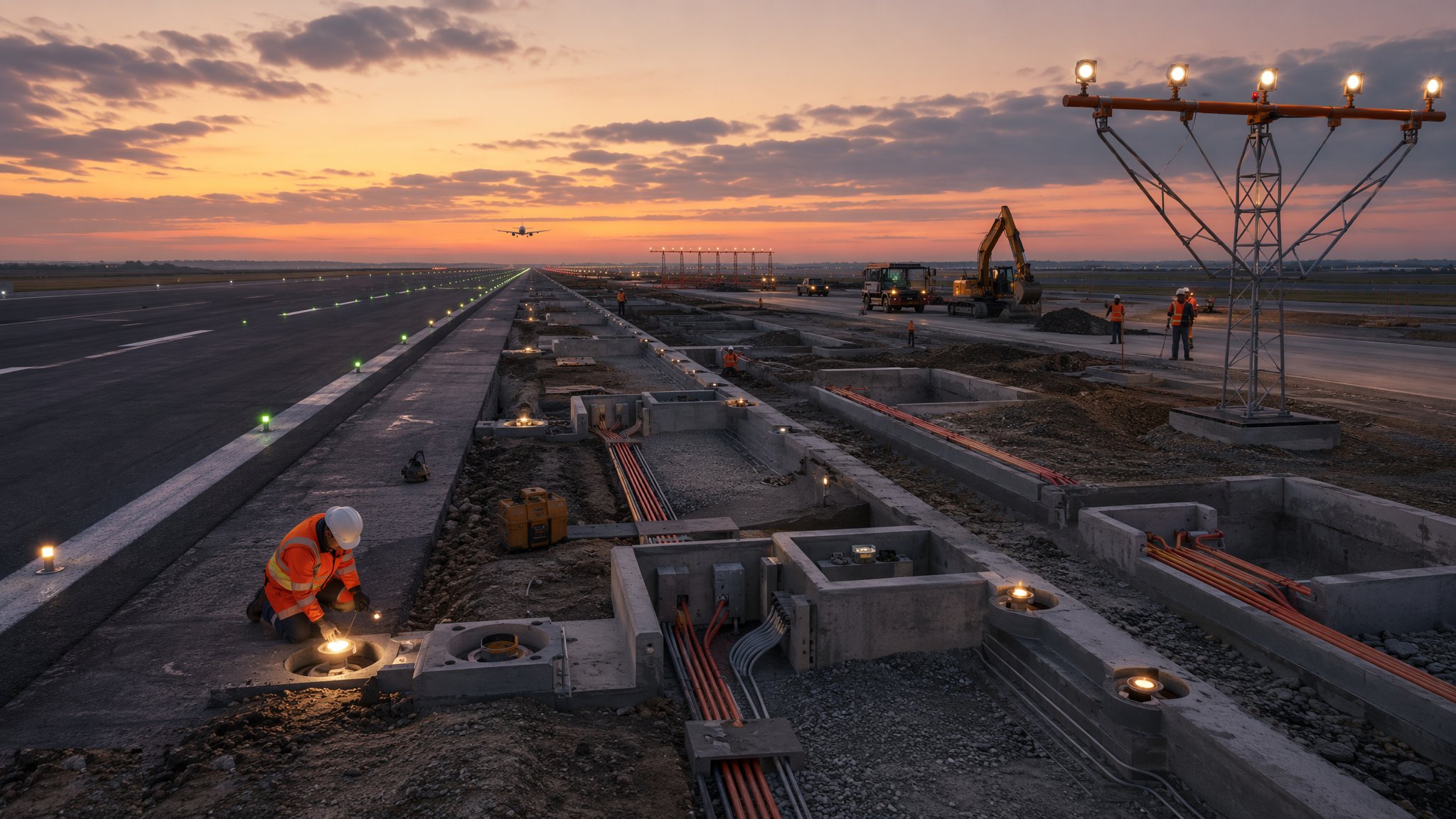
What is Inset pavement luminaires?
Inset luminaires are the lights installed flush within the pavement itself, used wherever an aircraft has to run over the light rather than past it. Each fitting sits in a base can cast or cored into the pavement, connected to the series circuit through its own isolating transformer, and finished so that its top is level with the surrounding surface within the tolerance the specification sets. They exist because there is no alternative: on a runway or a taxiway centreline there is nothing to mount a light on, so the light has to be in the ground.
That puts the fitting in a punishing environment. It is run over by aircraft, so it takes direct wheel loading and the shear that goes with a turning tyre. It is blasted by jet efflux and by de-icing chemicals. It heats up in service and is then cooled by rain or snow, so the seal between the fitting and the pavement is worked constantly. Water sitting in a base can is a common cause of failure, so drainage of the base and the integrity of the seal matter as much as the light itself. Standing water, ice and freeze-thaw all attack the joint between a hard metal fitting and the pavement around it.
Installation is therefore as much a pavement operation as an electrical one. Coring or casting the base accurately, bedding it at the right level, grouting or sealing it with the specified product, and finishing the surrounding surface without leaving a lip or a depression are what determine whether the fitting lasts. On an operating airfield all of this happens inside a possession, which is why inset light replacement is one of the most common reasons for a night runway closure. The connection into the series circuit is high-voltage specialist work carried out under the operator's permit system, and the light is proved and returned to service by the operator.
How does Inset pavement luminaires work, step by step?
- 1
Step 1: The designer fixes the layout
Where inset lights go, which functions they serve and how they are grouped onto circuits are set by the designer with the airport operator and agreed with the aviation regulator. Position on the ground is surveyed from the design, not judged on site, because these fittings define what a pilot sees. The civils and lighting contractors work to that setting-out and do not vary it. Any conflict found on site - a duct, a drain, an existing base - is referred back rather than resolved by moving the light.
- 2
Step 2: Install or core the base can
On new pavement the base can is cast into the construction; on existing pavement it is installed by coring a hole to the required depth and diameter. Coring is a controlled operation: the core is taken cleanly, the arisings and water are collected rather than washed away, and any reinforcement or buried service encountered stops the work for a decision. The base is set with its top at the level the fitting requires, plumb and square to the surface, and held while the surround is placed. Getting the base level wrong is the mistake that cannot be corrected later.
- 3
Step 3: Form the duct and cable connection
The base is connected to the circuit through ducts or a slot cut in the pavement, with the cable and isolating transformer installed by the lighting specialist. Slots are cut, cleaned, dried and sealed with the specified product so that they do not become a water path into the base. Where the connection runs to a chamber, the chamber is positioned so it can be reached for maintenance. Every route is recorded before it is covered, because the next team to work on this light will only have the records.
- 4
Step 4: Grout, seal and drain the base
The base is grouted or sealed into the pavement with the product the specification names, mixed and placed to its stated working time and cured before trafficking. The seal has to accommodate the thermal movement between a metal fitting and the pavement around it without opening. Drainage of the base is provided as the design requires, because a base can that fills with water will fail electrically and will damage the fitting. On most projects this step, not the light, is where the durability of the installation is decided.
- 5
Step 5: Fit and set the luminaire flush
The luminaire is bolted into the base with the specified fixings, torqued as the manufacturer requires, and set so that its top is flush with the surrounding surface within the specified tolerance. It is aligned to the design orientation using the setting-out, since these fittings are directional and their aiming is part of the design. The surrounding surface is finished so there is no lip, no depression and no ponding. Fixings, gaskets and seals are new items, not reused ones.
- 6
Step 6: Connect and prove under the operator's permit system
The connection into the series circuit is made by qualified airfield lighting specialists working under the airport operator's permit-to-work, with the circuit isolated by the operator beforehand. This is high-voltage series circuitry and no one else goes near it. The fitting is proved and the circuit tested by those specialists, and the light is returned to service by the operator, who confirms it on the control and monitoring system. Until that happens the operator decides what restriction applies to the area.
- 7
Step 7: Clean, sweep and hand back within the window
Coring produces slurry, cut slots produce dust and fixings produce small loose items, all of them foreign object debris on a trafficked pavement. Arisings and water are collected as the work proceeds, the area is mechanically swept and then walked, and fixings and tools are tallied and reconciled. Because inset work almost always happens in a night possession, this cleaning is planned into the window rather than added to the end of it, and the pavement is handed back jointly with the operator.
- 8
Step 8: Maintain, monitor and plan replacement
Inset fittings are consumables in a way that other lighting is not. Lenses abrade, seals age, bases take water and fixings loosen under repeated loading. The operator monitors circuit and lamp status through the control system and inspects fittings physically on a routine cycle. Replacement is planned into possessions in batches rather than done one light at a time, because the cost of the closure usually exceeds the cost of the fitting. Records of each base, its position and its history make that planning possible.
What are the benefits of Inset pavement luminaires?
- The only workable solution where aircraft have to pass directly over the lit position
- Flush installation leaves nothing standing above the pavement to be struck
- Robust sealed fittings designed specifically for direct wheel loading and jet blast
- Connected through isolating transformers, so a failed fitting does not take out the circuit
- Status is reported back to the operator through the control and monitoring system
- Bases can be reused when the fitting is replaced, provided the seal and drainage remain sound
What are the limitations of Inset pavement luminaires?
- Installation and replacement almost always require a pavement closure or a night possession
- The environment is severe - wheel loading, jet blast, de-icing chemicals, thermal cycling and freeze-thaw
- Water in the base can is a persistent failure mode and depends entirely on seal and drainage quality
- Coring into existing pavement risks striking reinforcement, ducts or existing cables
- Flush setting and orientation are unforgiving, and errors cannot be corrected without redoing the base
- High-voltage series connection work is restricted to specialists under the operator's permit system
What is Inset pavement luminaires best suited for?
What plant does Inset pavement luminaires need?
- Core drilling rigs with slurry and water collection, sized to the base can
- Slot cutting equipment with dust and water control for cable routes
- Base cans, isolating transformers, connectors and specified sealing and grouting products
- Torque tools and new fixings, gaskets and seals to the manufacturer's requirement
- Survey and setting-out equipment for position, level and orientation
- Mechanical sweeper, vacuum equipment and mobile lighting for possession working
How is Inset pavement luminaires quality-checked?
- Position, level and orientation set out from the design survey and checked before grouting
- Base can drainage provided and sealing product mixed, placed and cured to its stated requirements
- Fitting confirmed flush within the specified tolerance, with no lip, depression or ponding
- Fixings new and torqued to the manufacturer's requirement, with seals and gaskets renewed
- Circuit connection, testing and proving carried out by qualified specialists under permit
- Return to service authorised by the operator, with full sweep, debris walk and fixings tally recorded