Pier-connected terminals
A central processor with long fingers of gates running off it - simple to build, easy to extend, and hard on passengers' legs.
Last updated 2026-09-05
What is Pier-connected terminals?
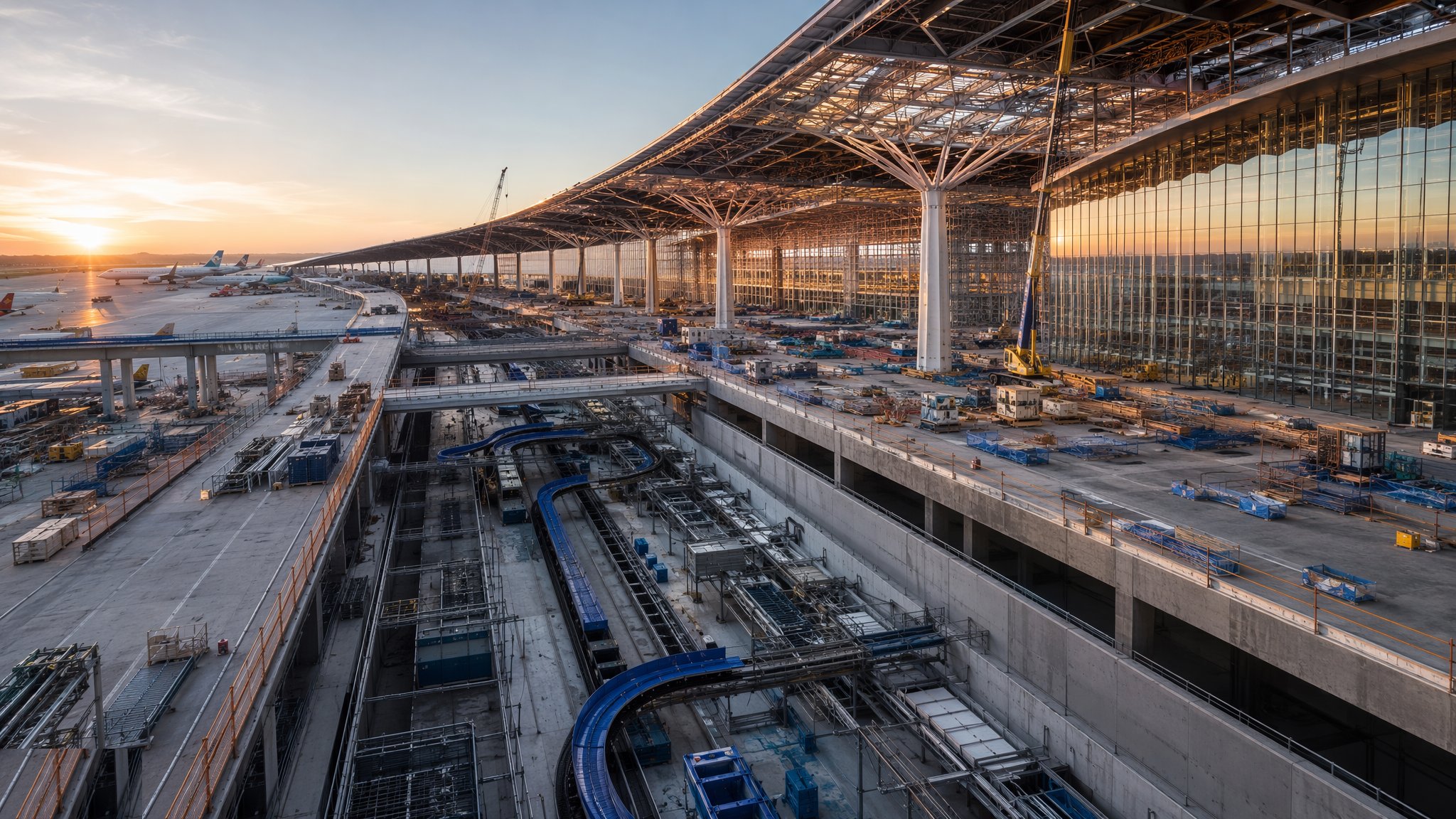
The pier configuration is the most common terminal arrangement in the world, and for good reason. All the processing happens in one central building - check-in, security, baggage, immigration, the main retail concentration - and from that processor one or more long narrow piers extend out onto the apron with aircraft parked along both sides. Passengers process once in the centre, then walk out along the pier to their gate. Everything about the arrangement follows from that single diagram: one set of processing facilities to build and staff, one security operation, one baggage system, and gates added by making the pier longer.
The construction consequence is that a pier terminal separates neatly into two very different kinds of building. The processor is a complex, heavily serviced, structurally demanding building with large column-free halls, deep basements for baggage handling, and dense mechanical and electrical plant. The pier is a long, narrow, highly repetitive building with a simple structural bay repeated dozens of times, moderate services and a simple envelope. Repetition on that scale is a gift to a construction programme. Once the first few bays are proven, the pier can be built as a rolling operation with the structure, envelope, services and fit-out following each other along its length, and the learning curve pays back over and over.
The weakness is walking distance, and it is inherent rather than fixable. Gates furthest from the processor can be a long way out, and the passenger who clears security last is the one who has furthest to walk. Operators mitigate it with moving walkways, with careful gate allocation, and with secondary facilities part way along the pier, but the distance remains. Piers also constrain apron layout: the aircraft parked along a pier need taxilanes between adjacent piers, and the spacing of those piers fixes how the apron can be used for the life of the building. Extending a pier that is already long makes the walking problem worse, which is usually the point at which an operator starts considering a satellite instead.
How does Pier-connected terminals work, step by step?
- 1
Step 1: Fix the configuration against the operator's forecast
The choice of a pier arrangement, the number of piers, their length and the gate mix is settled with the airport operator against its traffic forecast and its airline mix. The processor is sized for peak passenger flows and the piers are sized for aircraft stands. Expansion is planned in at this stage: how the pier will be extended later, where the construction joint and the temporary end wall will be, and how a future extension will be built against an operational pier without closing it.
- 2
Step 2: Coordinate the building with the apron and the taxilanes
The pier position dictates stand layout, taxilane clearances and aircraft manoeuvring, and those requirements are set by the aviation regulator and the airport operator. The building geometry is coordinated with them before the design is fixed, because the apron requirements are the ones that cannot move. Fuel hydrants, ground power, stand equipment, service roads and the airside road crossings all get located at the same time, since they run underneath and alongside the pier.
- 3
Step 3: Build the substructure and the baggage basement
The processor usually needs the deepest and most complex substructure on the project, because the baggage handling system sits below the check-in hall and needs headroom, tunnels and connections running out towards the piers. Excavation, groundwater control and structural works for that basement drive the early programme. The pier substructure is far simpler and highly repetitive, typically foundations and a service trench repeated bay after bay along its length.
- 4
Step 4: Erect the processor structure with its large column-free spans
The processor carries the long-span roof over the check-in and security halls, and its construction is the most demanding structural work on the project. It proceeds alongside the pier rather than before it, since the two are largely independent until they meet. Craneage, laydown and airside access all have to be shared between the two operations, and the sequence is planned so that neither blocks the other.
- 5
Step 5: Roll the pier structure out bay by bay
The pier is built as a repeating bay: frame, floor, roof, envelope. Because the bay repeats, the operation becomes a production line moving along the pier, and each trade follows the one in front at a settled rate. The first few bays are treated as the proving run, with details tested and problems designed out before the rate is established. That rolling sequence is the main commercial advantage of the pier form and it is worth protecting against interruption.
- 6
Step 6: Install the baggage system and the services running the length of the pier
Baggage conveyors, sortation equipment, ventilation, power distribution, fire systems, security and communications all run from the processor out along the pier, so the pier acts as a distribution spine. Those long service runs are installed behind the structure and envelope in the same rolling sequence. Access for installing and later maintaining them is designed in, because a service run buried above a finished ceiling along a pier is expensive to reach.
- 7
Step 7: Fit out the gates and install the airbridges
Gate lounges, seating, gate desks, boarding doors and passenger boarding bridges are installed along the pier. Airbridges are heavy items that need airside crane access and commissioning against actual aircraft door positions, so their installation is coordinated with the airport operator and with whatever apron works are still under way. Moving walkways, if the walking distance calls for them, are installed as part of the same fit-out.
- 8
Step 8: Commission end to end and prove the passenger journey
Systems are commissioned as complete journeys rather than as separate installations: the baggage system from check-in to the make-up area and out to the stand, the security and boarding systems, wayfinding, fire and smoke control across the whole processor and pier, and the evacuation strategy for the far end of the pier. Trials with volunteers walking the journey expose wayfinding and capacity problems that no drawing review finds. The operator accepts the building on the strength of those trials.
What are the benefits of Pier-connected terminals?
- One set of processing facilities to build, staff and maintain, which is efficient for the operator
- Highly repetitive pier construction gives a fast rolling programme and a strong learning curve
- Straightforward to extend by lengthening the pier or adding another one
- Simple, well-understood passenger journey with a single processing point
- Aircraft park along both sides of the pier, giving a good number of stands per metre of building
- Phased delivery is natural, since a pier can be brought into use before later bays are complete
What are the limitations of Pier-connected terminals?
- Long walking distances to the furthest gates, and the problem worsens with every extension
- Pier spacing fixes the apron and taxilane layout for the life of the building
- Peak loads concentrate in the single processor, so a failure there affects the whole terminal
- Long service runs out along the pier are expensive to install and to maintain
- Extending an operational pier means building against a live building and a live apron
- Aircraft manoeuvring around piers is less efficient than around a detached concourse
What is Pier-connected terminals best suited for?
What plant does Pier-connected terminals need?
- Piling and excavation plant for the processor basement and baggage tunnels
- Tower and mobile cranes serving both the processor and the rolling pier operation
- Steel and precast erection plant working bay by bay along the pier
- Mobile elevating work platforms and material handling for the rolling fit-out
- Airside cranage and handling equipment for passenger boarding bridge installation
- Commissioning and testing equipment for baggage, fire, security and communications systems
How is Pier-connected terminals quality-checked?
- Building geometry checked against the apron, stand and taxilane requirements before design freeze
- First pier bays treated as a proving run with details signed off before the rate is set
- Setting out surveyed along the full pier length, since errors accumulate over repeated bays
- Service runs surveyed and recorded before ceilings close, with maintenance access proven
- Airbridge positions verified against actual aircraft door geometry with the operator
- End to end system commissioning and passenger journey trials witnessed and recorded