Emergency and reactive airside repairs
Damage is found, part of the airfield closes, and the only measure of success is how fast it safely reopens.
Last updated 2026-09-05
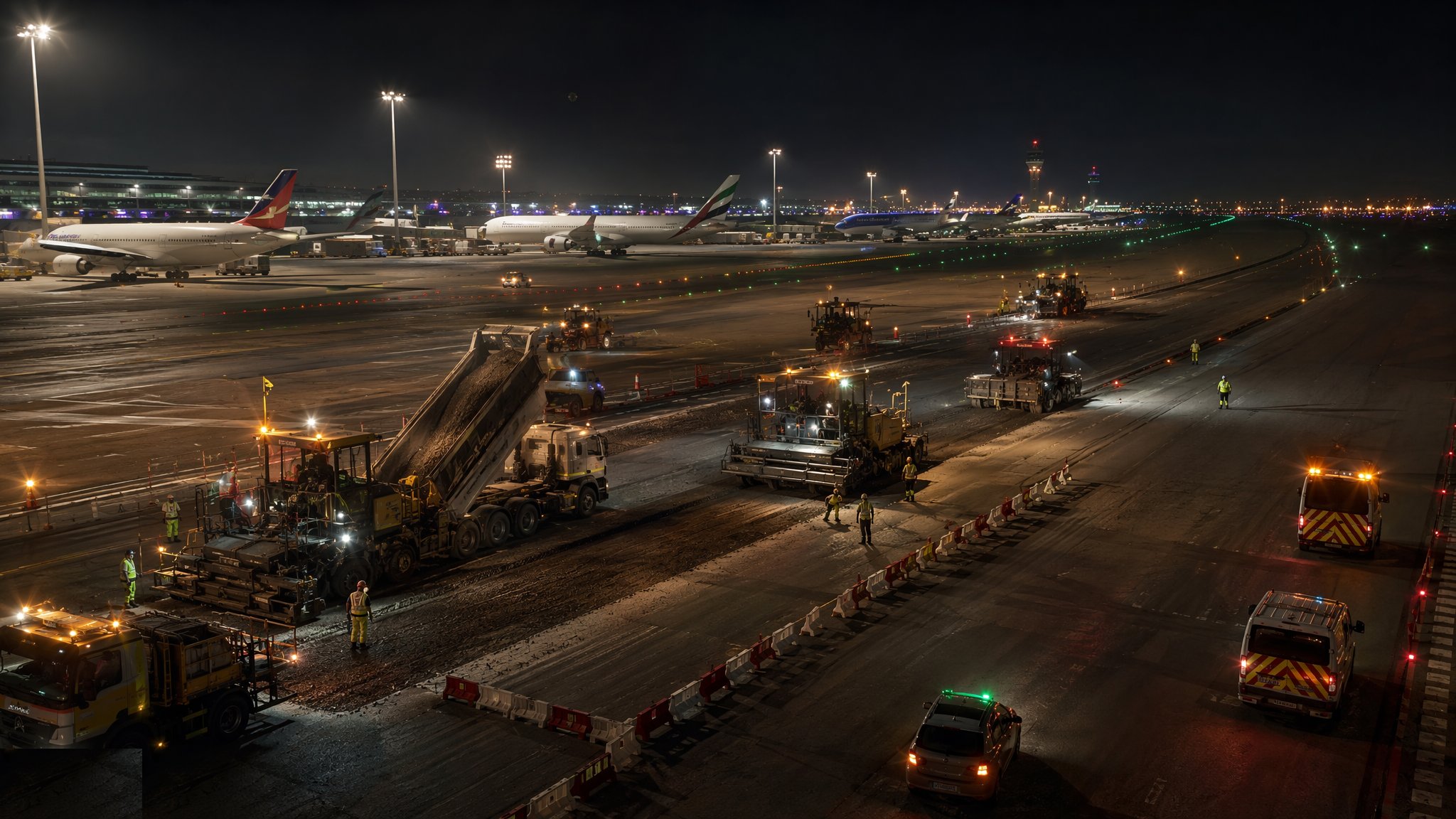
What is Emergency and reactive airside repairs?
Emergency and reactive airside repairs are what happens when a pavement fails, a light is damaged, a slab lifts, a joint opens or an inspection finds something that cannot wait. The airport operator closes whatever it has to close - a stand, a taxiway, a length of runway - and the airfield operates in a reduced state until the repair is done. Every hour of that state costs the operator capacity, and in some cases it stops movements altogether. The whole method is therefore built around one objective: return the surface to service safely, as fast as possible, without compromising what an aircraft will meet when it does.
That objective drives the material choice more than anything else. Reactive repairs use products selected to gain strength and be trafficked immediately rather than conventional materials that need time. The trade-off is accepted openly: these products cost far more, and the repair may be an interim measure that will be replaced properly in a planned window later. The operator makes that call. What matters in the moment is that the repair is sound, flush with the surrounding surface, free of loose material and able to take aircraft loading the moment the closure lifts.
The second thing that makes reactive work different is that there is no time to plan. The response depends on things being ready before the call comes: a stocked store of repair materials, plant that is already airside-cleared and permitted, a team whose passes and driving authorisations are current, and a standing method statement that only needs the location filling in. On most projects with a maintenance contract, that readiness is the deliverable. The constants of airside work still apply in full - security passes, escorting, foreign object debris control, radio discipline and immediate handback - and they are, if anything, tested harder under time pressure.
How does Emergency and reactive airside repairs work, step by step?
- 1
Step 1: Respond to the call and confirm the closure
The operator identifies the damage, closes the affected area and calls the maintenance team. Before anyone moves, the extent of the closure, the access route and the escort arrangements are confirmed. The team goes to the location under escort with air traffic control clearance for every movement, exactly as it would for a planned possession. Speed is not permitted to erode any of the access controls, and on most projects the first person on site is the one who owns the radio.
- 2
Step 2: Assess the damage and agree the repair with the operator
The damage is inspected and its cause considered, because a repair that treats a symptom will be back. The team and the operator agree what repair is appropriate for the time available: a permanent reconstruction if the closure allows it, or an interim repair that returns the surface to service now with a planned permanent replacement later. The decision belongs to the operator, informed by the designer where the failure is structural. That decision is recorded, along with any restriction the operator wants applied when the area reopens.
- 3
Step 3: Mobilise pre-cleared plant and stocked materials
The response depends on what was ready beforehand. Repair materials, primers, aggregates and mixing equipment are held in an airside store with stock rotated so nothing is out of date when it is needed. Plant is kept airside-cleared, permitted, fuelled and serviced. Radios are charged. The team's passes and airside driving authorisations are current. On most maintenance contracts this readiness is checked routinely, because the time to discover an expired permit is not at two in the morning with a taxiway closed.
- 4
Step 4: Prepare the repair area properly, despite the pressure
The failure is cut out or broken out to sound material, the edges are squared, and the base is cleaned and dried as the material requires. This is the step that time pressure attacks, and it is the step that decides whether the repair lasts. Loose material is removed rather than compacted in. Where water is present it is dealt with, because most rapid materials will not bond to a wet or contaminated surface. On most projects the supervisor's job during a reactive repair is to protect the preparation from the clock.
- 5
Step 5: Place a material chosen for immediate return to service
Rapid-setting and rapid-strength products are used so the surface can take aircraft as soon as the closure lifts. They are mixed and placed strictly to the manufacturer's working times, which are short and unforgiving, so the batch size, the number of people and the sequence are all set to match. The finished repair is brought flush with the surrounding surface and its texture matched as closely as the product allows, because a step or a smooth patch is a defect in its own right. Curing and trafficking times are taken from the product data and stated to the operator.
- 6
Step 6: Repair or make safe any lighting and services affected
Damage to pavement frequently damages what is buried in it. Where a ground light, its base, its cabling or a duct is affected, the specialist lighting contractor deals with it under the operator's permit system - series-circuit airfield ground lighting is high-voltage work and is isolated and worked on only by qualified specialists. If a light cannot be restored before reopening, the operator decides what restriction applies to the area until it is. That is an operational decision, and the repair team's role is to report the condition accurately and promptly.
- 7
Step 7: Reinstate markings and clean to an absolute standard
Markings cut or covered by the repair are reinstated to the operator's layout, using rapid products where necessary. The area and every route used are swept mechanically and then walked. Cut-out material, packaging, mixing waste and tools are all removed and reconciled. Under time pressure this is where standards slip, so on most projects the sweep and the debris walk are given a named owner who is not doing anything else and who signs for the area.
- 8
Step 8: Hand back and record the repair for the permanent works
The area is handed back jointly with the operator, with the trafficking time and any interim status clearly stated. If the repair is interim, it is logged with its location, extent, material and date so that it can be programmed into a planned possession for permanent replacement. The cause is recorded too, because a pattern of reactive repairs in one area is usually telling the operator something about the pavement that a planned investigation should follow up.
What are the benefits of Emergency and reactive airside repairs?
- Returns a closed runway, taxiway or stand to service in the shortest possible time
- Rapid materials allow immediate trafficking, so the closure ends as soon as the work does
- A pre-cleared team and stocked store turn an emergency into a rehearsed operation
- Prevents a small defect becoming a large failure or a debris hazard
- Interim repairs buy time so that permanent reconstruction can be planned properly
What are the limitations of Emergency and reactive airside repairs?
- Rapid-setting materials are expensive and have very short working times
- An interim repair often has to be replaced permanently in a later planned window
- Preparation quality is under constant pressure from the clock, and preparation governs durability
- Wet, cold or contaminated conditions can defeat the materials at the worst possible moment
- Depends entirely on readiness - expired passes, permits or stock defeat the response
- Work is unplanned, often at night, and fatigue management is difficult to apply
What is Emergency and reactive airside repairs best suited for?
What plant does Emergency and reactive airside repairs need?
- Airside-cleared response vehicle kept fuelled, permitted and equipped at all times
- Cutting, breaking and compaction equipment sized for small localised repairs
- Forced-action mixers and placing tools matched to rapid-setting products
- Airside store of repair materials, primers and aggregates with stock rotation
- Mobile lighting, sweeper and line marking equipment available on call
- Charged radios with spares, and a specialist lighting contractor on the same call-out arrangement
How is Emergency and reactive airside repairs quality-checked?
- Closure and access confirmed, with radio clearance for every movement despite the urgency
- Repair type agreed with the airport operator and recorded, including any interim status
- Materials in date, stored correctly and mixed strictly to the stated working times
- Repair confirmed flush with the surrounding surface, with texture matched as far as the product allows
- Trafficking time stated to the operator in writing before handback
- Documented sweep, debris walk and tool reconciliation, with the repair logged for permanent replacement