Stand and apron works under closures
Individual stands are taken out of service one at a time, and every day a stand is closed the airport is paying for it.
Last updated 2026-09-05
What is Stand and apron works under closures?
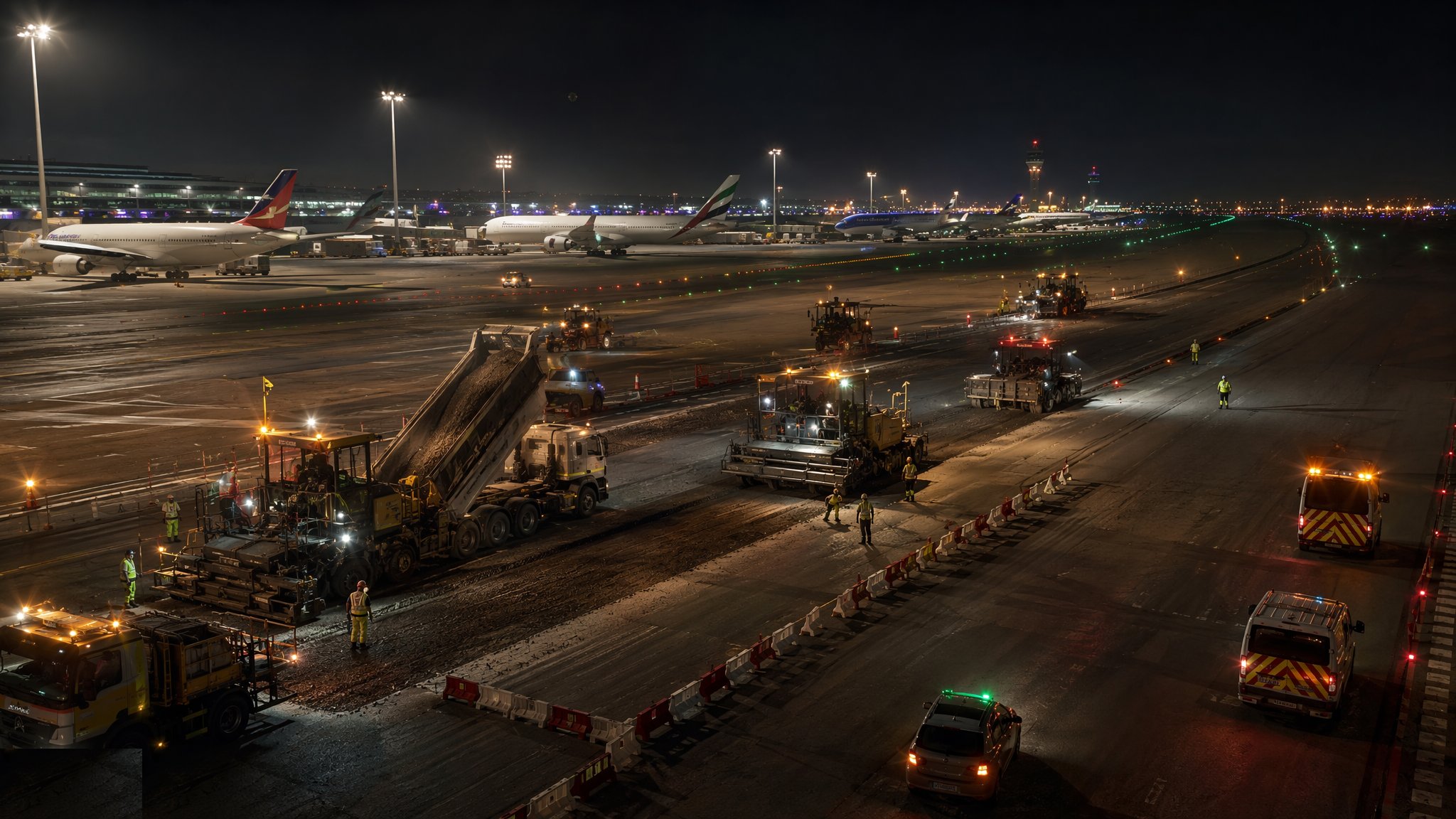
Apron work is rarely done by closing an apron. It is done by taking individual aircraft stands out of service, one or a few at a time, while the stands around them stay in use. The closed stand becomes the works area; everything outside it remains a live apron with aircraft manoeuvring, ground handling vehicles moving, fuel being delivered and passengers walking. That single fact shapes the whole method. The works area has to be physically bounded, the boundary has to be visible to a pilot and to a driver, and the work inside it has to be organised so that plant and people never need to stray outside it.
The commercial driver is different from runway work as well. A closed stand is a stand that cannot be sold. The airport operator plans stand closures around the schedule, and the number of stands that can be down at once is decided by the operator on the basis of traffic, not by the contractor on the basis of programme. On most projects that produces a rolling sequence: a small group of stands closed, worked and returned, then the next group, with the sequence agreed weeks ahead and reviewed constantly against the flight schedule. Handback of each stand is a hard date because the schedule has already been built on it.
Working inside a live apron also means working alongside people who are not part of the project. Ground handlers, fuellers, cleaners and crews all move through the area on their own routines and to their own pressures. Pedestrian and vehicle routes past the works are agreed and marked. Site deliveries follow escorted routes and defined timings so they do not conflict with turnarounds. Foreign object debris control matters as much here as anywhere on the airfield, because jet engines are started a short distance from the works and loose material does not stay where it is dropped. As with all airside work, security passes, escorting, radio discipline and immediate handback are constants rather than extras.
How does Stand and apron works under closures work, step by step?
- 1
Step 1: Agree the stand closure sequence with the operator
The contractor proposes a sequence; the airport operator decides it. How many stands can be out at once, which ones, in what order and for how long are operational decisions taken against the flight schedule, the aircraft types that use each stand and the pressure on the remaining stands. On most projects the sequence is fixed some weeks ahead and then confirmed week by week, because a schedule change can pull a stand back into service at short notice. The programme has to be built so that it can absorb that without stranding an open excavation.
- 2
Step 2: Establish a bounded, visible works area
The closed stand is physically defined on the ground with barriers, cones and signage to the pattern the operator uses, and stand markings and any stand guidance are put out of use so no aircraft is directed onto it. The boundary is set where the operator says it goes. Everything the project needs - plant, materials, welfare, storage - sits inside that boundary or in a compound elsewhere, never spread onto the live apron. The barrier line is checked at the start and end of every shift because apron traffic knocks cones over routinely and a gap in the line is an invitation.
- 3
Step 3: Brief the works to the people who share the apron
A stand closure affects handling agents, fuel operators, crews and airport staff long before it affects the contractor. The closure, its extent, the alternative routes and the timings are communicated by the operator and reinforced on site. Contractor personnel are briefed on which aircraft movements will happen around them, what the warning signals mean, and what to do when an aircraft is being pushed back or a turnaround starts nearby. On most projects a short daily briefing covers what is happening on the neighbouring stands that day.
- 4
Step 4: Control access, escorting and deliveries
Everyone on the apron holds a current airside pass, and anyone without one is escorted at the ratio the operator sets. Deliveries are booked, routed and timed so that vehicles are not waiting on live taxiways or crossing active areas during peak movements. Drivers hold the airside driving authorisation for the areas they enter, and the routes they use are the routes on the permit. On most projects a single person on site owns access control for the works area and knows at any moment who and what is inside it.
- 5
Step 5: Break out and reconstruct within the stand
The work itself is conventional heavy pavement construction - breaking out, excavating, reworking formation, drainage, reinstating slabs or overlay - but confined to the stand footprint and organised so that the excavation can be made safe at the end of every shift. Materials are chosen with the handback date in mind, which often means early-strength products for the last layers. Excavations at the boundary are given particular attention because they sit right against a trafficked surface. Spoil and materials are removed rather than stockpiled where jet blast can reach them.
- 6
Step 6: Manage jet blast, noise and the neighbours
Adjacent stands stay in use, so people and equipment in the works area are exposed to engine noise and to jet blast from aircraft manoeuvring nearby. Lightweight items, sheeting, insulation, empty containers and loose barriers are secured or removed, not left to be found later. Hearing protection and high-visibility clothing are worn throughout. Where the operator requires it, work stops or people withdraw to a defined position while a neighbouring aircraft is started or pushed back. The operator sets those rules and they are followed without negotiation.
- 7
Step 7: Reinstate stand markings, services and equipment
A stand is not just pavement. It carries markings, lighting, drainage, fuel hydrants, ground power and often a passenger bridge and its services. Everything disturbed is reinstated and proved before the stand goes back, and specialist elements are proved by the specialists who own them. Markings are set out from the operator's records and applied to the same layout, because the stand has to look to a pilot exactly as it did before. Covers, gullies and hydrant pits are checked to be flush, secure and clear.
- 8
Step 8: Clean, inspect and hand the stand back
The stand is mechanically swept, walked for foreign object debris, and the barrier line is removed only when the operator has accepted it. Handback is a joint inspection: surface, markings, lighting, drainage, services, cleanliness. The operator then puts the stand back into service. Because the schedule is already relying on it, the handback date is treated as immovable, and any risk to it is flagged early enough for the operator to plan around rather than discovered on the day.
What are the benefits of Stand and apron works under closures?
- Keeps the majority of the apron and the terminal operating throughout the works
- Allows conventional daytime working with normal shift lengths, unlike runway possessions
- A bounded stand gives a stable, secure works area with storage and welfare close to the face
- Work can be phased stand by stand to match the airport's seasonal traffic pattern
- Repeating the same operation on successive stands drives out learning quickly
What are the limitations of Stand and apron works under closures?
- Every closed stand has a direct operational cost, so the operator limits how many can be down at once
- Handback dates are fixed by the flight schedule and are effectively non-negotiable
- A schedule change can force a stand back into service before the works are ready
- The works area is small, so plant size, storage and delivery sequencing are all constrained
- Constant exposure to jet blast, engine noise and third-party vehicle movements
- Barrier lines are knocked over by apron traffic and need continual checking and reinstatement
What is Stand and apron works under closures best suited for?
What plant does Stand and apron works under closures need?
- Compact breakers, excavators and rollers sized to work within a single stand footprint
- Airside-cleared delivery and muck-away vehicles on booked, escorted routes
- Barriers, cones and signage to the airport operator's pattern, with spares for replacement
- Mechanical sweeper on call throughout the shift, not only at handback
- Line marking equipment and the operator's marking layout records
- Bounded storage and welfare inside the closure, with everything securable against jet blast
How is Stand and apron works under closures quality-checked?
- Written stand closure permit in force, with extent and dates confirmed by the operator
- Barrier line and out-of-service marking checked at the start and end of every shift
- Pass and escort records maintained, with airside driving authorisation checked for every driver
- Reinstated markings set out from the operator's records and inspected before handback
- Services, lighting and drainage proved by the responsible specialist before the stand reopens
- Documented sweep and foreign object debris walk, with a joint handback inspection against a checklist