Night runway and taxiway possessions
The runway is handed over for a few hours between the last landing and the first departure, and it goes back open on time.
Last updated 2026-09-05
What is Night runway and taxiway possessions?
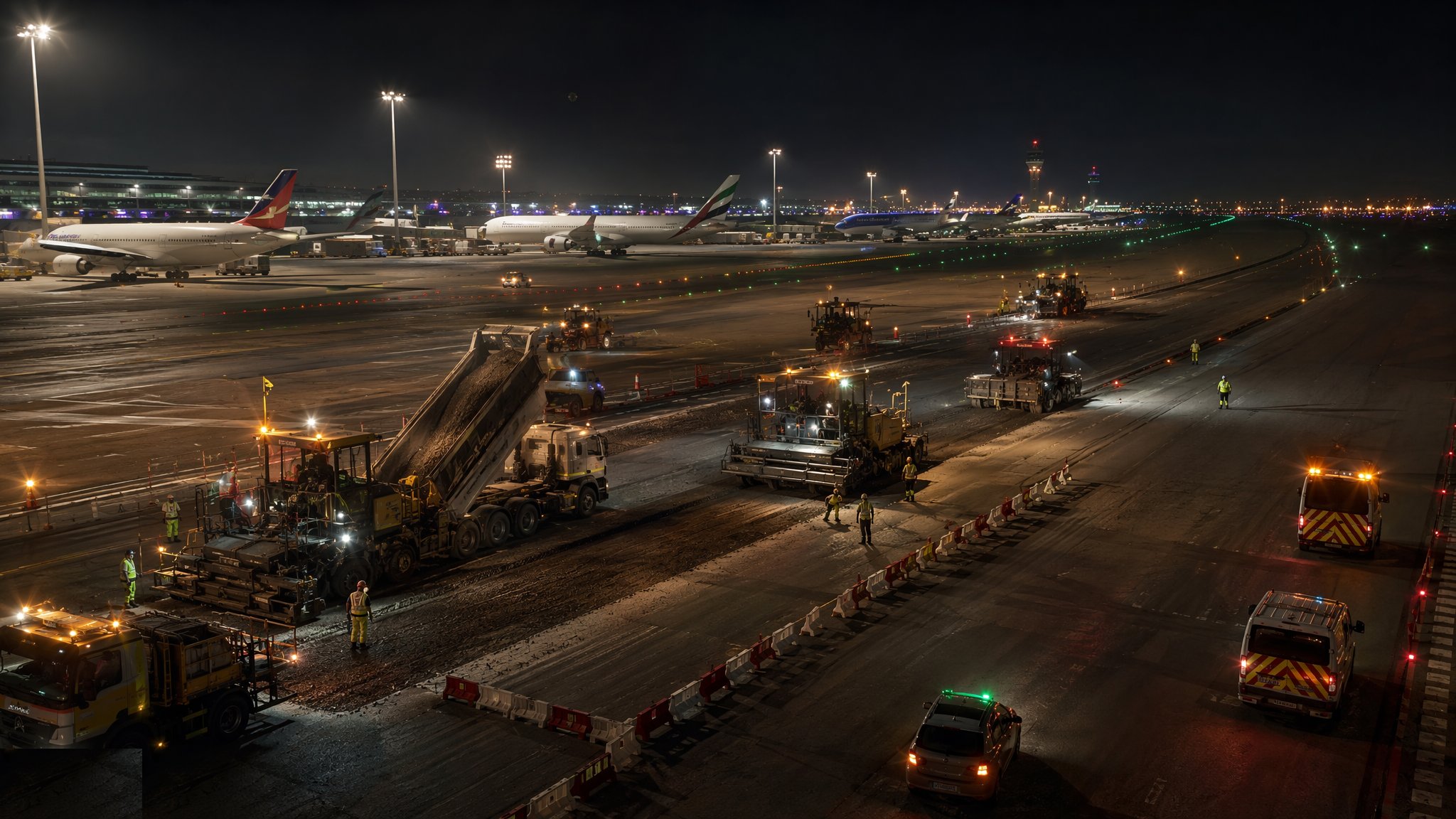
A night possession is the standard way major work is done on an operating runway or taxiway. The pavement stays in service all day, and for a few hours in the middle of the night - between the last arrival and the first departure - a defined length of it is formally handed over to the works. The construction team gets a window measured in hours, not shifts. Everything inside it is planned to the minute: the escorted convoy on, the setting out, the breaking out, the laying, the sweeping, the reinstatement of markings and lighting, the final inspection, and the convoy off. At the end of the window the airport operator takes the pavement back and it opens to aircraft. On most projects that handback time is the one fixed point the whole programme is built around.
The consequence of that is a different way of planning work. The window is short, so the sequence has to be rehearsed rather than discovered. Materials, plant and labour are marshalled in a compound off the operational area during the day and moved in as one controlled convoy. Quantities are set so that whatever is opened up can be closed again within the window, which usually means working in short bays and accepting more joints and more mobilisations than a road contract would ever tolerate. Materials are chosen for early strength and early trafficking rather than lowest cost. Plant is checked before it goes airside, because a machine that will not start in the middle of the runway is the single most expensive breakdown on the project.
Every possession carries an abort plan. If the works fall behind, there is a defined point in the window - agreed with the airport operator in advance - at which the team stops opening new ground and switches to reinstating what is already open. Overrunning is not treated as a delay to be absorbed; the pavement has to be safe and clean at handback, and if it will not be, the possession is curtailed early rather than pushed. Handback is a joint inspection with the operator, and it covers surface condition, joint and edge integrity, markings, lighting operation, drainage and - above all - the absence of any loose material. Foreign object debris control is not a housekeeping item on this work. It is the acceptance criterion.
How does Night runway and taxiway possessions work, step by step?
- 1
Step 1: Agree the possession with the airport operator
The possession is applied for and granted well in advance. The operator decides what can be closed, for how long, and on which nights, balancing the works against traffic, weather patterns, the state of the other pavements and any parallel projects. What the contractor gets back is a window with a start time, an end time and a defined extent, together with the conditions attached to it. The operator and the aviation regulator - not the contractor - decide how the airfield runs with that pavement out of use, and what has to be in place before the closure takes effect. On most projects a fixed pattern of nights is agreed for a season so that the works can be planned as a series of repeatable windows rather than one-off events.
- 2
Step 2: Plan the window minute by minute
The programme for a possession is written in minutes, not days. It sets the time the convoy forms up, the time it is escorted on, the time the last vehicle is clear of the pavement, and every milestone between. Each activity has an owner and a duration taken from previous windows or from a rehearsal on a non-operational area. The plan names the go and no-go decision points and the person who makes each call. On most projects the plan is briefed to the whole team before the shift, in the compound, with the drawings and the closure extent in front of them, and it is briefed again to anyone who joins late.
- 3
Step 3: Marshal everything before the window opens
Nothing is fetched during a possession. Plant, materials, tools, spares, lighting, fuel and the sweeper are all assembled in the compound during the day, checked, counted and loaded. Vehicles are inspected for leaks and for loose items, aerials and beacons are fitted, and radios are tested. Tools and small items are tallied out and tallied back in, because an item that cannot be accounted for at the end of the window is a foreign object on a runway until proven otherwise. Delivery vehicles that are not airside-cleared are broken down at the compound and their loads transferred to escorted plant.
- 4
Step 4: Take handover and move on under escort
At the agreed time the operator confirms the pavement is closed and hands it over. Only then does the convoy move, escorted, on a route agreed in advance, with the lead vehicle in radio contact with air traffic control throughout. Vehicle numbers are counted on and will be counted off. The extent of the closure is marked out on the ground so that everyone working inside it can see where it ends, and no one crosses that boundary without a fresh clearance. On most projects the works area is treated as a bounded box from that moment until handback, and all movement in and out of it is controlled by one person.
- 5
Step 5: Work in short bays with early-strength materials
The work itself is sequenced so that each bay opened can be finished within the window. Planing, breaking out, formation preparation, laying and compaction run as a continuous train with no idle plant. Materials are selected for early strength and early trafficking, which usually means proprietary rapid-setting products rather than conventional pavement construction, and their working times govern how much can be opened at once. Testing that has to happen before handback is planned into the window, not left until the end. Lighting for the works is set up so it illuminates the task without spilling where the operator has said it must not.
- 6
Step 6: Reinstate everything the aircraft will meet
Before the pavement can go back it has to be complete, not merely finished. Surface levels and joints are checked against the specification. Markings disturbed by the works are reinstated to the layout the operator holds. Any ground lighting in the works area is put back into service and confirmed operational by the specialist. Drainage runs clear, covers are secure and edges are made good. Nothing temporary is left in place unless the operator has specifically accepted it and recorded it. The rule of thumb on most projects is that the pavement is handed back in the condition an aircraft expects to find it, every single night.
- 7
Step 7: Sweep, search and control foreign object debris
The whole works area and the routes used to reach it are mechanically swept and then walked. Sweeping happens progressively through the window rather than only at the end, because loose material tracked out by plant is as dangerous as material left in the works. The final sweep is followed by a line search on foot by the team, and the tool and material tally is reconciled. Any item unaccounted for is reported to the operator immediately, whatever the time and whatever the effect on the handback. This is the discipline that defines the trade, and it does not bend.
- 8
Step 8: Hand back jointly, on time, and record the window
Handback is a joint inspection walked or driven with the airport operator against an agreed checklist, and the pavement is not open until the operator says it is. The team, the plant and the vehicles are counted off and the count is confirmed. What was achieved, what was not, and anything left for a future window is recorded before everyone leaves. On most projects that record drives the next possession plan, so the durations get sharper window by window. Overrunning is not an option that exists: the abort plan is used instead, and using it early is treated as a good decision rather than a failure.
What are the benefits of Night runway and taxiway possessions?
- Allows heavy pavement work on a runway that has to carry traffic every day
- Traffic is unaffected in the operating day, so the commercial disruption to the airport is minimal
- Repeatable windows let the team rehearse and improve the sequence night after night
- Forces a level of pre-planning and marshalling that reduces waste and idle plant
- Early-strength materials give a pavement that can be trafficked as soon as the window closes
- Progressive treatment across many nights avoids the cost of a long full closure
What are the limitations of Night runway and taxiway possessions?
- Productive time is a fraction of the shift once convoy, setting out and handback are taken out
- Weather can cancel a window outright, and cancelled windows are rarely recoverable in the season
- Rapid-setting materials and repeated mobilisations cost far more than conventional daytime work
- Night working, fatigue management and repeated escorted moves add risk and supervision cost
- Any plant breakdown inside the window threatens the handback and may trigger the abort plan
- Access is granted, never assumed - the operator can withdraw or shorten a window at short notice
What is Night runway and taxiway possessions best suited for?
What plant does Night runway and taxiway possessions need?
- Airside-cleared plant with beacons, aerials and current permits, checked for leaks before every window
- Planers, breakers, pavers and rollers sized to the bay rather than to the total quantity
- Mechanical sweepers running progressively through the window and again before handback
- Mobile lighting towers positioned to the operator's constraints on light spill
- Escort vehicles in radio contact with air traffic control, with a marshalling compound off the operational area
- Rapid-setting and early-strength materials with their mixing and placing equipment held in the compound
How is Night runway and taxiway possessions quality-checked?
- Written possession permit in force, with the extent and times confirmed before anything moves
- Vehicle, plant, personnel and tool counts reconciled on and off the pavement
- Pre-agreed handback checklist walked jointly with the airport operator
- Surface levels, joints and markings checked and recorded before the window closes
- Ground lighting in the works area confirmed operational by the specialist before handback
- Documented foreign object debris sweep and line search, with any unaccounted item reported immediately
More airside works in live airports methods
Next method
Stand and apron works under closures