Greenfield airfield works
Building an airfield away from operations gives normal construction freedom - right up until the day it becomes operational.
Last updated 2026-09-05
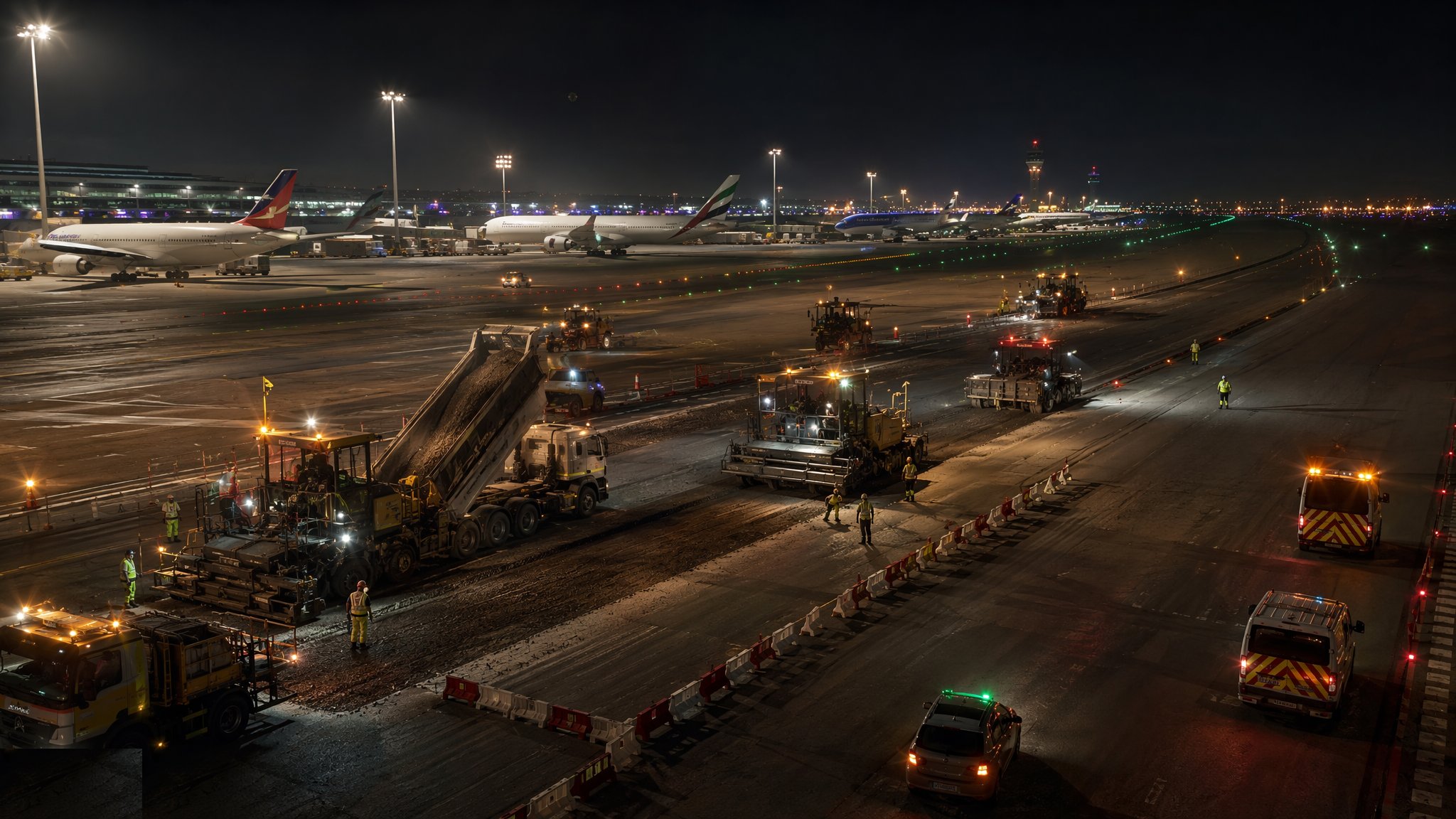
What is Greenfield airfield works?
Greenfield airfield works are the exception in this trade: construction on land that is not yet part of an operating airfield, or that has been fully separated from one. A new runway on open ground, a new apron outside the existing boundary, or a large expansion built behind a hoarding all fall into this category. Because there are no aircraft movements in or next to the works, the project runs largely like any other major civils project. Normal shifts, normal plant, normal deliveries, long continuous operations and conventional pavement construction are all available, and productivity is a different order of magnitude from possession working.
That freedom is real but temporary. The works are being built to become an operational airfield, and everything installed has to satisfy the airport operator and the aviation regulator when it does. Pavement construction, drainage, ducting, ground lighting, nav-aid foundations and cabling are all built to the operational specification from the start, because retrofitting to that standard later is far more expensive than building to it now. Survey control, records and as-built information are kept to the standard the operator will need, since the operator inherits and maintains everything the project leaves behind.
The critical phase is the transition. At some point the site stops being a construction project and becomes part of an airfield: the boundary moves, the security regime changes, passes and escorting become mandatory, radio discipline applies, foreign object debris control becomes absolute, and the airport operator takes control of access. On most projects that transition is planned as a distinct stage with its own programme, its own briefings and its own commissioning sequence, because the day it happens the whole culture of the site has to change at once. Nav-aid and lighting commissioning, including any flight checking, is the regulator's and the specialist's domain and sits at the end of that sequence.
How does Greenfield airfield works work, step by step?
- 1
Step 1: Separate the site from operations completely
The first move is to establish an unambiguous, secure separation between the construction site and anything operational. That means a physical boundary, its own access from the public road network, its own compound, and a clear agreement with the airport operator on where the responsibility line sits. Once that separation exists and is accepted, the site can run under normal construction rules. On most projects the separation is inspected and formally accepted by the operator before conventional working is allowed to begin.
- 2
Step 2: Build with normal construction freedom
With no aircraft nearby, the project uses full-size plant, continuous paving trains, long working days and conventional deliveries. Earthworks, drainage and pavement construction proceed as they would on a major highway project. Cranes and tall plant are not permit-constrained in the way they are airside, subject to any wider constraints the operator or the regulator places on the surrounding airspace. This is where the productivity and the cost advantage of greenfield working is earned, and the programme should exploit it fully before the transition.
- 3
Step 3: Build every buried element to the operational specification
Drainage, ducts, chambers, cable routes, ground lighting bases and nav-aid foundations are installed to the specification the operator will inherit, not to a temporary standard. Everything is surveyed as it goes in and recorded, because once the pavement is over it there is no second chance. Duct routes are proved and left with draw ropes. On most projects the operator's maintenance team reviews these details during construction, since they will be living with them for decades.
- 4
Step 4: Install ground lighting and cabling ahead of surfacing
Lighting bases, primary cabling and duct networks are installed and tested before the final surfacing, in normal working conditions and with full access. Working in the open on a greenfield site removes almost all the constraints that make the same work difficult on an operating airfield. The circuits themselves remain specialist work: series-circuit airfield ground lighting is high-voltage installation, installed, tested and energised only by the qualified specialists under the operator's permit system, and the civils contractor's role stops at the civils.
- 5
Step 5: Introduce the operational regime before it is needed
A greenfield site that will become operational needs its people to change habits before the day they must. On most projects the security, pass, escort, radio and foreign object debris regimes are introduced progressively in the closing stages, so that they are established practice rather than a shock. Training, briefings and airside driving authorisation are put in place ahead of the transition date, and site rules are rewritten to the operator's standard while there is still time to learn them.
- 6
Step 6: Complete the transition to operational control
The transition is a planned event. The boundary is moved, the construction access is closed or converted to a controlled airside gate, the site becomes a security-restricted area, and the airport operator takes control of who and what may enter. From that moment the works - if any remain - are airside works and follow airside rules in full. On most projects the transition is scheduled deliberately early enough to allow the commissioning sequence to run under operational control, and late enough to preserve the construction advantage.
- 7
Step 7: Commission systems under the operator and the regulator
Ground lighting, navigation aids, visual aids, markings and signage are commissioned in a sequence set by the airport operator and the aviation regulator. Where a navigation aid or visual approach aid is involved, its siting, calibration and flight checking belong entirely to the regulator and the appointed specialists, and the construction team's role is to provide the completed civils and access. Nothing goes into service until the operator and the regulator say it does.
- 8
Step 8: Hand over records as well as pavement
The operator inherits an asset it has to maintain, so as-built survey, duct and cable records, chamber and base schedules, test results and operation and maintenance information are as much part of the deliverable as the pavement. On most projects these are compiled progressively rather than at the end, because a greenfield airfield buries a great deal of infrastructure and a gap in the records becomes an excavation later. Final clean-down and a full foreign object debris sweep precede handover.
What are the benefits of Greenfield airfield works?
- Full-scale plant, continuous operations and normal working hours give far higher productivity
- Conventional pavement construction rather than expensive rapid-setting materials
- Buried services, ducts and lighting bases can be installed and proved with unrestricted access
- No exposure to jet blast, aircraft movements or possession windows during the main build
- Programme certainty is much greater because there are no operational cancellations
- Quality is easier to achieve and verify with time and space to work in
What are the limitations of Greenfield airfield works?
- Everything must still be built to the operational specification, which is stricter than general civils
- The transition to operational control is a hard programme milestone with no flexibility
- Commissioning of lighting and navigation aids sits with the operator, the regulator and specialists
- Site teams accustomed to construction freedom have to adopt a full airside culture at the transition
- Buried records and as-built survey have to be maintained to an operator's asset standard throughout
- Greenfield sites are usually remote from existing infrastructure, so temporary works and haul are significant
What is Greenfield airfield works best suited for?
What plant does Greenfield airfield works need?
- Full-size earthmoving fleet, dozers, scrapers, graders and compaction plant
- Continuous paving trains for large-area pavement construction
- Survey control and machine guidance systems for setting out and as-built recording
- Trenching and ducting plant for drainage, cable routes and lighting bases
- Site compound with its own access, security and welfare separated from operations
- Specialist lighting and nav-aid contractors mobilised for the commissioning phase
How is Greenfield airfield works quality-checked?
- Physical separation from operations inspected and formally accepted before normal working starts
- All buried elements built and tested to the operational specification, with survey records as installed
- Duct routes proved and draw ropes left, with chamber and base schedules maintained
- Airside regime, passes, driving authorisation and radio discipline in place before the transition date
- Commissioning sequence agreed with the airport operator and the aviation regulator in advance
- Full as-built, test and maintenance records handed over, with a complete final debris sweep