Works adjacent to live taxiways
Aircraft keep taxiing past the works, so the boundary, the plant height and the people are all controlled to the letter.
Last updated 2026-09-05
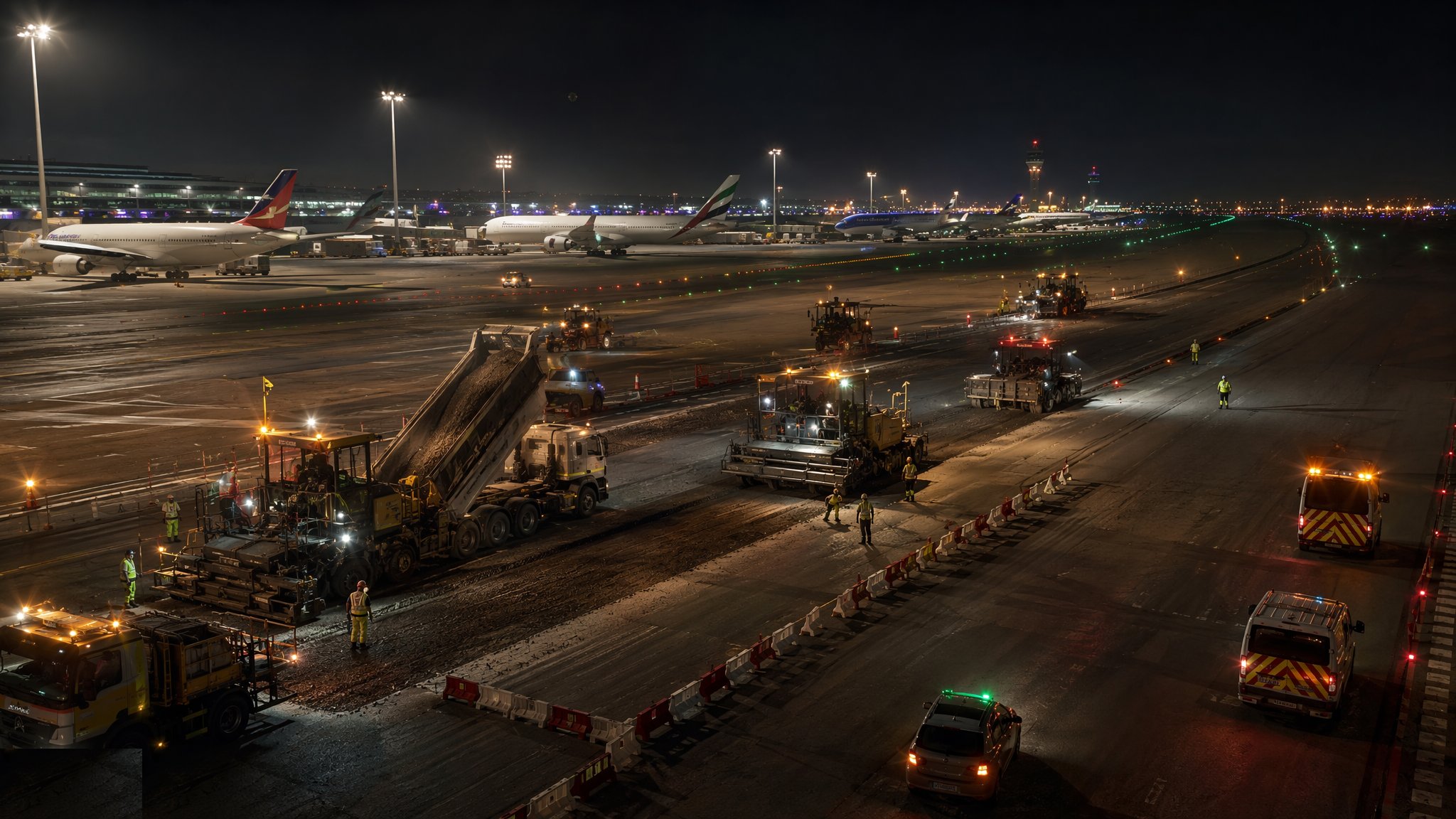
What is Works adjacent to live taxiways?
A great deal of airside construction happens next to a taxiway that stays open. New stands, new buildings, drainage, ducting and diversions are all built while aircraft continue to move past on their own routes. The taxiway is not closed, so nothing about the works is allowed to encroach on it, above it or beside it. The airport operator and the aviation regulator define the area that has to stay clear and the conditions under which anyone may work near it. The contractor's job is to build a method that keeps every person, every vehicle and every part of every machine inside the area given to the project, at all times, without exception.
Three things dominate the method. The first is physical separation and marking: a boundary that a driver on site, a driver on the airfield and a pilot in a cockpit can all see, maintained continuously and reinstated the moment it is damaged. The second is plant height. Cranes, piling rigs, tipper bodies, telehandlers and even a raised excavator boom are tall objects near a surface where aircraft move, and their permitted height and position are controlled by the operator through a permit rather than decided on site. The third is jet blast, which arrives without warning from aircraft turning or breaking away nearby and moves anything not secured.
The fourth constant is people. Airside discipline near a live taxiway is unforgiving: current passes, escorting for anyone without one, airside driving authorisation for every driver, defined routes, defined parking, radios monitored and answered, and an absolute rule that nobody crosses the boundary without a clearance from air traffic control. Vehicles are parked facing the escape route, loose loads are sheeted, and nothing lightweight is left where blast can lift it. As with all airside work, immediate handback of any area entered, and foreign object debris control on every route used, are the price of being allowed to work there at all.
How does Works adjacent to live taxiways work, step by step?
- 1
Step 1: Establish the works area with the operator
Before anything starts, the operator defines the area the project may occupy and the area that must remain clear for aircraft. Those boundaries come from the operator and the aviation regulator, and they are stated in the permit rather than derived on site. The permit also states the conditions - what may be done, when, with what plant, and what has to stop if a particular aircraft movement is expected. On most projects the boundary is surveyed and set out physically so it can be checked rather than remembered.
- 2
Step 2: Mark the boundary so it is visible from the air and the ground
The boundary is marked with barriers, cones, and where the operator requires it, lighting and marker boards to the pattern the airfield uses. It is set out to be unambiguous from a taxiing aircraft as well as from a site vehicle. It is inspected at the start of every shift and after any high wind or jet blast event, and anything displaced is put back straight away. On most projects a named person owns the boundary and walks it daily, and any breach - by a person, a vehicle or a stockpile - is reported as an incident rather than corrected quietly.
- 3
Step 3: Permit and control plant height and position
Every tall item of plant near a live taxiway is subject to the operator's permit: what it is, where it will stand, how high it may go and when it may be there. Cranes and rigs are the obvious cases, but tipper bodies, telehandlers, scaffold, lighting towers and a raised excavator boom all count. Limiting devices are set where the plant allows it, operators are briefed on the limit, and lifting plans are written to keep loads inside the permitted envelope. The permitted height is set by the operator and the regulator; it is never estimated by the site team, and plant is lowered and secured whenever it is not in use.
- 4
Step 4: Plan for jet blast
Aircraft passing or turning nearby produce blast that arrives suddenly and moves what it finds. Materials are stored below the height where blast bites and are strapped, netted or housed. Sheeting, insulation, empty drums, barriers, formwork and rubbish are secured or removed. People are given a defined position to withdraw to when a movement is expected, and vehicles are parked nose-out and braked. On most projects the operator states which movements require work to pause, and the works stop for those movements as a matter of routine rather than judgement.
- 5
Step 5: Control vehicles, routes and parking
Site vehicles use defined routes to and from the works area, keep to the airfield speed limits and park only in designated places inside the boundary. Every driver holds the airside driving authorisation for the areas they enter and drives with beacons and radio on. Reversing near the boundary is banned or banksman-controlled. Deliveries are booked so vehicles are not queuing where they should not be, and unauthorised vehicles are broken down at a compound and their loads transferred to cleared plant.
- 6
Step 6: Maintain radio discipline and air traffic control contact
Radio contact with air traffic control is maintained by a named, trained person for the duration of the works, and the radio is monitored continuously rather than carried. Clearances are read back. No vehicle or person crosses the boundary into the manoeuvring area without a specific clearance for that movement, and clearances are for one movement, not for the shift. If radio contact is lost, work stops in the affected area until it is restored. On most projects the person holding the radio has no other task that could take them away from it.
- 7
Step 7: Control foreign object debris on every route
The works area, the boundary line and every route the project uses are swept and inspected daily and after any activity likely to spread material. Wheel washing or mechanical cleaning is used where plant tracks material out of an excavation. Tools and small items are tallied. Waste and packaging are contained in closed skips, not open ones. This is the single most common cause of an airside project losing its access, and on most projects it is audited by the operator without notice.
- 8
Step 8: Hand back any area entered, immediately
Where the works do briefly require access to an area outside the permitted boundary - a crossing, a temporary closure, a survey - the area is entered under clearance, used, cleaned, inspected and handed back straight away. Nothing is left in place on the assumption of returning tomorrow. The habit of immediate handback is what keeps a project welcome on an operating airfield, and on most projects it is written into the method statement as a rule rather than a preference.
What are the benefits of Works adjacent to live taxiways?
- Allows substantial construction to proceed without closing the taxiway or reducing capacity
- Normal daytime working hours, so productivity is far higher than possession work
- Conventional construction plant and methods can be used inside the permitted area
- Long continuous programmes are possible rather than a series of short windows
- A stable bounded site allows proper storage, welfare and material management
What are the limitations of Works adjacent to live taxiways?
- Every tall item of plant needs a permit, and permitted positions and heights constrain the build method
- Constant exposure to jet blast, engine noise and unexpected aircraft movements
- A single boundary breach can stop the project and put the contractor's airside access at risk
- Work may have to pause repeatedly for aircraft movements the operator has identified
- Radio, pass, escort and driving authorisation requirements add significant supervision overhead
- Storage, delivery and crane positions are all dictated by the operator rather than by efficiency
What is Works adjacent to live taxiways best suited for?
What plant does Works adjacent to live taxiways need?
- Cranes, piling rigs and telehandlers operating under a permit with height limits set and briefed
- Airside-cleared vehicles with beacons, aerials and current permits, driven by authorised drivers
- Barriers, cones, marker boards and lighting to the operator's pattern, with spares held on site
- Air traffic control radios with a dedicated trained holder and charged spares
- Mechanical sweeper and wheel cleaning for every route the project uses
- Securable storage, closed skips and netting or strapping for anything jet blast could move
How is Works adjacent to live taxiways quality-checked?
- Permit in force stating the works area, permitted plant, heights and conditions
- Daily documented boundary inspection, with displaced barriers reinstated and breaches reported
- Plant height limits set, briefed and checked, with lifting plans kept inside the permitted envelope
- Radio holder named per shift, clearances read back and recorded, work stopped if contact is lost
- Pass, escort and airside driving authorisation records current and auditable
- Daily foreign object debris sweep of the works area and all routes, with tool and material tallies