Flexible thick-lift asphalt
Bound layers built up in thick lifts, laid and rolled fast enough to hand a runway back before the first movement of the morning.
Last updated 2026-09-05
What is Flexible thick-lift asphalt?
A flexible pavement carries load by spreading it downwards through successive bound and unbound layers, each one weaker and thicker than the one above, until the pressure reaching the subgrade is something the ground can take. On an airfield the bound thickness is substantial and is built up in lifts rather than as a single layer, because asphalt can only be compacted properly to a limited depth at a time. Thick-lift working means laying each of those layers as deep as the plant can compact it, so that the required build-up is achieved in the fewest passes and the fewest closures. Airfield asphalt build-ups commonly run to several hundred millimetres of bound material in total, but the layer thicknesses and the mixture types for any given pavement are the pavement engineer's decision, taken from the traffic, the ground and the design life the airport operator sets.
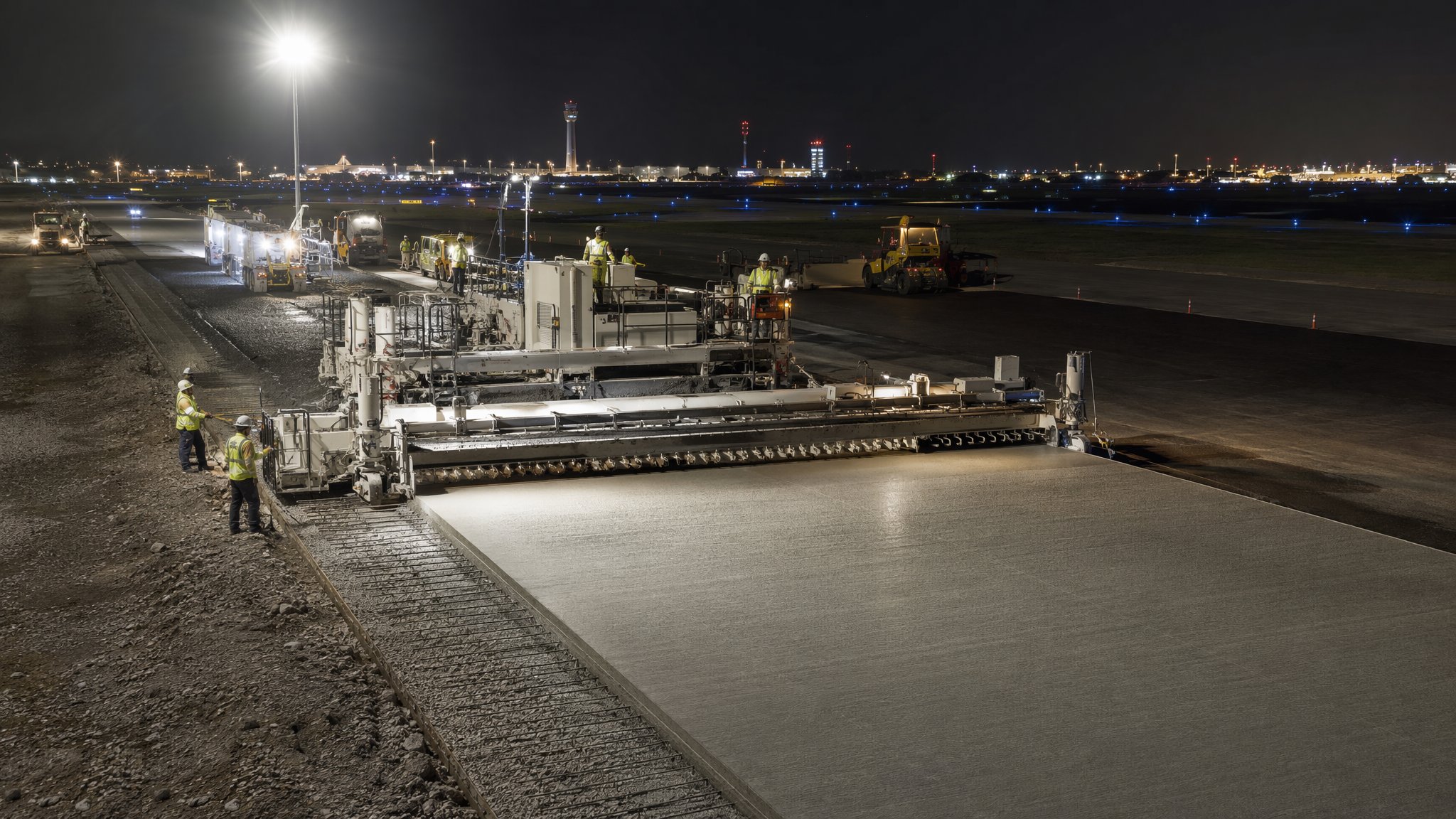
The reason airports keep coming back to asphalt is speed. A paving train can lay, roll and cool a large area inside a single night closure, and the surface can be trafficked as soon as it has cooled rather than waiting to gain strength. That fits the way a runway actually works: the operator can offer a window of a few hours between the last movement and the first, and asphalt is one of the few construction techniques that can use a window that short and hand back a serviceable surface. Asphalt is also quiet to lay compared with concrete, easily planed off and replaced in patches, and simple to reinstate around a trench or a new light fitting. Nothing else gives an airfield the same ability to open, work and close again night after night.
The weaknesses are equally well known. Asphalt is a viscoelastic material: it deforms slowly under sustained load, and it does so faster when it is hot. Aircraft standing on it in summer press in, and heavily loaded slow turns push the surface sideways, so rutting and shoving appear where movement is slow and load is static. It is also vulnerable to fuel and hydraulic fluid, which soften the binder and strip the surface, which is why stands and fuelling areas usually get concrete instead. Ageing hardens the binder over time and the surface loses flexibility, cracks and lets water into the layers beneath. The result is a pavement that is cheap and fast to build, cheap to repair, and needs attention more often than a rigid pavement does.
How does Flexible thick-lift asphalt work, step by step?
- 1
Step 1: Establish the layer build-up and the closure plan together
The pavement engineer fixes the layers, their thicknesses and the mixtures. In parallel the team works out how much area can realistically be planed, laid, rolled and cooled inside the closure the airport operator will grant. Those two answers have to meet. On most projects the closure length decides how the work is divided into strips and how many nights the job takes, and the design is only signed off once the sequence is shown to be deliverable night after night without leaving an unserviceable surface at daybreak.
- 2
Step 2: Plan the plant, the supply and the escorting
Thick-lift working needs a lot of hot material arriving without gaps, which means a mixing plant that can deliver the tonnage, a lorry fleet sized for the haul, and a route onto the airfield that has been agreed with the operator. Every vehicle and every driver needs airside clearance or an escort, and escorting a convoy takes time out of the closure. On most projects the convoy management is planned in as much detail as the paving itself, because a paver waiting for material is a closure being spent on nothing.
- 3
Step 3: Plane out and prepare the existing surface
Where the work is an overlay or a reconstruction, the existing surface is planed to the depth required and the arisings are carted off. The exposed surface is swept clean and inspected, weak areas are dug out, and any drainage or ducting work in the strip is completed. A tack coat is applied so that the new layer bonds to what is beneath it. Bond between layers is what makes the build-up act as one pavement rather than a stack of separate slabs, and it is the first thing lost when a surface is dirty or damp.
- 4
Step 4: Lay the bound layers in thick lifts
Material is laid by paver, ideally with a shuttle or material transfer vehicle feeding it so the mix stays uniform in temperature and the paver never stops. Each lift is laid as deep as the specified mixture and the compaction plant can handle. Joints between adjacent strips are planned so they do not stack up vertically through the layers and do not fall where wheel loads track, and the previous strip edge is kept warm or cut back and tacked before the next strip goes against it.
- 5
Step 5: Compact to the target while the mixture is workable
Compaction is a race against cooling. The rolling pattern - which rollers, in what order, how many passes, how close behind the paver - is set from a trial and then followed. Density is the property that governs how the pavement will perform and how long it will last, and it can only be achieved inside the temperature window. Night working, wind and a cold base all shorten that window, so the roller train is sized for the worst case rather than the average and the crew works to the pattern rather than to appearances.
- 6
Step 6: Finish the surface and restore friction and drainage
Surface regularity is surveyed as the work proceeds and corrected while correction is still cheap. Falls are checked so water runs off rather than standing, because standing water on a runway is an operational problem, not a cosmetic one. Where the specification calls for it, the finished surface is grooved or otherwise textured once it has cooled, and that operation is programmed as its own activity rather than squeezed into the paving night.
- 7
Step 7: Reinstate lighting, markings and edges before handback
Inset light fittings, cable ducts, drainage covers and edge details are reinstated to the correct level. Markings are reapplied, and any temporary marking needed for a partially completed surface is agreed with the airport operator in advance. The area is swept and inspected for foreign object debris, and the surface is checked for loose material at the joints and edges. The runway is handed back only when the operator is satisfied it is serviceable.
- 8
Step 8: Repeat, strip by strip, and monitor what the earlier nights did
The work advances strip by strip and night by night, with each shift starting from a surface that was operational a few hours earlier. Earlier strips are inspected as the job proceeds, because a defect that shows up under traffic is far easier to correct while the plant is still on site. Records of laying temperature, density, levels and joint locations build up night by night and are what the operator relies on when assessing the pavement later.
What are the benefits of Flexible thick-lift asphalt?
- Fast to lay and can be trafficked once cool, so a runway can be handed back inside a night closure
- Quiet to construct compared with concrete, which matters where night working is the only option
- Easily planed and replaced in patches, so localised defects are cheap to correct
- Simple to reinstate around trenches, ducts and inset light fittings
- Smooth riding surface with good ride quality when laid and compacted well
- Lower initial cost per square metre than an equivalent rigid pavement
What are the limitations of Flexible thick-lift asphalt?
- Deforms under sustained and slow-moving load, so rutting and shoving appear at stands and slow turns
- Fuel and hydraulic fluid soften and strip the binder, which rules it out of fuelling areas
- Performance depends on achieving density inside a temperature window that night working shortens
- Binder hardens with age, and an aged surface cracks and admits water into the layers beneath
- Shorter service life than a rigid pavement, with more frequent intervention over the pavement life
- Needs continuous material supply, and airside escorting can throttle the delivery rate
What is Flexible thick-lift asphalt best suited for?
What plant does Flexible thick-lift asphalt need?
- Pavers with heated screeds, ideally fed by a material transfer or shuttle buggy
- Cold planers sized for the strip width, with sweepers behind them
- Tandem and pneumatic tyred rollers in a train sized for the cooling conditions
- Tack coat sprayer and sweeping plant
- Lorry fleet with airside clearance, escorts and a marshalled haul route
- Survey and level control equipment, thermal monitoring and density testing gear
How is Flexible thick-lift asphalt quality-checked?
- Trial section used to fix the rolling pattern and confirm achievable density
- Laying and rolling temperatures monitored continuously and recorded per load
- Density verified by the method the specification sets, with results reviewed the same shift
- Layer thickness and surface levels surveyed strip by strip against the design
- Joint locations recorded and checked so joints do not stack vertically or sit in wheel paths
- Foreign object debris sweep and operator inspection recorded before every handback