Rapid-setting repair systems
Materials chosen so a failed bay can be broken out, replaced and flying again before the first movement.
Last updated 2026-09-05
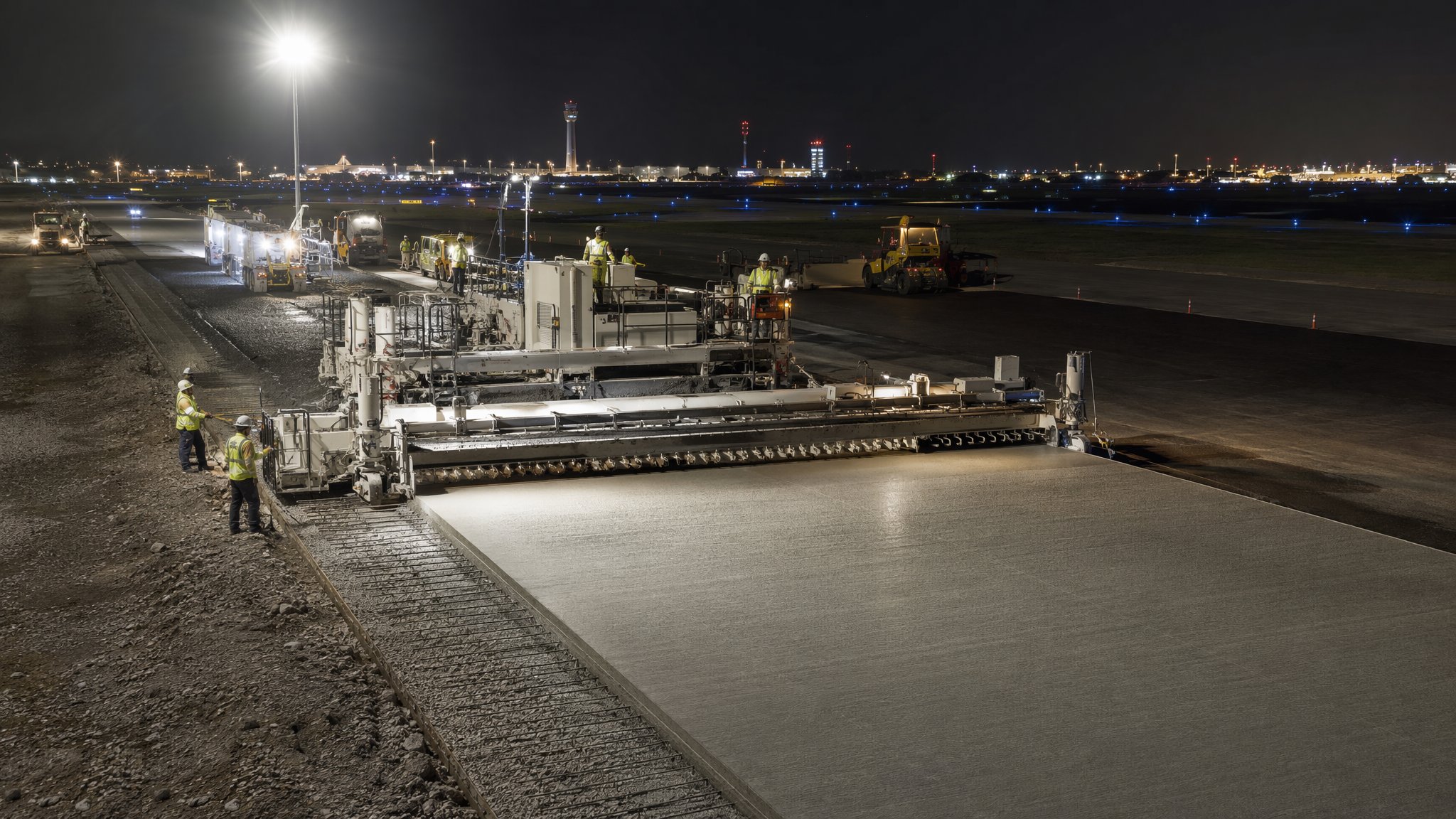
What is Rapid-setting repair systems?
A rapid-setting repair system is a materials choice made to fit a closure rather than a structural choice made to fit a load. The requirement is simple to state and hard to meet: a defect appears in an operational pavement, the airport operator can close the area for a handful of hours overnight, and at the end of that window the repair has to be strong enough for aircraft. Ordinary concrete cannot do this. Rapid-setting proprietary mortars and concretes, rapid-hardening cements and resin-based systems can, because they gain usable strength in hours instead of days. The whole discipline is built around that constraint.
The work sits at the sharp end of airfield maintenance. A spalled joint, a broken slab corner, a failed inset light pot, a pothole at a threshold or a patch of surface that has begun to shed material are all foreign object debris hazards, and an operator will not run movements over them. The repair therefore has to happen quickly, often at short notice, and often at night in whatever weather is available. Crews who do this work keep materials, plant and mixing gear ready to mobilise, because the value of the technique is entirely in its speed of response. The size of a single repair is usually modest, from a fraction of a square metre up to a full bay, and the operator will normally accept a series of small closures rather than one long one.
The trade-off is real and should be stated plainly. Rapid-setting materials cost far more per unit than ordinary concrete or asphalt, they have short working times that leave no margin for a delay on site, they are more sensitive to temperature and to surface preparation, and their long-term durability and their compatibility with the surrounding pavement are usually less well proven than that of conventional construction. Differences in stiffness and in thermal movement between a repair and the pavement around it concentrate stress at the interface, which is where rapid repairs most often fail. The honest position is that these are the right materials when returning the surface to service quickly is worth more than maximising service life, and the airport operator makes that call. Where a longer closure can be obtained, a conventional repair usually lasts longer.
How does Rapid-setting repair systems work, step by step?
- 1
Step 1: Assess the defect and decide the repair type
The defect is inspected and its cause identified, because a repair that treats the symptom of a structural problem will simply fail again in the same place. A spall at a joint, a debonded surface patch and a slab that has cracked through are three different problems needing three different answers. The designer or the operator's engineer decides the repair extent, the depth and the material class. On most projects a defect that keeps returning is referred for a proper structural assessment rather than being patched a fourth time.
- 2
Step 2: Agree the closure and plan backwards from handback
The closure length is fixed by the airport operator and everything else is planned backwards from the handback time. The crew works out how long breaking out, preparing, mixing, placing, finishing and curing will each take, adds the time to clear plant and sweep for foreign object debris, and checks that the total fits with contingency to spare. If it does not fit, the repair is broken into stages or a different material is chosen. Starting a rapid repair that cannot be finished inside the window is the one failure mode with no recovery.
- 3
Step 3: Mark out and break out to sound material
The repair is marked out in a regular shape with straight edges, usually saw cut so the perimeter is clean and full depth at the edges rather than feathered. Feather edges fail. The defective material is broken out to sound substrate, which sometimes means going deeper or wider than the initial mark-up once the extent of the damage is visible. Debris is removed completely, and any exposed reinforcement, dowels or fittings are assessed and dealt with according to the design.
- 4
Step 4: Prepare the substrate to the material manufacturer's requirement
Rapid-setting systems are far more sensitive to preparation than ordinary concrete. The exposed surface is cleaned of dust, oil, fuel and loose material, and prepared to the texture and moisture condition the material requires. Some systems need a dry substrate, some need it damp, some need a primer, and getting this wrong is the most common cause of a repair debonding within weeks. The requirement is read and followed for the specific product rather than assumed from the last product used.
- 5
Step 5: Mix and place inside the working time
Materials are batched exactly as specified, mixed in the quantity that can be placed before they stiffen, and placed without delay. Working times are short and shorten further in warm weather, so batches are kept small and the crew is briefed on who does what before mixing starts. Placing is continuous within a single repair so that no cold joint forms inside it. Any material that has begun to set is discarded rather than worked back, because reworking a stiffening rapid-set material destroys it.
- 6
Step 6: Finish to the surrounding level and texture
The repair is finished flush with the surrounding pavement, checked with a straightedge rather than by eye, and given a surface texture that matches its surroundings so that friction is not locally different. A repair standing proud is a hazard and a repair sitting low holds water. Where the surrounding surface is grooved or textured, the treatment of the repair is agreed with the operator in advance, since a small smooth patch in a textured runway has an operational effect.
- 7
Step 7: Reinstate joints, seals and any embedded fittings
Where the repair crosses a joint, the joint is reformed through the repair so the pavement can still move, and it is sealed. A repair that bridges a joint solid will crack, and it will crack in the pavement rather than in the repair. Inset light fittings, drainage covers and duct routes are reinstated to level and tested. Sealants are applied inside their own working windows, which are checked against the remaining closure time.
- 8
Step 8: Confirm strength, sweep and hand back
Strength before opening is confirmed by whatever method the specification allows in the time available, commonly companion specimens cured alongside the repair. The area is swept thoroughly for foreign object debris, plant is cleared and the surface is inspected with the operator. The repair is recorded, with location, material, date and closure, so that the operator can track how these repairs perform over time and decide when a patched area needs proper reconstruction instead.
What are the benefits of Rapid-setting repair systems?
- Returns an operational surface to service inside a single short closure
- Removes foreign object debris hazards quickly, which is often the reason the repair is urgent
- Repairs are small and localised, so very little of the airfield is affected
- Can be mobilised at short notice with a small crew and modest plant
- Avoids the operational cost of taking a runway or taxiway out of service for days
- Allows the operator to defer full reconstruction until a suitable possession is available
What are the limitations of Rapid-setting repair systems?
- Materials cost far more per unit than conventional concrete or asphalt
- Very short working times leave no margin if anything on site goes wrong
- Sensitive to temperature and to substrate preparation, and unforgiving of either being wrong
- Long-term durability is generally less than a conventional repair of the same defect
- Differences in stiffness and thermal movement concentrate stress at the repair interface
- Repeated patching hides an underlying structural problem rather than fixing it
What is Rapid-setting repair systems best suited for?
What plant does Rapid-setting repair systems need?
- Saw cutting equipment and concrete breakers sized for the repair depth
- Forced action mixers matched to the material and to small controlled batches
- Vacuum and compressed air cleaning gear for substrate preparation
- Hand finishing tools, straightedges and texturing equipment
- Task lighting, generators and weather protection for night working
- Joint sealing equipment and site curing facilities for companion test specimens
How is Rapid-setting repair systems quality-checked?
- Defect cause identified and the repair extent agreed before any breaking out
- Closure timeline planned backwards from handback with contingency, and briefed to the crew
- Substrate cleanliness, texture and moisture condition checked against the material requirement
- Batching, mixing and working times controlled and recorded batch by batch
- Finished level checked with a straightedge and surface texture matched to the surroundings
- Opening strength confirmed, foreign object debris sweep witnessed, and the repair logged for the operator