Grooved and textured surfaces
Cut and formed surface texture that lets water escape from under a tyre, and the inspection cycle that keeps it working.
Last updated 2026-09-05
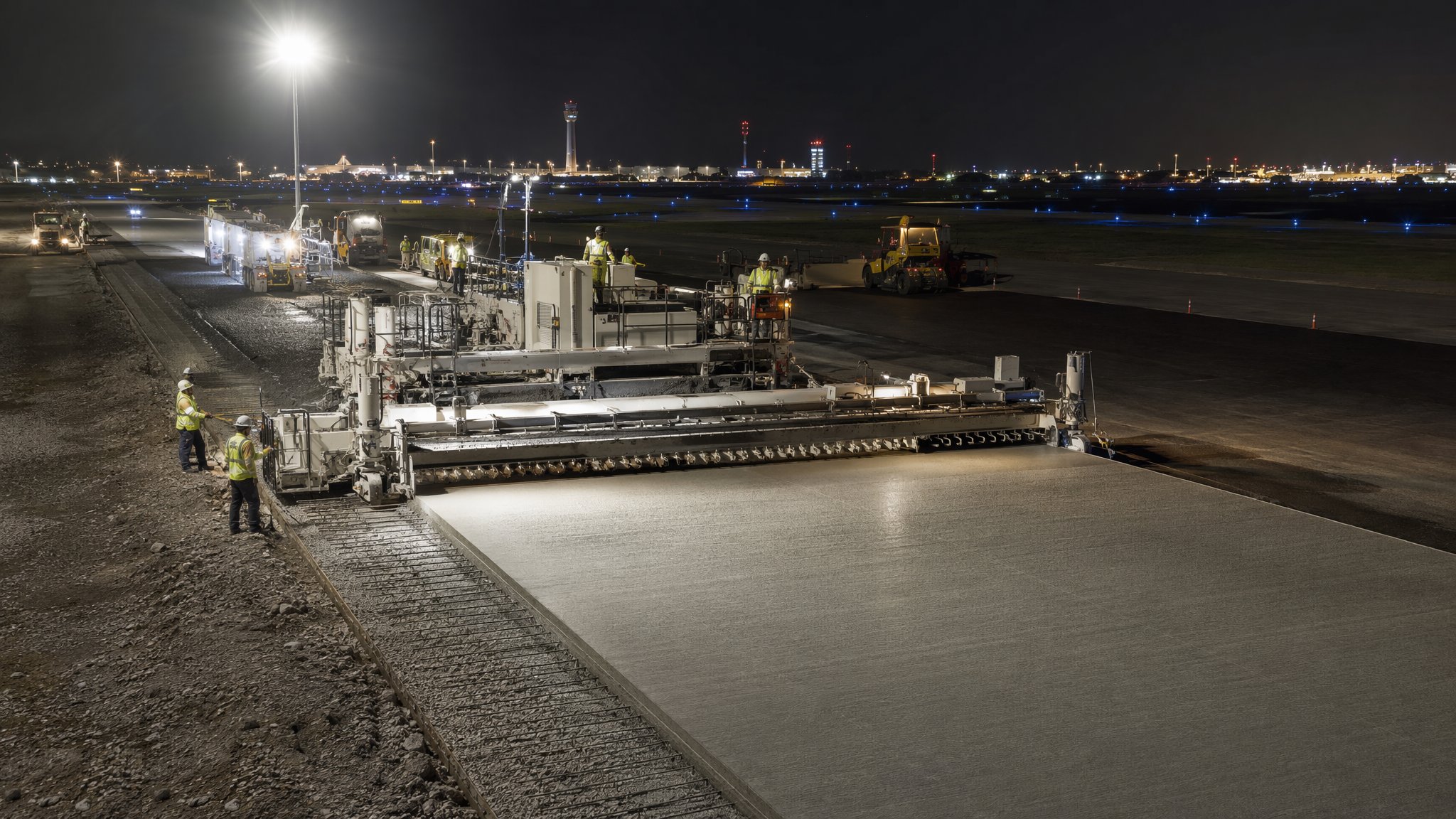
What is Grooved and textured surfaces?
A runway surface has to do something no ordinary pavement is asked to do: keep providing braking friction to a heavy aircraft on a wet day. Water on a smooth surface cannot escape from under a fast-moving tyre quickly enough, and the tyre lifts onto a film of water and stops gripping. Surface texture is how that is prevented. Macrotexture, the coarse open structure of the surface itself and any grooves cut into it, gives the water somewhere to go. Microtexture, the fine roughness of the exposed aggregate, is what actually generates friction through the remaining thin film. Both are needed, and they are provided in different ways and lost in different ways.
On concrete pavements, texture is formed while the surface is still workable and grooves are usually sawn afterwards. On asphalt, the mixture itself provides much of the macrotexture and transverse grooves are cut into the finished surface once it has cooled and gained enough strength. Grooving is done with a gang saw carrying multiple blades, running transversely across the runway, and it is a separate operation from paving with its own programme, its own water supply and its own slurry containment requirement. Grooves are commonly a few millimetres in width and depth and spaced at a few tens of millimetres, but the dimensions, the spacing and where grooving starts and stops are set by the designer and the airport operator for that runway. Grooving does not extend everywhere - areas of slow manoeuvring and turning are usually treated differently, because grooves in a turning area wear quickly and can chew tyres.
The part that is easy to overlook is that this is an operational cycle, not a construction activity that finishes at handover. Aircraft tyres deposit rubber on touchdown, and it builds up in the touchdown zones, filling the grooves and glazing the microtexture until the surface behaves like a smooth one in the wet. The airport operator therefore runs a repeating cycle: friction testing at intervals it sets, rubber removal by high pressure water or another approved method when the results or the visual condition call for it, and re-inspection afterwards. Rubber removal is itself done under closure, is water intensive, and is capable of damaging the surface and the groove edges if it is done too aggressively. The removal method, the pressures used, the testing intervals and the values that trigger action are all set by the airport operator and the aviation regulator, not by the contractor doing the work.
How does Grooved and textured surfaces work, step by step?
- 1
Step 1: Establish the texture requirement with the designer and the operator
The surface texture strategy is set before the pavement is built: what texture the surfacing itself provides, where grooving is required, where it deliberately stops, and how the transitions are handled. Touchdown zones, turning areas, holding points and the runway ends are each considered separately because they are used differently. The airport operator and the aviation regulator between them set the requirements the finished surface has to satisfy, and the designer translates those into what the contractor builds.
- 2
Step 2: Build texture into the surface as it is laid
On concrete, texture is applied to the fresh surface while it is workable, uniformly and to the pattern the specification requires, and then protected by curing. On asphalt, the macrotexture comes largely from the mixture, which means the mixture selection, the laying temperature and the compaction all affect the texture the finished runway will have. Over-rolling an open surfacing closes the texture up. This is why the paving crew is briefed that surface texture is a performance requirement rather than an appearance one.
- 3
Step 3: Let the surface reach the condition grooving needs
Grooving cannot start until the surface has enough strength for a saw to cut clean grooves without ravelling the edges. On asphalt that means allowing the surfacing to cool and stabilise; on concrete it means allowing strength gain. The waiting period is programmed as its own activity and agreed with the airport operator, because it usually means the surface exists but is not yet in its final condition, and the operator needs to know what that means for use in the interim.
- 4
Step 4: Set out the grooving and plan the closures
Groove runs are set out transversely across the runway, with the start and stop lines marked where the design says grooving begins and ends, and with the stand-off from inset lights, joints, drainage covers and markings agreed in advance. Grooving a full runway is a substantial operation covered over multiple closures, so the sequence is planned so that every night ends with a surface the operator can accept, with no half-grooved strip left in the touchdown zone.
- 5
Step 5: Cut the grooves and manage the slurry
A gang saw carrying multiple blades cuts the grooves in passes across the runway, with water fed to the blades. That water comes back as a slurry of cementitious or bituminous fines that cannot be allowed into the airfield drainage or the watercourse beyond it. Collection, containment and disposal are planned before cutting starts and are a genuine cost item. Groove dimension and spacing are checked continuously as blades wear, since worn blades cut shallow grooves that will not do the job.
- 6
Step 6: Clean, inspect and verify the finished surface
Grooves are cleaned out completely, because a groove full of slurry is not a groove. The finished texture is checked against the acceptance requirements the specification sets, and the surface is inspected for ravelled edges, missed runs and inconsistent depth. Any area not meeting the requirement is recut or made good before handback. The completed extent is recorded and given to the airport operator as part of the surface record.
- 7
Step 7: Reinstate markings and hand the surface back
Runway markings are applied over the grooved surface using the method and materials the operator specifies, since paint over grooves behaves differently from paint on a plain surface and can itself reduce texture where it is thick. Inset lighting and drainage details are checked and cleared of slurry. A thorough foreign object debris sweep is carried out, the operator inspects, and the runway is returned to service.
- 8
Step 8: Hand over into the operator's friction and rubber removal cycle
The finished surface enters an ongoing operational cycle. The airport operator carries out friction testing at the intervals it has set, monitors rubber build-up in the touchdown zones visually and by measurement, and schedules rubber removal when its criteria are met. Removal is done under closure by high pressure water or another approved method, at settings chosen to take rubber off without damaging the surface or the groove edges, and the surface is re-tested afterwards. The baseline record from construction is what all later results are compared against.
What are the benefits of Grooved and textured surfaces?
- Gives water a path out from under the tyre, which is what preserves braking friction in the wet
- Reduces the risk of an aircraft losing grip on a wet runway during landing and rollout
- Improves surface drainage generally, so less standing water forms on the runway
- Can be applied to an existing sound surface without reconstructing the pavement
- Gives the operator a measurable surface property that can be tested and trended over time
- Extends the useful life of a surfacing that is structurally sound but has lost texture
What are the limitations of Grooved and textured surfaces?
- A separate operation after paving, needing its own closures and its own programme
- Cutting slurry has to be collected, contained and disposed of, which is a real cost
- Grooves fill with rubber in the touchdown zones and stop working until they are cleaned
- Rubber removal is water intensive, needs closures, and can damage the surface if done too hard
- Grooving is not appropriate everywhere, and turning areas are usually treated differently
- Worn saw blades produce shallow grooves that look right and do not perform
What is Grooved and textured surfaces best suited for?
What plant does Grooved and textured surfaces need?
- Gang saw grooving machine with multiple blades and a water feed
- Water bowsers, and slurry collection, containment and disposal equipment
- Texturing equipment for fresh concrete surfaces
- Sweepers and vacuum units for cleaning grooves and clearing debris
- High pressure water rubber removal plant for the operational cycle
- Friction testing equipment and texture measurement gear
How is Grooved and textured surfaces quality-checked?
- Texture strategy agreed with the designer and the operator before the surfacing is laid
- Laying and compaction controlled so the surfacing delivers the macrotexture assumed
- Groove dimension and spacing checked continuously as blades wear, not just at the start
- Stand-offs from lights, joints, covers and markings confirmed before each run
- Grooves cleaned out and the finished surface verified against the acceptance requirements
- Baseline friction and texture records handed to the operator to start the monitoring cycle