Rigid PQC pavement, dowelled
Unreinforced concrete slabs tied across their joints by steel dowels, so load passes from one bay to the next instead of breaking the edge.
Last updated 2026-09-05
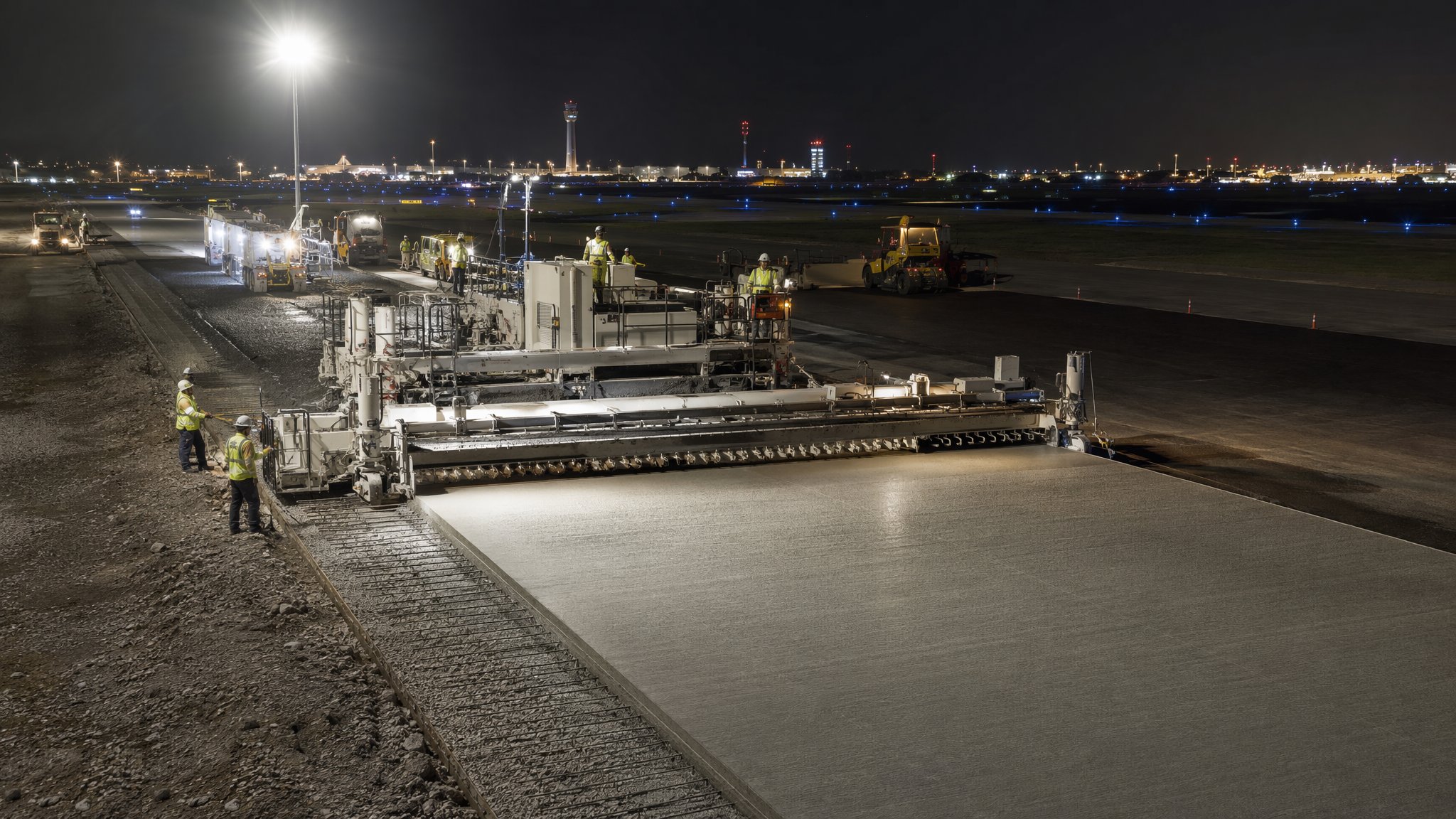
What is Rigid PQC pavement, dowelled?
A rigid pavement quality concrete pavement carries aircraft loads by bending as a stiff plate rather than by spreading load through layers of stone. The slab is strong enough in flexure to pick up a concentrated wheel load and distribute it over a wide area of the ground beneath, which is why rigid construction is chosen where loads stand still and concentrate: aircraft stands, apron areas, runway thresholds and turning nodes, and hardstandings where fuel and hydraulic fluid are spilled. Airfield pavement slabs are commonly a few hundred millimetres thick, laid on a bound or granular sub-base over a prepared subgrade, but the thickness for any particular pavement is a design output. The pavement engineer sets it from the traffic the airport operator expects, the strength of the ground and the design life required, and no thickness taken from another project transfers to a new one.
The word that matters in the description is dowelled. Concrete shrinks as it cures and moves with temperature, so the pavement is built as separate bays with joints between them. A joint is a weakness: without help, the wheel load arriving at the edge of one bay has nothing to lean on, the corner deflects, and the slab cracks from the bottom up. Dowels solve that. Plain round steel bars are set across the transverse joints, bonded into one bay and free to slide in the other, so the two bays deflect together while still being able to open and close as the concrete moves. Tie bars do a related job along longitudinal joints, holding adjacent lanes together rather than transferring load. The diameters, lengths and spacings are set by the designer for the pavement in question and are never carried over from a previous project.
The trade-off is time and money. Rigid pavement has the longest service life of any airfield surface, is indifferent to fuel and heat, and holds its shape under static aircraft where asphalt would deform. Against that, it is slow. Concrete has to be placed, finished, textured, cured and then left to gain strength before it takes traffic, and the joints have to be sawn and sealed as a separate operation. On a live airfield that programme rarely fits inside a night closure, so rigid work is usually done inside a longer possession or on a taxiway or stand taken out of use for weeks. The initial cost per square metre is higher than asphalt and the whole-life cost is usually lower, which is the argument the airport operator has to settle at the start.
How does Rigid PQC pavement, dowelled work, step by step?
- 1
Step 1: Fix the design and the possession before anything else
The pavement engineer sets the slab thickness, the bay layout, the joint arrangement and the load transfer details from the ground investigation, the traffic the airport operator forecasts and the design life required. That work happens well before mobilisation because it drives everything else: the depth of excavation, the volume of concrete, the number of concrete trucks needed per shift, and therefore the length of closure the operator has to grant. On most projects the possession is the hardest thing to obtain and the design is adjusted to fit it rather than the other way round.
- 2
Step 2: Prepare and prove the formation and sub-base
Rigid pavement is only as good as what it sits on. The formation is trimmed and proof-rolled, soft spots are dug out and replaced, and the sub-base is laid and compacted to level and to the tolerance the specification calls for. Levels are surveyed rather than eyeballed, because every millimetre the sub-base is high is a millimetre of slab thickness lost. Drainage is completed and proven at this stage, since water trapped under a concrete pavement pumps fines out through the joints and destroys the support the slab depends on.
- 3
Step 3: Set out the bays, joints and dowel positions
The bay layout is set out on the ground and checked against the drawings. Dowel assemblies are fixed on cradles at the transverse joint lines, aligned parallel to the direction of paving and parallel to the surface. Alignment is the whole point: a dowel skewed in plan or tilted in section locks the joint instead of allowing it to move, and the slab then cracks somewhere the designer did not intend. Tie bars are fixed at the longitudinal joints. Half of each dowel is debonded so it can slide.
- 4
Step 4: Place the concrete
Concrete is placed either by slipform paver, which extrudes a continuous strip and forms the edges as it travels, or between fixed side forms with a vibrating beam or truss screed. Slipforming is faster and gives a better surface but needs an uninterrupted supply and room to run. Fixed form work suits small bays, awkward geometry and infill areas. Either way the supply chain governs: the paver cannot stop, so the batching plant, the truck fleet and the haul route are planned around a continuous pour and a standby plan exists for the day a truck fails to arrive.
- 5
Step 5: Finish, texture and cure
The surface is finished to level and regularity, then textured while the concrete is still workable, and a curing compound is sprayed on immediately behind. Curing is not a formality on an airfield. A large slab drying too fast in wind or sun cracks before it has any strength, so curing is applied promptly, evenly and to the whole exposed surface including the edges as forms come off. On night work the temperature drop and the dew point both get watched, because they change how quickly the surface can be worked.
- 6
Step 6: Saw and seal the joints
Contraction joints are sawn as a groove in the top of the slab so that the shrinkage crack forms where the designer wants it. The timing is critical and narrow: too early and the saw ravels the green concrete, too late and the slab has already cracked randomly. Crews watch the concrete rather than the clock and are ready to start early if the weather pushes the window forward. The groove is later cleaned and sealed so that water and grit are kept out of the joint.
- 7
Step 7: Prove strength before the pavement takes any load
The concrete has to gain strength before construction traffic, let alone aircraft, run on it. Test specimens are cast and tested to the schedule the specification sets, and the pavement stays closed until the designer confirms it may open. This is where rigid pavement costs programme, and it is not a step that can be argued down on site. Where the operator needs the area back sooner, that requirement belongs in the design and materials selection at the start, not in a conversation on the last night.
- 8
Step 8: Hand back with the surface and markings complete
Before the area returns to operational use the surface regularity is surveyed, joints are checked and sealed, drainage is proven, and markings and any embedded lighting are reinstated. A foreign object debris sweep is carried out and witnessed, because loose material on an operational surface is a hazard in its own right. The airport operator inspects and accepts the area, and only then is it released.
What are the benefits of Rigid PQC pavement, dowelled?
- The longest service life of any airfield pavement type, with low routine maintenance once built
- Holds its shape under static and slow-moving aircraft where a bound surface would rut
- Unaffected by fuel, hydraulic fluid and jet blast heat, which is why stands and thresholds favour it
- Load transfer across dowelled joints keeps bay edges from breaking down, which is where untied concrete fails first
- Predictable long-term behaviour, so the operator can plan maintenance rather than react to it
- Individual bays can be broken out and replaced later without disturbing the pavement around them
What are the limitations of Rigid PQC pavement, dowelled?
- Slow to build and slow to gain strength, so it rarely fits inside a single night closure
- Higher initial cost per square metre than a bound alternative
- Needs continuous concrete supply, and a paver that stops leaves a defect in the pavement
- Joints are a permanent maintenance liability and have to be resealed through the pavement life
- Sensitive to weather during placing and early curing, which is a real constraint on winter night work
- Poor dowel alignment locks joints and causes cracking that only shows up years later
What is Rigid PQC pavement, dowelled best suited for?
What plant does Rigid PQC pavement, dowelled need?
- Slipform paver, or fixed side forms with vibrating beam or truss screed for smaller bays
- Batching plant or supplied ready-mixed concrete with a planned truck fleet and haul route
- Dowel cradles and fixing gear, or a dowel bar inserter fitted to the paver
- Texturing and curing spray equipment mounted behind the paver
- Joint saws with a water supply, and joint cleaning and sealing equipment
- Survey instruments, proof-rolling plant and site testing facilities for concrete specimens
How is Rigid PQC pavement, dowelled quality-checked?
- Formation and sub-base levels surveyed and proof-rolled before any concrete is ordered
- Dowel position, alignment and debonding checked bay by bay before the pour
- Concrete supply, workability and placing conditions monitored continuously through the pour
- Surface regularity surveyed against the tolerance the specification sets
- Joint sawing timing controlled by observing the concrete, with the record kept per joint
- Strength results reviewed and opening confirmed by the designer before any traffic is admitted
More runway & taxiway pavement construction methods
Next method
Flexible thick-lift asphalt