Perimeter & gate systems
Cameras away from the building, which turns the job into civils, power distribution and gate interfaces as much as electronics.
Last updated 2026-09-05
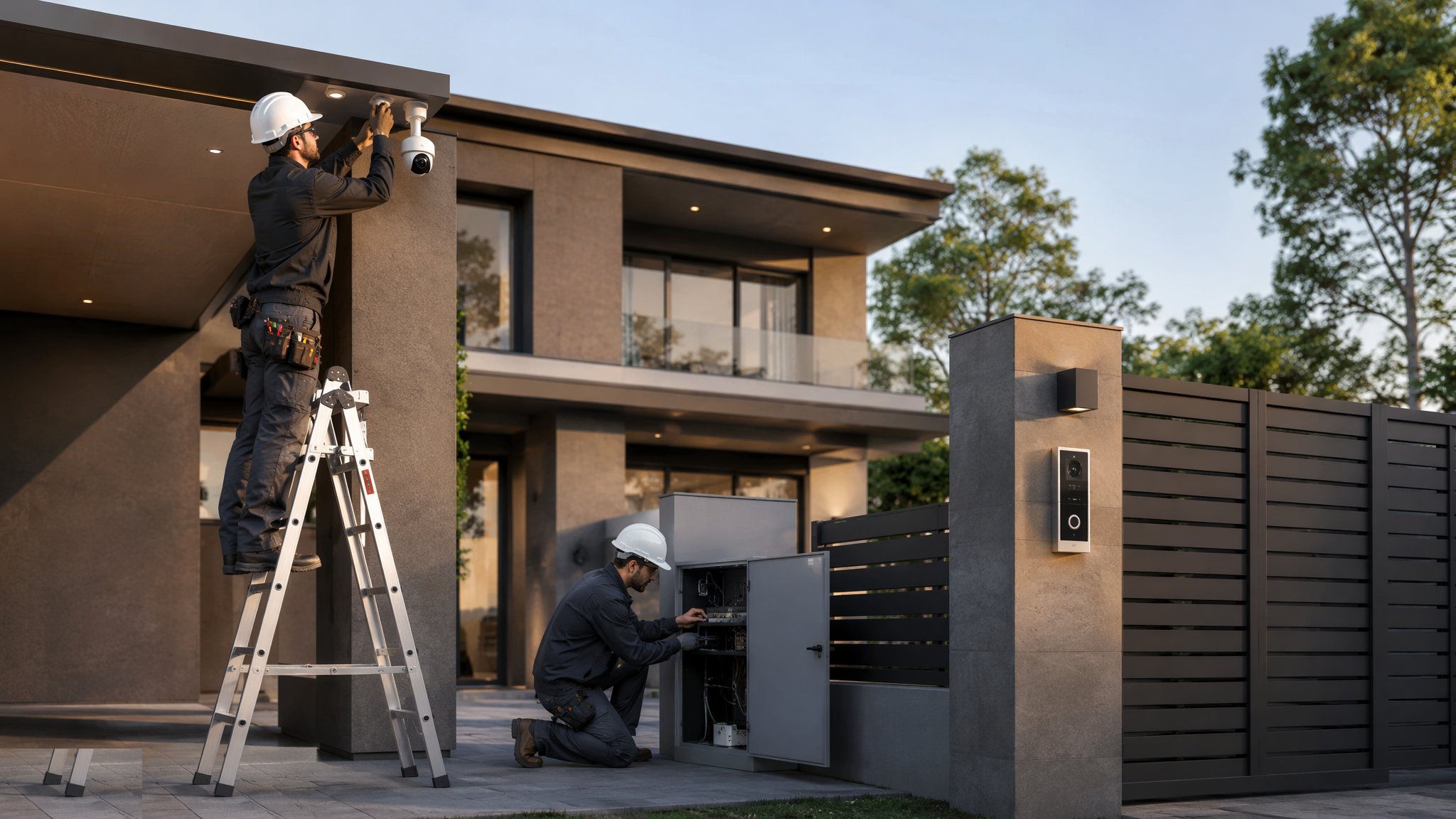
What is Perimeter & gate systems?
Once positions leave the building the work changes character. A perimeter or gate installation is a civils and external services exercise with electronic equipment on the end of it. Cables run in ducts and trenches rather than in ceilings, positions sit on posts, walls or existing structures out in the weather, and power and network have to be carried to places that have neither. On most projects the external cabling routes are installed by the groundworks contractor long before the security specialist appears, which means the duct runs, chambers and foundations have to be right first time. Getting a duct wrong at the far corner of a site is a very expensive thing to find out at second fix.
The gate and barrier interface is the other half of the package. Vehicle and pedestrian entrances usually combine an access control point, the gate or barrier equipment and camera coverage, and each of those is provided by somebody different. The gate installation carries its own safety requirements - it is powered moving plant on a route people and vehicles use - and those safety devices are the gate contractor's responsibility and take precedence over anything the security system asks the gate to do. The designer defines what interfaces to what; the contractors agree the boundary; the gate contractor confirms that nothing in the arrangement compromises the gate's own safety functions.
External work also runs into things that building work does not. Landscaping grows, and planting that was specified as low cover at handover is a different proposition after two seasons, so the landscape architect and the designer coordinate positions and planting between them. Vehicle movement dictates where posts can safely stand and whether protection is needed. Exposure means mountings, enclosures and cable entries have to be detailed for wind, rain, temperature and, in some settings, salt. Recording in publicly visible external areas carries the same obligations around signage, retention and access as anywhere else, and signage at entrances is a physical item that has to be located and installed, not left to be taped up later.
How does Perimeter & gate systems work, step by step?
- 1
Step 1: Set the external strategy with the design team
The designer and the client agree what the external system is for and where positions are needed in principle, working with the landscape architect and the civil engineer from the start. External positions are constrained by things that do not apply inside the building: site levels, vehicle routes, planting, existing structures, boundary treatments and the practicality of getting power and network to each point. The strategy is set against those constraints rather than marked on a plan and handed to the groundworker.
- 2
Step 2: Design the duct routes and the civils
External cabling runs in ducted routes with draw chambers at changes of direction and at intervals along straight runs so cables can be pulled and, later, replaced. Routes are coordinated with every other buried service and with the drainage and landscape design, and depths and protection follow the requirements for buried services. This work is designed and priced with the groundworks package, because it is installed with it - typically during the external works, months before the security specialist mobilises.
- 3
Step 3: Install ducts, chambers and foundations with the external works
Ducts are laid, jointed, sealed and proved with a draw cord left in every one. Chambers are set to finished levels and covered. Foundations for posts and equipment cabinets are cast at the same time, sized and reinforced to the design for the loads and the exposure, with the duct entries built into them. Everything is surveyed as installed, because once the surfacing and landscaping go on, an unrecorded chamber is effectively lost.
- 4
Step 4: Get power and network to remote positions
Remote positions need both power and a data path, and the design decides how each is delivered. On most projects that means a distribution arrangement with equipment housed in external cabinets at intervals around the site, so that runs from the cabinet to each position stay within the limits the cabling design allows. The electrical designer accounts for the external distribution, its protection and its earthing arrangements as part of the site-wide electrical design. Where the client requires positions to keep working through a power interruption, that requirement is set at design stage because it changes the external distribution.
- 5
Step 5: Mount on posts and structures for the exposure
Posts, brackets and enclosures are selected by the designer for the wind loading, the exposure and the height, and they are fixed to foundations designed for the same. Movement matters more outside than in: a mounting that sways gives an unusable image however good the equipment. Cable entries are made from below or through purpose-made glands so water is not led into the enclosure, and dissimilar metals at fixings are considered where corrosion is a risk. Positions on existing structures need the structure checked for the added load and the fixings agreed with whoever owns it.
- 6
Step 6: Coordinate the gate and barrier interface
Where the system serves a vehicle or pedestrian entrance, the interface with the gate or barrier is agreed between the gate contractor, the access control contractor and the security specialist, with the boundaries written down. The gate installation has its own safety devices, and those take precedence: nothing in the interface may compromise them. The gate contractor confirms that in writing after installation. Interfaces are proved on site with the gate operating normally and in its fault conditions, witnessed by the design team.
- 7
Step 7: Coordinate with landscaping and vehicle movement
Planting and position coverage are coordinated with the landscape architect at design stage and reviewed again before handover, because plants specified at nursery size will not stay that size. Long-term maintenance of the planting around external positions is written into the maintenance regime the client is handed. Vehicle routes are considered for both the safety of the installation and the safety of drivers, with protection provided where the design calls for it and posts kept clear of turning paths and reversing areas.
- 8
Step 8: Commission the external system and hand over the record
Each position is proved back to the head end, and the gate and barrier interfaces are proved as a working sequence rather than as individual signals. Commissioning is done in the conditions the system will face, including after dark and in poor weather, because an external system checked only on a clear afternoon has not really been checked. Handover includes the as-built survey of ducts, chambers and cabinets, the interface confirmations, the maintenance requirements including the landscaping, and the signage installed at entrances. Signage and the wider obligations around recorded images are the client's and their advisers' to determine and manage.
What are the benefits of Perimeter & gate systems?
- Extends coverage to entrances, boundaries and yards that building-mounted positions cannot reach
- Ducted routes and chambers make later cable replacement and extension straightforward
- External distribution cabinets keep cable runs within limits on large sites
- Combines naturally with the access control and gate equipment at entrances into one coordinated entrance package
- Civils are installed with the external works, sharing plant and trenching with other buried services
- A surveyed as-built record of ducts and chambers has value for every future project on the site
What are the limitations of Perimeter & gate systems?
- Civils have to be right first time - correcting duct routes after surfacing and landscaping is expensive and disruptive
- Power and network provision to remote positions is a design exercise in its own right, not an extension of the building installation
- Exposure to weather, temperature and in some settings salt drives mounting, enclosure and maintenance requirements
- Mountings that move give unusable images regardless of the equipment on them
- Landscaping grows, so coverage degrades unless maintenance is written into the handover
- Gate interfaces cross three contractors and must never compromise the gate's own safety devices
What is Perimeter & gate systems best suited for?
What plant does Perimeter & gate systems need?
- Excavator and trenching equipment working with the external works package
- Duct, draw cord, chambers and covers, with bedding and surround materials
- Concrete and reinforcement for post and cabinet foundations, with shuttering
- Cable pulling equipment, rods, winches and lubricant for long ducted runs
- Mobile elevating work platform or similar access for mounting at height on posts and structures
- External cabinets, distribution and earthing equipment, with test instruments for the external electrical installation
How is Perimeter & gate systems quality-checked?
- Duct routes and chamber positions coordinated with all other buried services before excavation
- Every duct proved with a draw cord left in and recorded before backfill
- Foundations and post fixings inspected against the design for the exposure and loading
- As-built survey of ducts, chambers, cabinets and positions completed before surfacing and landscaping
- Gate and barrier interfaces proved on site and the gate contractor's written confirmation obtained that its safety devices remain unaffected
- Commissioning carried out in the conditions the system will work in, with the maintenance regime including planting management handed over