Column erection - sectional or single lift
Tall absorber and stripper columns either lifted in one piece with a very large crane or built in sections - a decision about crane availability, ground and risk appetite.
Last updated 2026-09-06
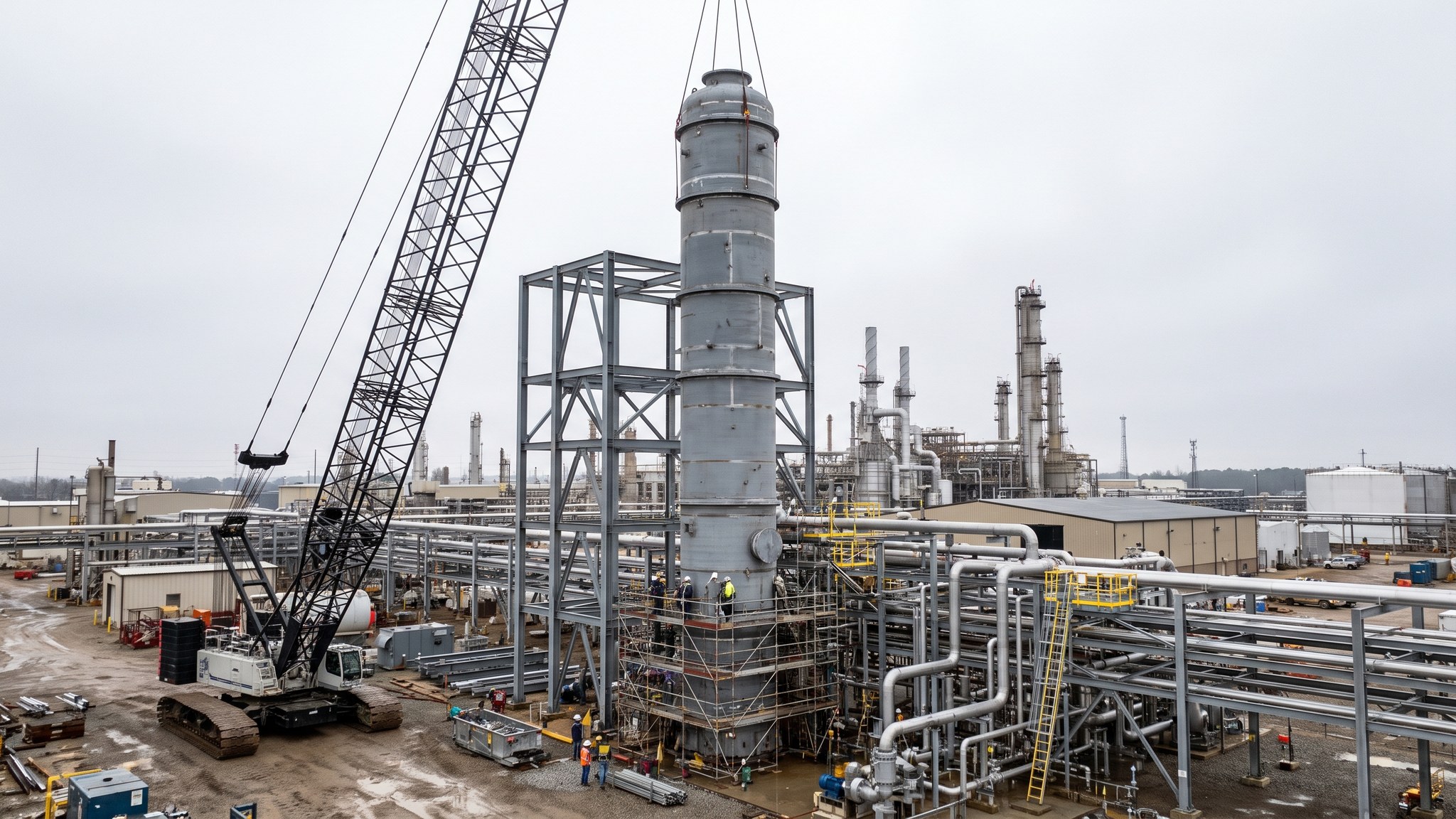
What is Column erection - sectional or single lift?
The columns are the plant. On a large capture plant the absorber commonly stands 40-60 m tall and the stripper is a substantial vessel in its own right, and together they dominate the skyline, the programme and the erection planning. There are two ways to get a column upright: bring it to site complete and lift it in one piece with a very large crane, or bring it in sections and build it in position, joining the sections at height. Both are entirely normal. The choice is made project by project, and it turns on what crane can actually be brought to the site and stood there, what the ground and the plot will allow, what the fabrication and transport route can deliver, and how the project feels about concentrating a great deal of risk into a single irreversible operation.
A single lift is fast and it is clean. The column is fabricated complete, with as much internal and external work done on the ground as possible - trays, internals, insulation, platforms, ladders and pipework - and then it goes up once and it is finished. There is very little work at height and very little joining in position. What it demands is enormous: a crane of a class that may not be readily available, a very large and heavily engineered crane standing area, an assembly area long enough to lay the column down and dress it, a transport route that can deliver a very long indivisible load, and a lift that has to succeed the first time. On a coastal or reclaimed site the crane platform for an operation like that is one of the largest civil engineering exercises on the project.
Sectional erection trades speed for manageability. Sections are delivered on ordinary heavy transport, lifted with cranes of a class that is widely available, and joined in position with welding, inspection, internal work and insulation carried out at height. The programme is longer, there is far more work at height, access has to be provided and maintained for weeks, and the joints have to be made and proved in the air rather than on the ground. But no single operation is irreversible, the crane requirement is achievable on almost any site, and the ground demands are far more modest. The heavy lifting on either route is planned by an appointed person working with the specialist lift contractor, and the arrangements are theirs - what the project decides is which of the two shapes of risk it would rather carry.
How does Column erection - sectional or single lift work, step by step?
- 1
Step 1: Establish what the site and the route will actually allow
The decision begins with physical facts. Whether a complete column could be transported to the site at all, whether there is an assembly area long enough to lay it down and dress it, whether there is room to stand a crane of the required class and whether the ground could ever be made to support it, and whether such a crane is available in the market within the programme. Where any of those fails, the answer is sectional and the project plans accordingly rather than hoping.
- 2
Step 2: Weigh the two risk shapes deliberately
A single lift concentrates risk into one short, irreversible, weather-sensitive operation with an exceptional consequence if it goes wrong. Sectional erection spreads risk across weeks of work at height with more people exposed for longer. Neither is obviously safer and the honest comparison is project specific. On most projects the decision is taken jointly by the client, the designer, the erection contractor and the appointed person, and it is taken early because it drives the fabrication split, the transport, the civils and the programme.
- 3
Step 3: Fix the fabrication split to match the method
If the column is going up in one piece it is fabricated complete, and the fabricator, the transport contractor and the lift contractor agree the lifting arrangement, the trunnion or lug positions and the required stiffening while it is still a drawing. If it is going up in sections, the section split is chosen against transport limits, crane capacity, the position of the field joints and the practicality of making and inspecting those joints at height. Either way the decision is made before fabrication starts, because it changes what is built.
- 4
Step 4: Prepare the foundation and the crane ground
The column foundation is completed, cured and surveyed, with the holding-down arrangement set and recorded to the tolerances the design requires. In parallel the crane standing area, the assembly area and the transport routes are designed, built and certified against the specific crane configuration proposed. On a reclaimed site this may require significant ground improvement, and it is programmed as a major work rather than as a preliminary.
- 5
Step 5: Dress the column on the ground wherever possible
Work done on the ground is safer, quicker and better than the same work done at height, so as much as the method allows is done lying down: internals, platforms, ladders, insulation, tracing, pipework and instruments. On a single-lift project this can be nearly everything. On a sectional project each section is dressed as far as the joint details allow before it is lifted. The temporary loads and the stiffening that dressing adds are accounted for in the lift arrangement.
- 6
Step 6: Plan the lift as an engineering exercise
The lifting operation is designed by the appointed person with the specialist lift contractor: crane selection and configuration, ground loading, the weight and centre of gravity of the item, the rigging arrangement, the tailing arrangement for lifting a long item from horizontal to vertical, exclusion zones, wind limits and the abort criteria. It is issued as a written plan and briefed to every person involved. None of it is decided on the day and none of it belongs on a page like this - it belongs to the appointed person for the specific operation.
- 7
Step 7: Erect, secure and stabilise
The column, or the first section, is lifted, brought upright, landed on the foundation, aligned and secured before the crane is released, with any temporary stability arrangements installed as the design requires. On a sectional erection each subsequent section is landed, aligned and made secure, with temporary stability maintained continuously until the permanent connections and any permanent bracing are complete. A part-erected column is a temporary structure and is designed as one.
- 8
Step 8: Complete, inspect and hand over the erected column
On a sectional erection the field joints are welded, inspected and tested at height, and the internals, insulation and external work interrupted by the joints are completed in position under proper access. On either route the erected column is surveyed for verticality and position, the foundation connection is completed and grouted as designed, and the item is handed over to the pipework, cabling and insulation trades. The access provided for the joint work is retained until the inspection and the punch items are closed.
What are the benefits of Column erection - sectional or single lift?
- A single lift removes almost all work at height and joining in position, finishing the column in one operation
- Ground-level dressing of internals, platforms and insulation is faster, safer and easier to inspect
- Sectional erection needs only widely available crane classes, so it is possible on nearly any site
- Sectional delivery uses ordinary heavy transport rather than exceptional indivisible loads
- Sectional working spreads risk across many reversible operations instead of one irreversible one
- Either route can be planned in detail well in advance, since both are governed by known physical constraints
What are the limitations of Column erection - sectional or single lift?
- A single lift needs a crane class that may not be available, and an engineered standing area that can be a major civils work in itself
- A complete column is an exceptional transport load requiring route survey, consents and often marine delivery
- A single lift concentrates risk into one short weather-sensitive operation that must succeed first time
- Sectional erection puts weeks of welding, inspection and finishing work at height
- Sectional field joints must be made and proved in position, which is slower and harder to control than shop work
- Sectional work requires access to be provided and maintained at height for an extended period
What is Column erection - sectional or single lift best suited for?
What plant does Column erection - sectional or single lift need?
- Very large crawler or ring cranes for single-lift operations, with tailing cranes or tailing trailers
- Widely available crawler and mobile cranes for sectional erection
- Heavy transport for column sections, or specialist transport and marine delivery for complete columns
- Engineered and certified crane standing areas, assembly areas and transport routes
- Site welding, preheat and non-destructive testing equipment for field joints at height
- Access systems, temporary stability steelwork, and survey equipment for verticality and position
How is Column erection - sectional or single lift quality-checked?
- Erection method chosen and recorded early, with the fabrication split, transport and civils aligned to it
- Crane standing area, assembly area and routes designed and certified against the specific configuration proposed
- Foundation and holding-down arrangement surveyed and released before the column arrives
- Written lift plan prepared by the appointed person, briefed to all involved, with wind limits and abort criteria defined
- Field joints welded and inspected to the specification, with the inspection access planned as part of the sequence
- Verticality and position surveyed after erection, temporary stability retained until permanent connections are complete, and access retained until punch items are closed