Stick-built on site
Erected piece by piece on site - more labour and a longer programme, but far more tolerant of change and of restricted access.
Last updated 2026-09-06
What is Stick-built on site?
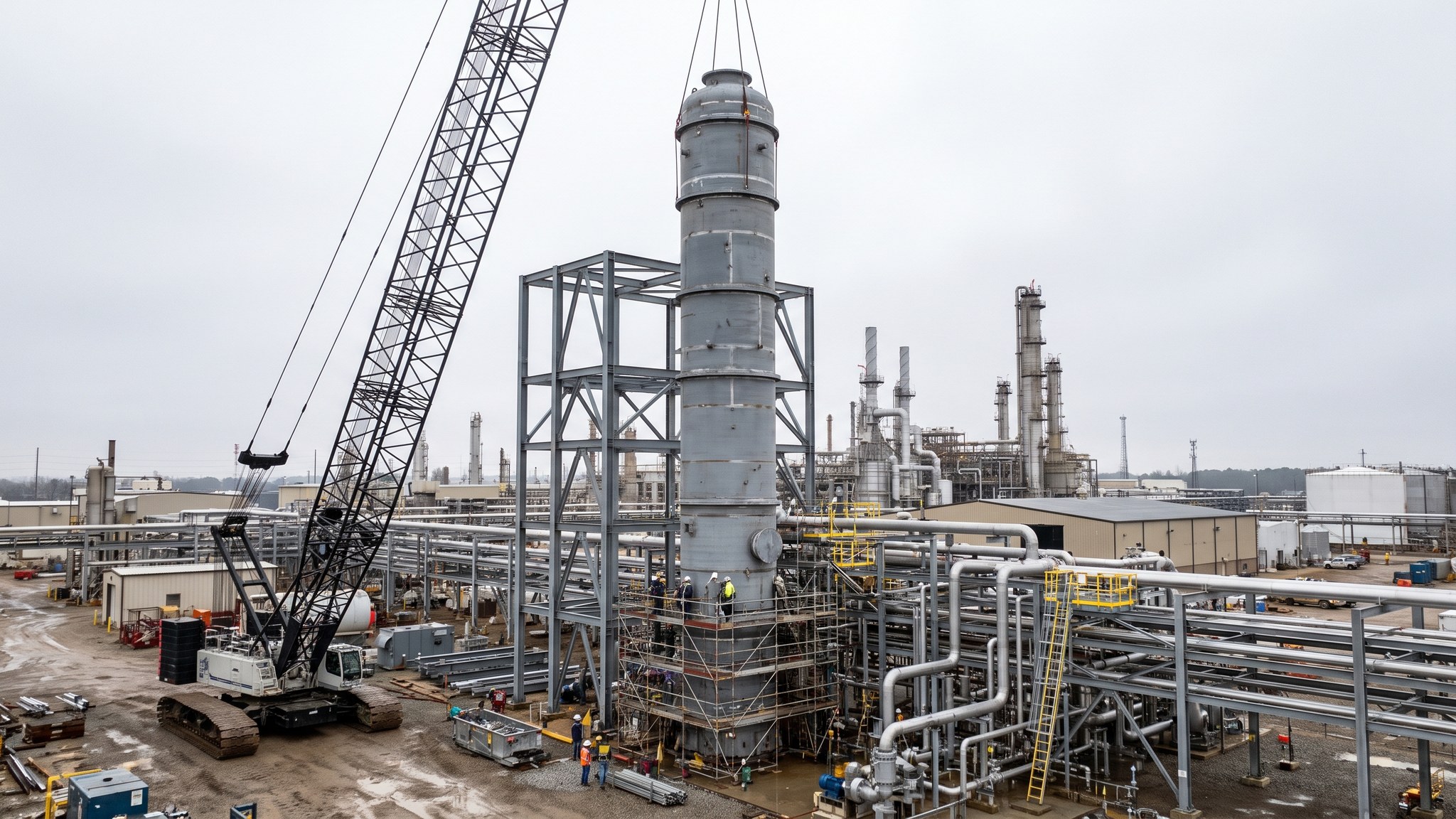
Stick-built means the plant is assembled on site from its individual components: steelwork erected member by member, vessels set individually, pumps and exchangers placed on their bases, and pipework fabricated and installed spool by spool in position. It is the traditional way process plant has always been built, and it remains the right answer more often than the enthusiasm for modularisation suggests. Where site access is too restricted for large indivisible loads, where the transport route cannot take a module, where no suitable crane can be brought in or stood, or where the design is genuinely not fixed, stick-building is not the fallback - it is the only method that works.
The great advantage of stick-building is tolerance, in both senses. Dimensionally, components are fitted to what is actually there: a spool is measured in place and cut to suit, a support is adjusted, a connection is trimmed. The accumulated errors that would stop a module fitting are absorbed piece by piece as the work proceeds. Programme-wise, the method absorbs change: a late design change, a client alteration, a discovery in the existing works, or a supplier delay affects the pieces concerned rather than a whole pre-assembled unit and its transport arrangements. On brownfield tie-in work into an existing operating plant, where what is actually there rarely matches what was drawn, this flexibility is worth a great deal.
The cost is site hours. Every hour of work done in position is an hour in a live industrial environment, under permit, frequently at height, often in poor weather, with more people on the plot, more scaffold, more temporary access and more supervision. The programme is longer and the exposure is greater, and on a remote or congested site the accommodation, welfare and logistics burden of a large site workforce becomes a project problem in its own right. So the honest comparison is not stick-built against modular in the abstract. It is what the specific site, route, crane availability and design maturity will actually allow, and on most real projects the answer includes some of each.
How does Stick-built on site work, step by step?
- 1
Step 1: Confirm that stick-building is the right answer for this plot
The decision is made against the physical constraints. Whether a module could be delivered at all along the available route, whether a crane large enough could be brought in and stood, how congested the plot is, how mature the design is, and how much change is expected. Where the constraints rule out modules, stick-building is chosen deliberately and early, so that the design, the procurement and the site organisation are all built around it rather than adapted to it later.
- 2
Step 2: Plan the erection sequence and the access that serves it
Stick-building is an access problem before it is an erection problem. The sequence is planned so that each element can be reached, lifted and worked on, and so that later work is not locked out by earlier work. Scaffold, mobile access, temporary platforms, crane positions and laydown are planned with the sequence rather than requested when they are needed. On a congested process plot the difference between a good sequence and a poor one is measured in months.
- 3
Step 3: Prepare foundations and set out from a single control network
Foundations are completed, surveyed and released area by area, and all erection setting-out comes from the same primary control network the civils used. Even though stick-building tolerates dimensional variation better than modular work, the structure still has to end up where the design put it, and the equipment on it still has to align. Working from a common network rather than from local measurements keeps the accumulated position honest.
- 4
Step 4: Erect the structural steel and the racks
Steelwork is erected member by member under a lift plan appropriate to each operation, bolted up, aligned, plumbed and finally torqued or welded as the design requires. Racks go up early where possible, because they open the plant for pipework and cabling. Temporary bracing and stability arrangements are designed rather than improvised, and their removal sequence is designed too, since a frame that is stable when finished may not be stable halfway through.
- 5
Step 5: Set vessels and equipment individually
Vessels, exchangers, pumps and drives are lifted and set on their prepared bases one at a time, each under a lift plan prepared by the appointed person. They are aligned, levelled, shimmed or grouted and secured as the supplier and the design require. Setting equipment individually keeps lift weights modest and crane requirements manageable, which is frequently the reason the plant is being stick-built in the first place.
- 6
Step 6: Fabricate and install pipework to measured dimensions
Spools are prefabricated where sensible and adjusted to measured dimensions in position, with the closing pieces cut and welded to what is actually there. This is where the flexibility of the method pays: differences that would prevent a module fitting are simply absorbed. Welding, inspection and testing are carried out to the specification, with the inspection regime planned around the access provided rather than assuming it.
- 7
Step 7: Install cabling, instruments and services in position
Cable routes, tray, conduit, instruments, tracing and insulation are installed on the erected plant. This work is labour-heavy, access-dependent and easily squeezed at the end of a programme, so it is sequenced deliberately alongside the mechanical work rather than left to follow it. Coordination between disciplines competing for the same access is a daily management activity on a stick-built plot.
- 8
Step 8: Complete, test and hand over system by system
The plant is completed, cleaned, tested and pre-commissioned system by system rather than area by area, because systems are what commissioning needs. Punch listing runs continuously as areas complete, and access is retained until the punch items are closed - taking scaffold down too early is one of the more reliable ways to lengthen a stick-built programme.
What are the benefits of Stick-built on site?
- Works on plots and routes where large indivisible loads simply cannot be delivered
- Needs only modest crane capacity, which may be the deciding constraint on a congested site
- Absorbs dimensional variation piece by piece, so accumulated error rarely stops the work
- Tolerates late design change far better than any pre-assembled approach
- Well suited to tie-in work into existing plant, where reality rarely matches the drawings
- Allows work to start before the design is fully frozen, which can pull the start date forward
What are the limitations of Stick-built on site?
- Much higher site labour content, with the cost, welfare, logistics and supervision burden that brings
- Longer site programme, which matters most where a shutdown or tie-in window is fixed
- More work at height, in confined spaces and under permit in a live industrial environment
- Weather exposure directly affects productivity and quality
- Heavy dependence on scaffold and temporary access, which is a cost and a coordination load in itself
- Quality control is harder in position than in a yard, and inspection access must be planned rather than assumed
What is Stick-built on site best suited for?
What plant does Stick-built on site need?
- Mobile and crawler cranes of modest capacity working across many small lifts
- Scaffold, mobile elevating work platforms and temporary access systems
- Site welding, cutting and pipe fabrication equipment, with weather protection
- Non-destructive testing and inspection equipment deployed in position
- Alignment, levelling, shimming and grouting equipment for individually set machines
- Survey equipment tied to the primary control network, with laydown and material handling plant
How is Stick-built on site quality-checked?
- Erection sequence and access plan agreed before work starts, with temporary stability designed and its removal sequence defined
- All setting-out taken from the single primary control network, with periodic verification
- Individual lift plans prepared by the appointed person for each equipment lift
- Welding and inspection carried out to the specification with access planned for the inspection, not improvised
- Alignment and grouting records for every machine, rechecked once running conditions are reached
- System-by-system completion, testing and punch listing, with access retained until punch items are closed