Hybrid - modular skids with site-built interconnects
Skids delivered complete, with the interconnecting pipework and cabling built on site - the common real-world compromise.
Last updated 2026-09-06
What is Hybrid - modular skids with site-built interconnects?
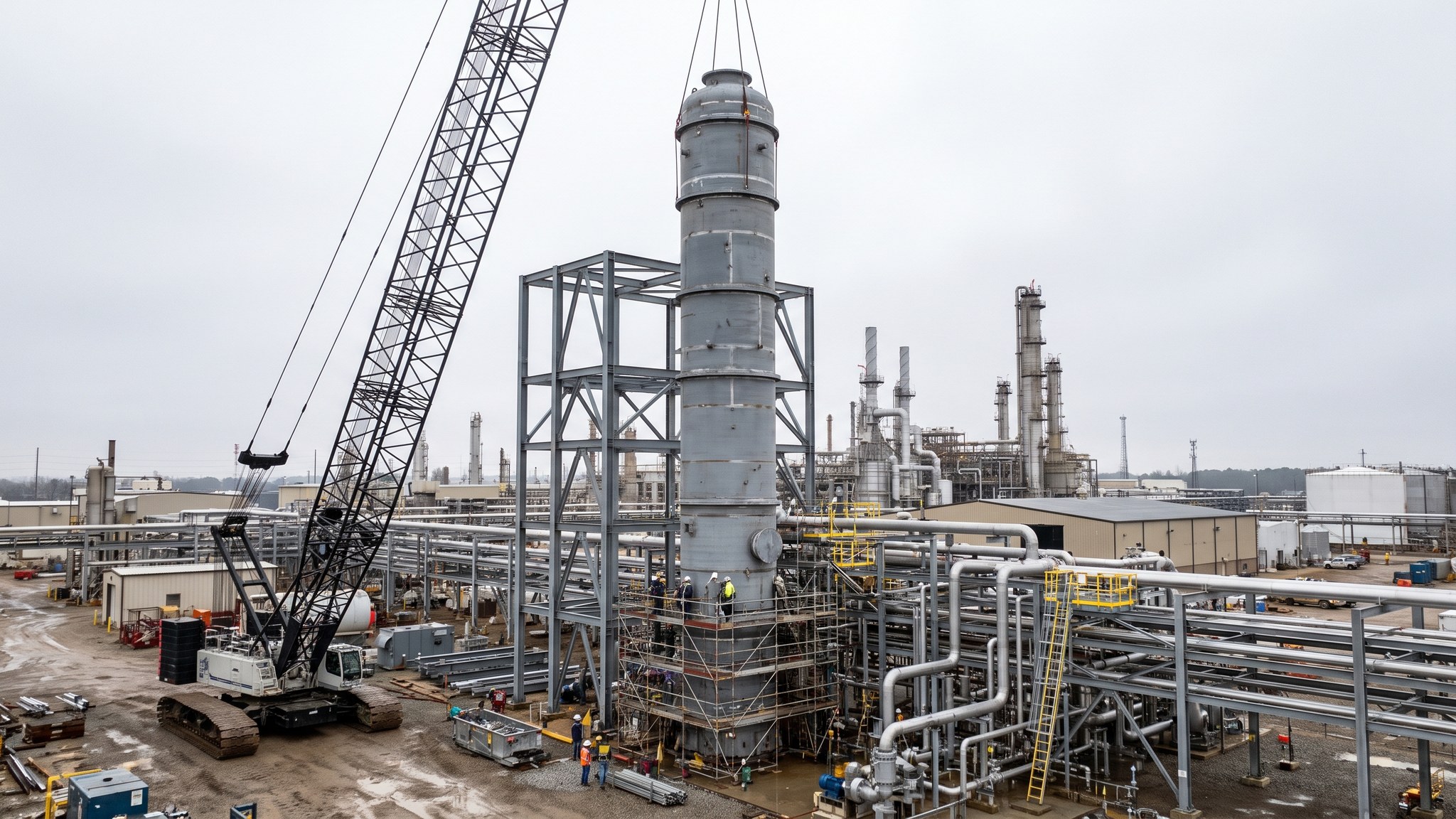
The hybrid approach is what most capture plants actually get built as, whatever the strategy paper said. Equipment that packages naturally - pump sets, chemical dosing systems, package units, small process assemblies, electrical and control rooms - is bought or built as complete skids in a yard, tested there and delivered ready to place. The things that connect them - the main pipework runs, the rack pipework, the cabling, the services and the tie-ins to the existing works - are built on site to measured dimensions. It is a deliberate division: put the dense, repeatable, testable content into a controlled environment, and keep the parts that have to absorb site reality in a form that can absorb it.
That division works because it puts each type of work where it is strongest. Skid content is exactly the work that suffers most on a congested plot: dense pipework in a small volume, lots of small connections, instruments and cabling, all needing good access and clean conditions. Built in a yard on a frame, tested and shipped, it arrives as a single item to be placed and connected. Interconnects, by contrast, are exactly the work that resists prefabrication: long runs that have to fit between things whose as-built positions are only known when they are built, and tie-ins into existing plant whose condition is discovered rather than designed. Cut and fitted in position, they absorb every accumulated difference on the plot.
The price of the compromise is that the interfaces multiply. Every skid has connection points, and every connection point is a place where the yard and the site have to agree. The projects that run well are the ones that manage those connections deliberately: a register of every skid interface with its position and tolerance, as-built surveys of skids and foundations exchanged before delivery, and deliberate closure pieces left in the interconnecting runs so that the final dimension is taken from the plant as built rather than from the model. Skid sizes are also chosen with the site in mind - modest enough to be handled with the cranes and routes already available, which is often the practical difference between a hybrid scheme and a full modular one.
How does Hybrid - modular skids with site-built interconnects work, step by step?
- 1
Step 1: Draw the line between skid content and site content
The split is decided early, package by package. Dense, self-contained, testable content goes on skids. Long runs, rack pipework, tie-ins and anything whose final dimension depends on as-built conditions stays on site. The test applied on most projects is simple: if it can be finished and proved in a yard and delivered as one item within the handling capacity available, it is a candidate for a skid. If its dimensions depend on what something else ends up doing, it is not.
- 2
Step 2: Size the skids to the site, not to the yard
Skid dimensions and weights are set by what the delivery route, the site access and the available cranes can actually handle, and by where the skid has to be set down and manoeuvred once inside the plot. Sizing skids to suit yard convenience and then discovering the route cannot take them is a common and expensive error. Where a skid is close to a handling limit, the transport and lift arrangements are confirmed with the specialist contractors before the design is frozen.
- 3
Step 3: Define every skid interface and its tolerance
Each skid has connection points for process, utilities, drainage, power, control and structure, and each one is defined with a position, an orientation and a tolerance, held on a register with a named owner. Deliberate closure pieces are designed into the interconnecting runs at these points so that the last dimension can be taken in the field. Designing the interconnects as if every skid will land exactly where the model says is the single most reliable way to create rework.
- 4
Step 4: Build, test and survey the skids in the yard
Skids are fabricated in the yard with the specified inspection and testing completed there, including as much cleaning and pre-commissioning as is sensible. Before shipment each skid is surveyed at its interface points and the as-built dimensions are issued to site. This survey, compared against the as-built foundations, is the check that turns a delivery into a straightforward placement.
- 5
Step 5: Prepare and survey the receiving foundations
Foundations, plinths and support steel for each skid are completed, cured, surveyed against the model and released. The as-built survey goes back to the yard so that any mismatch is dealt with before the skid is loaded. Where the difference cannot be resolved in the yard, the designer decides the remedy - a modified support, a shim arrangement or an adjusted closure piece - and it is planned rather than improvised on delivery day.
- 6
Step 6: Deliver and place the skids
Skids are transported and placed under arrangements planned by the specialist transport contractor and, for the lifting, by the appointed person. Because skid weights are modest compared with full modules, the plant needed is usually available on site already, which is much of the attraction of the approach. Each skid is set, aligned, levelled and secured to its supports, then surveyed in place so that the interconnect dimensions can be taken from reality.
- 7
Step 7: Build the interconnecting pipework and cabling to measured dimensions
With the skids in position, the main runs, rack pipework, cabling, services and tie-ins are fabricated and installed to dimensions measured on the plant as built. Closure spools are cut last. This is the part of the project that absorbs everything the survey did not predict, and it works precisely because it was designed to be measured rather than assumed. Welding, inspection and testing follow the specification, with access planned alongside the sequence.
- 8
Step 8: Complete and test as whole systems
Skid testing done in the yard does not remove the need to test the completed system, because the connections between skids were made on site. Systems are completed, cleaned, tested and pre-commissioned end to end, with the yard test records forming part of the overall pack rather than replacing it. Punch items are worked off system by system while access is still available.
What are the benefits of Hybrid - modular skids with site-built interconnects?
- Puts dense, fiddly, testable content in a controlled yard while leaving the variable content adjustable on site
- Skid sizes stay within the handling capacity already available, avoiding very large cranes and special transport
- Interconnects absorb accumulated dimensional differences that would defeat a full modular scheme
- Copes well with tie-ins into existing plant, where conditions are discovered rather than designed
- Reduces site labour meaningfully without freezing the whole design as early as full modularisation requires
- Skid procurement can proceed in parallel with site civils and with continuing design of the interconnects
What are the limitations of Hybrid - modular skids with site-built interconnects?
- Many more interfaces to manage than either a full modular or a full stick-built scheme
- Requires disciplined as-built survey exchange between yard and site to work properly
- Site labour content remains significant, with the access, permit and weather exposure that brings
- Skid deliveries still create fixed dates that the foundation programme must meet
- Yard testing does not remove system testing on site, so some duplication of effort is inherent
- The split has to be decided early; moving content between yard and site later is disruptive
What is Hybrid - modular skids with site-built interconnects best suited for?
What plant does Hybrid - modular skids with site-built interconnects need?
- Yard fabrication and testing facilities for skid build and pre-commissioning
- Road transport suited to modest indivisible loads, with route confirmation
- Mobile and crawler cranes of the capacity already available on site
- Site pipe fabrication, welding and cutting equipment for closure pieces and interconnects
- Scaffold and mobile access for the interconnecting runs and tie-ins
- Precise survey equipment for interface as-built recording at both the yard and the site
How is Hybrid - modular skids with site-built interconnects quality-checked?
- Skid and site content split formally recorded, with the handling capacity that justified the skid sizes
- Interface register maintained with position, orientation and tolerance for every skid connection
- Yard inspection, testing and pre-shipment interface survey completed and issued to site
- Foundation as-built survey issued to the yard before loading, with a defined route for resolving mismatches
- Post-placement survey of every skid before interconnect dimensions are taken
- System-level testing and pre-commissioning completed on site, with yard records included in the pack rather than substituted for it