Modular - pre-assembled units built off site
Large pre-assembled units built in a fabrication yard and shipped in, moving the work away from a congested or remote site.
Last updated 2026-09-06
What is Modular - pre-assembled units built off site?
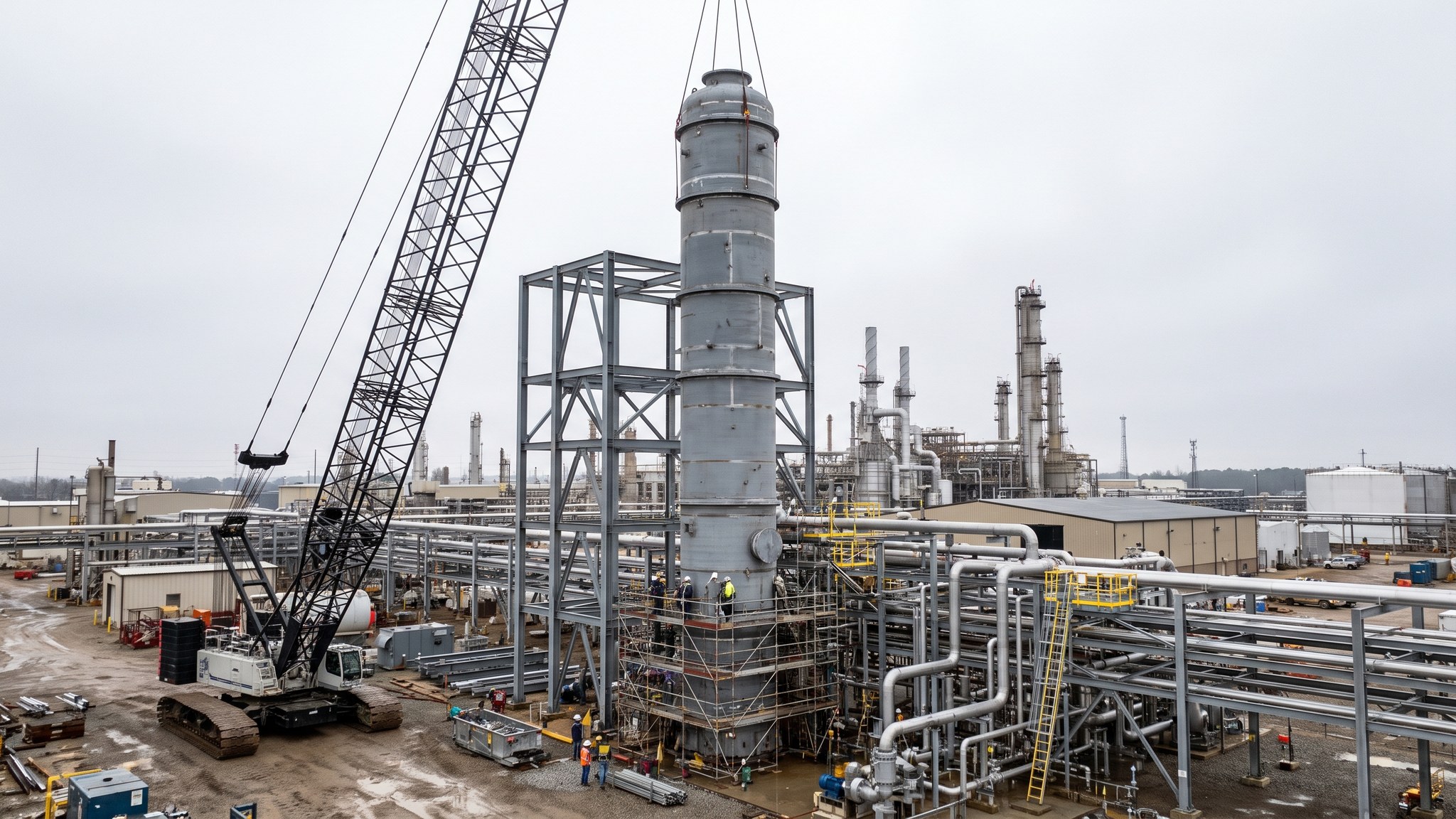
Modular installation means building as much of the plant as possible somewhere else. Vessels, pumps, exchangers, pipework, cabling, instruments, structural steel and access are assembled into large pre-assembled units in a fabrication yard, tested there, and then transported to site and set on prepared foundations. The reason is almost always the site: capture plants are built inside or beside operating industrial works, on congested plots, often in remote coastal locations, and site labour there is expensive, weather-exposed, permit-controlled and slow. A fabrication yard is flat, sheltered, laid out for the work, has cranes on rails and a stable workforce. Work done there is generally faster, safer and more consistent than the same work done in a live plant with a permit queue.
What that buys is programme and quality, and what it costs is flexibility. Once a module is designed for transport and lifting, the design is effectively frozen: the steelwork is sized for the transport and lift cases as well as the operating case, the centre of gravity has been calculated, the lifting points are engineered, and the route has been surveyed. A change after that point is not a change to a drawing, it is a change to a transport study, a lift plan and possibly a vessel booking. On most projects the modular decision therefore forces engineering completeness far earlier than a conventional project would, and that in itself is a significant discipline shift for the client and the designer.
The other consequence is that the critical path leaves the site. Delivery dates set by fabrication and by marine or road transport become fixed points in the programme, and everything on site is arranged around them: the foundations for that area, the crane, the platform, the route, the receiving arrangements. Heavy transport and heavy lifting are planned by the appointed person and the specialist heavy lift and transport contractors, with the lift itself designed as an engineering exercise and not decided on site. The recurring failure mode on modular projects is not fabrication quality. It is interface tolerance: modules that were each built correctly, to slightly different interpretations, meeting at a flange that will not close.
How does Modular - pre-assembled units built off site work, step by step?
- 1
Step 1: Decide the modularisation strategy early
The split between what is built in the yard and what is built on site is settled at an early design stage, because it drives the whole project. The decision weighs site congestion, the availability and cost of site labour, the working environment, the transport routes and the vessel or trailer capacity available, and the tolerance for programme risk. Modularising late is not really possible: by then the design has been drawn as a stick-built plant and re-cutting it into modules is a redesign.
- 2
Step 2: Design the modules for transport and lifting as well as for service
A module has to survive being lifted, driven, sailed and lifted again, and those load cases are frequently more onerous than operation. The designer sizes the frame accordingly, engineers the lifting points, calculates and marks the centre of gravity, and adds temporary bracing where the module needs it in transit. Transport and lift studies are carried out by the specialist contractors and their conclusions feed back into the design. This is an iterative loop, and it has to close before fabrication starts.
- 3
Step 3: Fix the interfaces and the tolerances in writing
Every module has edges where it meets another module, a rack, a foundation or the existing works, and each of those is a defined interface with an agreed position, orientation and tolerance. On most projects the interfaces are managed on a register with a named owner, because the modules are built by different teams, sometimes in different yards, and the only thing keeping them compatible is a common and unambiguous statement of where the connection points are.
- 4
Step 4: Build and test in the yard
Fabrication proceeds in the yard with the inspection and test regime the specification sets, done there where access is good rather than on site where it is not. As much testing, cleaning, and pre-commissioning as can sensibly be completed off site is completed off site, because every test moved into the yard is a test removed from the congested end of the project. Dimensional control in the yard is continuous, and the module is surveyed against the model before it leaves.
- 5
Step 5: Survey the module and the foundations before shipping
Before a module is loaded, its interface dimensions are surveyed and compared with the as-built survey of the foundations and adjacent structures waiting for it on site. Mismatches found at this point can be corrected in the yard cheaply. The same mismatch found when the module is hanging on a crane is a very expensive discovery, and this single check is the most valuable quality activity on a modular project.
- 6
Step 6: Transport the module under a planned route and method
Load-out, sea or road transport, sea fastening, and delivery to the receiving point are planned and executed by the specialist transport contractor, with the route surveyed and the necessary consents obtained. On site the receiving arrangements are prepared to match: the engineered transport route, the ground beneath it, the set-down area and the access controls. Weather and tidal windows are part of the plan, not an afterthought, and they routinely govern the date.
- 7
Step 7: Set the module under a lift plan prepared by an appointed person
The lift is planned by an appointed person, using the crane configuration, ground conditions, module weight and centre of gravity, rigging arrangement and exclusion zones set out in a written plan. The plan is briefed to everyone involved, the platform certificate is checked against the configuration actually being used, and the operation proceeds under the control of the lift supervisor. Nothing about a lift of this scale is decided on the day, and the arrangements themselves belong entirely to the appointed person and the specialist lift contractor.
- 8
Step 8: Set down, align, connect and close out
The module is set on its prepared foundations, aligned and levelled to the requirements, secured, and grouted or shimmed as the design requires. Then the site work begins: the interconnecting pipework, cabling and services between modules, the tie-ins to the existing works, and the reinstatement of anything removed for access. Those connections are surveyed and adjusted rather than assumed, and they are where the residual site labour on a modular project is concentrated.
What are the benefits of Modular - pre-assembled units built off site?
- Moves large volumes of work away from a congested, permit-controlled or remote site into a yard laid out for it
- Reduces site labour hours and therefore reduces exposure to work at height and confined space on a live plant
- Yard conditions give better access, better weather protection and more consistent quality control
- Shortens the site programme substantially, which matters most where a shutdown or a tie-in window is fixed
- Allows testing and pre-commissioning to happen where access is good, off the critical end of the project
- Fabrication can proceed in parallel with site civils rather than after them
What are the limitations of Modular - pre-assembled units built off site?
- Freezes the design very early, and changes after that point ripple into transport and lift planning
- Steelwork must be sized for transport and lift cases, adding weight and cost that operation alone would not require
- Route, vessel, trailer and crane availability constrain module size and can govern the whole programme
- Interface tolerance between separately built modules is the dominant failure mode
- Delivery dates become immovable fixed points that the rest of the site must serve
- Weather and tidal windows for load-out, sail and lift introduce risk outside anybody's control
What is Modular - pre-assembled units built off site best suited for?
What plant does Modular - pre-assembled units built off site need?
- Fabrication yard facilities: covered bays, rail-mounted or crawler cranes and dimensional control equipment
- Self-propelled modular transporters, heavy trailers and load-out arrangements
- Barges or heavy transport vessels with sea fastening for marine delivery
- Very large crawler or ring cranes on site, configured for the planned lifts
- Engineered transport routes, set-down areas and certified crane platforms
- Precise survey equipment for dimensional control in the yard and as-built checking on site
How is Modular - pre-assembled units built off site quality-checked?
- Interface register maintained with a named owner, defining position, orientation and tolerance for every connection
- Transport and lift studies completed and fed back into the module design before fabrication starts
- Yard inspection and test regime completed and documented, with dimensional control throughout fabrication
- Pre-shipment survey of module interfaces compared against as-built survey of the receiving foundations
- Written lift plan prepared by the appointed person, briefed to all involved, and checked against the platform certificate for the configuration in use
- Post-set survey, alignment record and formal close-out of every interface, tie-in and reinstatement
More capture plant installation methods
Next method
Stick-built on site