Category 7 / full volumetric DfMA
Complete rooms or whole units built and fitted out in a factory, then stacked into a building.
Last updated 2026-09-05
What is Category 7 / full volumetric DfMA?
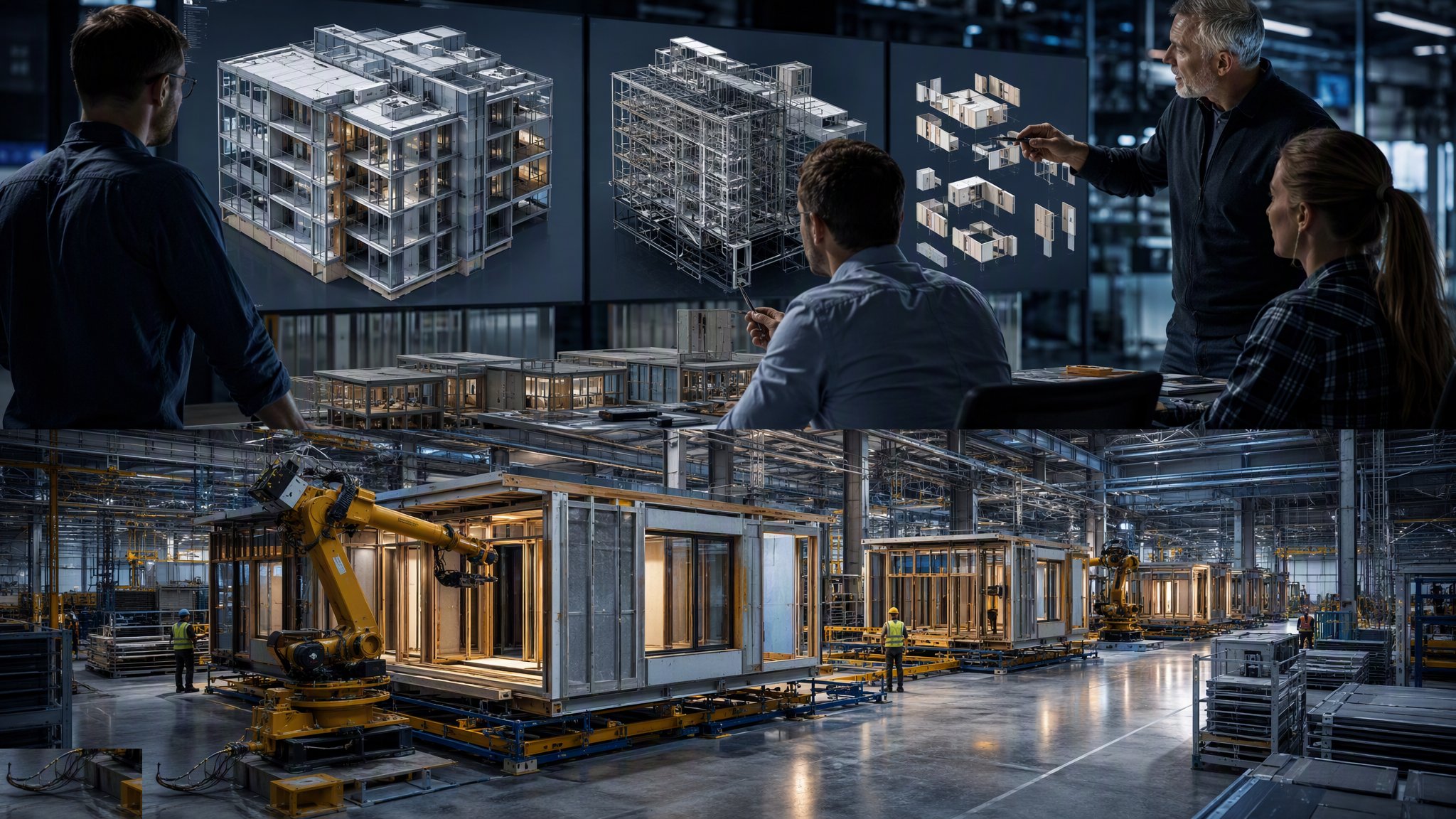
Full volumetric construction - known in the industry as category 7, the deepest level of off-site commitment - builds complete three-dimensional units in a factory. A module is a room, a group of rooms, or an entire apartment or hotel bedroom, built with its structure, its envelope, its services, its finishes, its sanitaryware, its kitchen and often its floor coverings and window dressings already in place. It leaves the factory as a finished interior. On site, modules are lifted into position, stacked and connected, and the building is completed by joining them together, connecting services between them and finishing the junctions. Practically all of the interior work has already happened.
The transformation this represents is a transformation of where the work happens, not of how much there is. A volumetric project moves the great majority of construction labour into a factory, where it is done under cover, at bench height, in sequence, by people who do the same task repeatedly with the right tools and materials at hand. What remains on site is groundwork and foundations, the crane operation, the connections, the external envelope junctions and the commissioning. Because the factory work and the site work can run in parallel, the overall programme can be dramatically shorter than a traditional build, and the period of disruption at the site itself shorter still - which is why the approach is chosen for constrained urban sites, live campuses and operational estates as often as for pure speed.
The commitment required is total and it is front-loaded. The design has to be complete - structurally, architecturally and in every service - before manufacture starts, because a module in production cannot absorb change. That design freeze happens far earlier than any traditional project would contemplate, and it is the single biggest cultural difficulty for teams new to the method. The building must also be designed as a stack of modules from the first sketch: the grid, the circulation, the structural strategy and the module dimensions are set by what can be made, transported and lifted, not adjusted to suit later. And the project becomes dependent on a factory - its capacity, its programme and its commercial health - in a way that traditional construction never is. Where volumetric goes wrong it is rarely the modules that fail; it is a design that was not finished before it was frozen, or a factory whose capacity was assumed rather than secured.
How does Category 7 / full volumetric DfMA work, step by step?
- 1
Step 1: Commit to volumetric at the very start
The decision has to be taken before the design has any real form, because it determines the structural grid, the module dimensions, the circulation strategy, the position of every joint, the foundation design and the whole procurement route. Transport limits and lifting capacity set the maximum module size, and the building is planned around that from the first sketch. A scheme designed conventionally and converted later is a different and much worse proposition.
- 2
Step 2: Design the building and the module together
The design team and the manufacturer work together from the outset, because the module is both a product and a part of a building. Structure, envelope, fire strategy, acoustics, services distribution, the connections between modules and the finishes are developed as one integrated design. The manufacturer's constraints - what the line can build, what the mould or jig allows, what the transport frame accepts - are inputs to the design rather than objections raised against it.
- 3
Step 3: Complete and freeze the design in full
The design is developed to full manufacturing information and then frozen. Every dimension, every service run, every socket, every finish and every interface is fixed. This is far beyond what a traditional project has resolved at the equivalent stage, and it is the discipline that decides whether the method delivers. Client sign-off has to be genuine and informed, because there is no meaningful opportunity to change anything once the line starts.
- 4
Step 4: Build and sign off a prototype module
A complete prototype module is built and inspected, walked through and used by the design team, the client and the end user. Everything that a drawing cannot settle - reach, light, acoustics, the feel of the space, the position of controls, how the kitchen actually works - is tested here. The prototype is also used to prove the assembly sequence on the line. It is then signed off as the benchmark, and every production module is measured against it.
- 5
Step 5: Manufacture on a production line
Modules move through the factory in a repeating sequence of stations: structure, envelope, first fix services, linings, second fix, finishes, fit-out and final test. Each station does the same work on every module, which is what produces the consistency. Quality control is embedded at each station rather than applied at the end, and each module carries its own identity and record. Line capacity, not site progress, becomes the governing production constraint.
- 6
Step 6: Test, protect and transport
Completed modules are fully tested - services pressure tested, electrical installation inspected and tested, drainage run, ventilation tested, weathertightness checked - and then sealed, wrapped and protected. Transport is a substantial exercise in its own right, with module dimensions governed by what can travel the route, escorts and permissions arranged, and deliveries sequenced tightly because there is nowhere on a typical site to store finished modules.
- 7
Step 7: Prepare the site in parallel and stack the modules
While the factory builds, the site carries out groundworks, foundations and any in-situ core or podium, all set out to a tolerance the modules can be landed on. Modules are then lifted and stacked as a planned lifting operation designed by the appointed person, following a sequence set out in advance, and connected structurally as they go. Stacking a floor of modules is commonly a matter of a day or two, which is why the site period is so short and why the lift planning has to be so thorough.
- 8
Step 8: Connect, seal, fire-stop and commission
The remaining work is at the junctions: structural connections, services connections between modules and to the incoming supplies, weathertightness at the envelope joints, acoustic separation between modules, and fire-stopping at every junction and penetration. This is the site-built part of a factory-built building and it is where the defects concentrate, so it is inspected and recorded exhaustively before anything is closed up. The building is then commissioned as a whole and handed over.
What are the benefits of Category 7 / full volumetric DfMA?
- The great majority of construction work moves into a controlled factory environment
- Factory production and site works run in parallel, so the overall programme can be much shorter
- The period of disruption at the site itself is dramatically reduced
- Consistent, repeatable quality from a production line with quality control at each station
- Far fewer people on site, less work at height and less exposure to weather
- Substantially less site waste and better material control
What are the limitations of Category 7 / full volumetric DfMA?
- Demands a complete design freeze far earlier than any traditional project
- The building must be conceived as a stack of modules from the first sketch
- Module size is bounded by transport and lifting limits, which constrain the architecture
- Total dependence on a factory's capacity, programme and commercial health
- Front-loaded cash flow, since modules are paid for before they are on site
- Defects concentrate at the site-built junctions between modules
- Not viable for irregular buildings or sites without crane access and delivery routes
What is Category 7 / full volumetric DfMA best suited for?
What plant does Category 7 / full volumetric DfMA need?
- Factory production line with stations for structure, envelope, services, finishes and fit-out
- Jigs, moulds and handling equipment sized to the module family
- Factory test facilities for services, electrical, drainage, ventilation and weathertightness
- Module transport frames, wrapping and protection, with escorted delivery where required
- Crane of the capacity and reach set by the lift plan, on assessed ground bearing
- Prepared foundations, podium or core set out to the tolerance the modules require
- Temporary weather protection and access for the connection and sealing works
How is Category 7 / full volumetric DfMA quality-checked?
- Design frozen at full manufacturing information, with recorded client sign-off
- Prototype module built, used and signed off as the benchmark before production
- Station-by-station quality control on the line, recorded against each module identity
- Full factory testing of services, electrical, drainage, ventilation and weathertightness per module
- As-built survey of foundations, podium and core against the module setting-out tolerance
- Stacking sequence and structural connections inspected and recorded floor by floor
- Weathertightness and acoustic separation at module junctions tested and recorded
- Fire-stopping at every junction and penetration inspected and photographed before concealment
- Whole-building commissioning with factory and site records combined for handover