Platform approach (P-DfMA)
One standardised kit of components and interfaces, reused across many different buildings.
Last updated 2026-09-05
What is Platform approach (P-DfMA)?
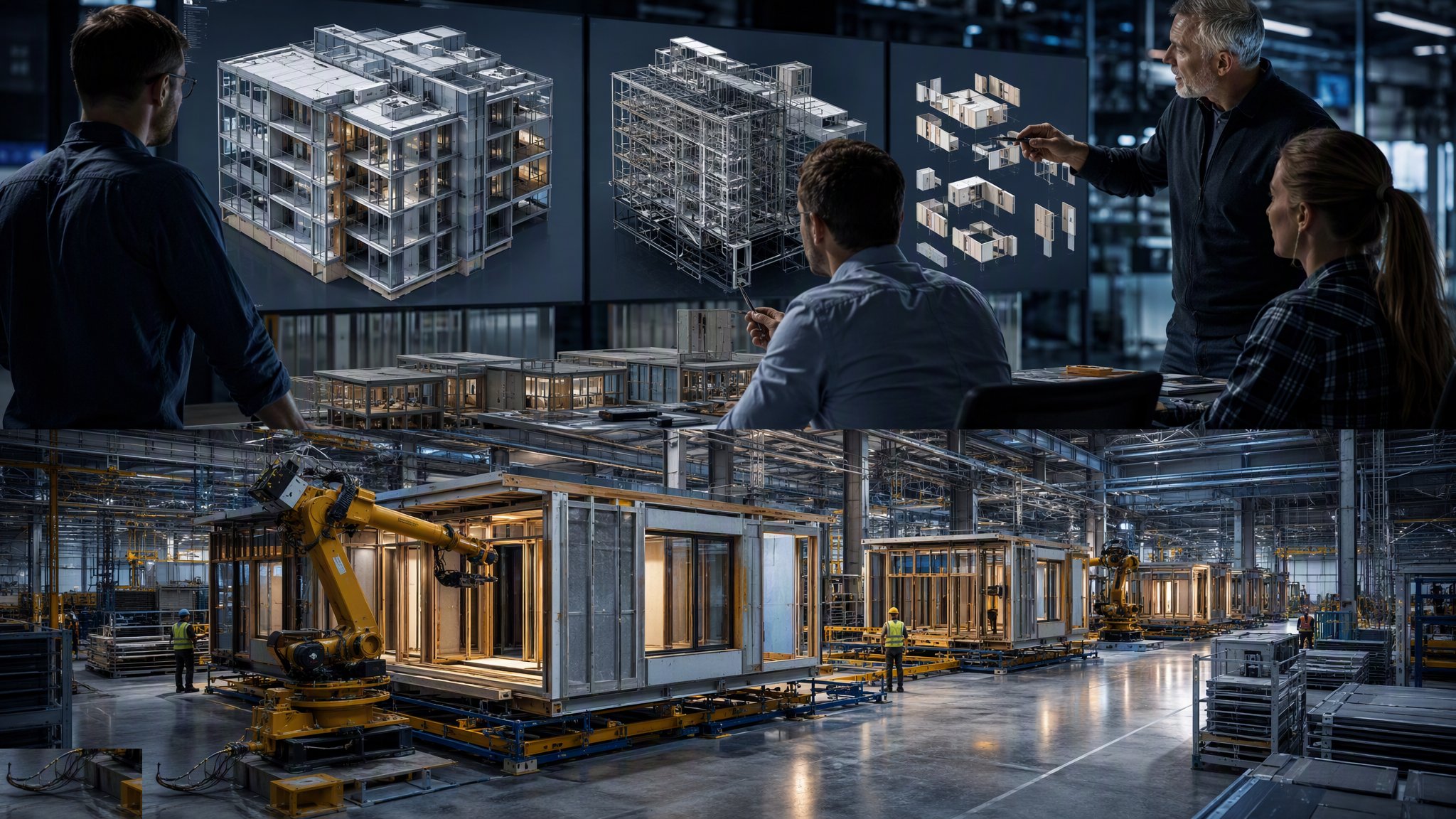
The platform approach turns the usual question around. Instead of asking how a particular building can be made off site, it asks what set of standardised components and interfaces could be used to build many buildings. The platform is the kit: a defined family of structural components, connections, floor and wall elements, services modules and interface rules, each designed once and manufactured repeatedly. Individual buildings are then configured from the kit rather than designed from scratch. A school, an office and a healthcare building can all be different buildings while sharing the same structural components and the same connection details, in the same way that very different products can share a common chassis.
The logic is a client-portfolio logic, and it does not work for a single project. The investment - defining the platform, designing and testing the components, establishing the manufacturing arrangements and building the supply chain - is substantial, and it is repaid across a programme of buildings rather than one. That makes the platform approach the natural territory of clients who build repeatedly and know they will keep building: public estate programmes, large institutional owners, portfolio developers and operators with many similar sites. For those clients the return is not only cost. It is repeatability of performance, of programme and of quality, and a supply chain that gets better at the same components year on year.
The discipline it demands is real, and it is a governance discipline as much as a technical one. Somebody has to own the platform - to decide what is in it, to control changes to it, to resist the pressure from each individual project to make just one exception. The interfaces are the heart of the thing: if the connection between components is defined and stable, then components can be improved or replaced over time without disturbing anything else. If the interfaces drift, the platform decomposes back into a set of one-off designs within a couple of projects. Architecturally, the approach is often misunderstood as producing identical buildings. It does not have to. The kit governs the components and the junctions between them, and a great deal of variety in form, arrangement and appearance remains available above that level - but the design freedom is exercised within the platform, not against it.
How does Platform approach (P-DfMA) work, step by step?
- 1
Step 1: Establish the portfolio case
The client examines its forward programme and asks whether there is enough repeated demand to justify a platform. The relevant questions are the number of buildings, the period over which they will be built, how similar their requirements are and whether the client can commit to the platform across them. If the answer is a handful of buildings over an uncertain timescale, the platform approach is the wrong tool and component DfMA is the right one. This decision belongs to the client, not to any individual project team.
- 2
Step 2: Define the platform scope
The client and its advisers decide what the platform covers. It might be the structural frame and its connections only, or it might extend through floors, walls, facade systems, services modules and fit-out. A narrower platform is easier to establish and control; a broader one captures more benefit. What matters is that the boundary is explicit, so that everybody knows which decisions belong to the platform and which remain with each project.
- 3
Step 3: Design the components and, above all, the interfaces
Each component in the kit is designed once, properly, with manufacture and assembly in mind. The interfaces between components are then designed as first-class deliverables in their own right: what connects to what, how, with what tolerance and what adjustment. Stable interfaces are what make a platform a platform. They allow a component to be improved, re-sourced or replaced later without redesigning everything around it, and they are the reason a platform survives its first few projects.
- 4
Step 4: Prototype, test and validate the kit
Components and connections are prototyped and tested against the performance the platform claims - structural, fire, acoustic, thermal, weathertightness and durability as applicable. This is done once, for the platform, rather than repeatedly for each building. A full assembly or demonstrator is often built to prove that the components go together as intended and that the assembly sequence works with real people and real tools. Problems found in a demonstrator are cheap; the same problems found on the third building are not.
- 5
Step 5: Build the supply chain and the manufacturing capacity
The client establishes how the platform will be made and by whom, with enough capacity for the forward programme and enough resilience that a single manufacturer's failure does not stop it. Because the components are defined by the platform rather than by any one supplier, more than one manufacturer can generally be qualified to make them, which is one of the approach's structural advantages over tying a programme to a single system supplier.
- 6
Step 6: Configure individual buildings from the kit
Each project is then designed by configuring platform components to the site and the brief, rather than by designing components. The design team's effort moves to arrangement, form, external envelope and the things that genuinely differ between buildings. Where the brief cannot be met by the kit, the exception is raised formally to whoever governs the platform rather than solved quietly on the project - which is the point at which most platforms are either preserved or lost.
- 7
Step 7: Govern change to the platform
A named owner controls the platform. Proposed changes are assessed for their effect across the whole programme, not just the project that raised them, and accepted changes are versioned and issued so that every project knows which version it is building. Without this governance, each project makes small local improvements, the components diverge, the interfaces drift, and within a few buildings there is no platform left - only a set of similar-looking one-offs.
- 8
Step 8: Measure, feed back and improve
Performance, cost, programme and defect data are collected from each completed building and fed back into the platform. This is the compounding benefit and the reason the approach is worth the effort: the fifth building genuinely should be better, cheaper and faster than the first, because the same components have been made and assembled repeatedly and what was learned each time has been captured in the kit rather than in one team's memory.
What are the benefits of Platform approach (P-DfMA)?
- Design and testing effort is spent once and reused across many buildings
- Manufacturing volume across a programme supports investment that no single project could justify
- Repeatable cost, programme and quality outcomes across a portfolio
- Stable interfaces allow individual components to be improved or re-sourced without wider redesign
- Multiple manufacturers can be qualified against the same defined components, reducing supplier dependency
- Learning compounds - each building should be better than the last
What are the limitations of Platform approach (P-DfMA)?
- Requires a portfolio of buildings and a client able to commit across them - useless for a single project
- Substantial up-front investment in definition, design, testing and supply chain before any return
- Needs continuing governance and a named owner, or the platform decomposes into one-offs
- Individual projects lose some freedom and must work within the kit
- Vulnerable to changing requirements over the life of a long programme
- Poorly defined interfaces undermine the whole approach, however good the components are
What is Platform approach (P-DfMA) best suited for?
What plant does Platform approach (P-DfMA) need?
- Manufacturing facilities qualified to produce the platform components at programme volume
- Prototyping and testing facilities for component and interface validation
- Demonstrator or trial assembly space to prove the assembly sequence
- Configuration and model libraries holding the current platform version
- Standard transport frames and handling equipment designed around the component family
- Site assembly equipment common to the kit, so crews and plant transfer between projects
How is Platform approach (P-DfMA) quality-checked?
- Platform scope, components and interfaces formally defined, versioned and issued
- Component and interface performance testing completed and recorded at platform level
- Demonstrator or trial assembly built and its lessons recorded before programme rollout
- Manufacturer qualification and audit against the platform definition
- Named platform owner with a recorded change control and versioning process
- Each project records which platform version it was built to
- Exceptions raised, assessed and either absorbed into the platform or formally recorded
- Post-completion performance, cost and defect data collected and fed back into the platform