DfMA retrofit of a conventional design
Converting a scheme already designed for traditional construction to off-site - usually the worst of both worlds unless it happens very early.
Last updated 2026-09-05
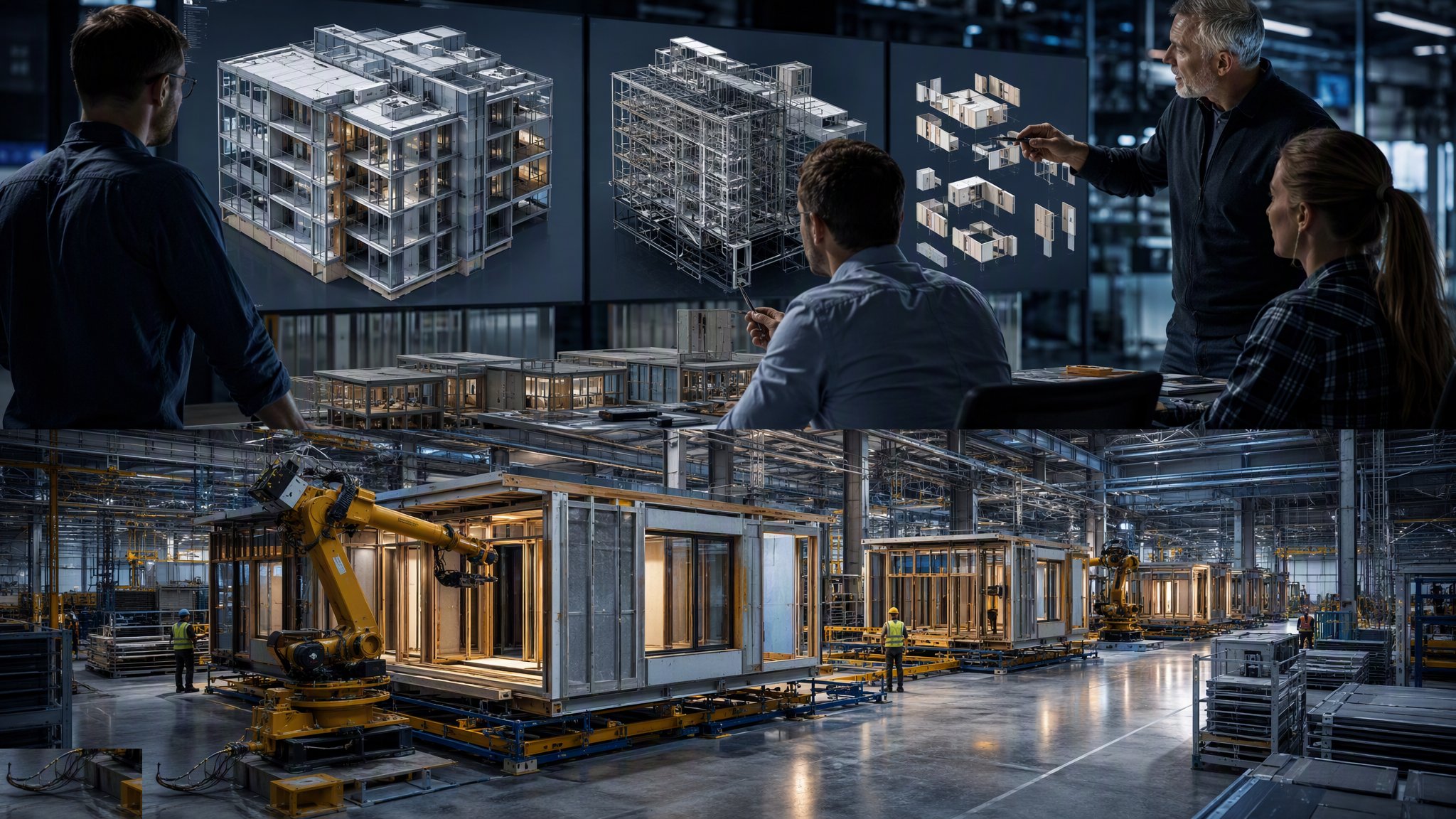
What is DfMA retrofit of a conventional design?
DfMA retrofit means taking a building already designed for traditional construction and reworking it to be built off site. It happens for ordinary commercial reasons: a programme is under pressure, labour cannot be found, a client changes its policy, a contractor proposes it at tender, or the numbers no longer work the conventional way. The proposition sounds attractive - keep the design that has already been developed and approved, and simply change how it is built. In practice it is the most difficult route in off-site construction, and the reason is structural rather than technical.
A conventionally designed building is optimised for site assembly. Its grid follows structural efficiency rather than transport limits. Its rooms are whatever size the plan needed. Its services run wherever the ceiling void allowed. Its junctions assume trades working in position and adjusting as they go. None of those decisions were taken with manufacture in mind, and most of them work against it. Converting the scheme therefore means unpicking and redoing them, which costs design fees and programme time that the conversion was supposed to save. Very often the result is a compromise: modules that do not suit the grid, components made to awkward sizes, and interfaces designed to reconcile a manufactured element with a plan that was never meant to receive one. The benefits of off-site are diluted while its constraints - the early freeze, the factory dependency, the transport limits - apply in full.
Timing is the whole question. Very early - while the design is still at concept, before the grid has hardened and before planning is fixed - conversion is genuinely feasible and can amount to a proper redesign for manufacture. Once the scheme is technically developed, coordinated and approved, conversion means substantially redesigning it, and the honest advice is usually one of three things: build it conventionally as designed; convert only selected components rather than the whole scheme; or accept a genuine redesign with the fees and programme that implies. The failure mode to avoid is the middle course, where a project half-converts, pays most of the cost of both approaches and gets the full benefit of neither.
How does DfMA retrofit of a conventional design work, step by step?
- 1
Step 1: Establish honestly how far the design has already gone
The first task is an unsentimental assessment of the design's maturity. A concept design with a flexible grid is one situation; a fully coordinated and approved technical design is another entirely. The assessment covers the structural grid, the planning approval, the coordination status of the services, the procurement position and how much of the design fee has already been spent. This determines whether conversion is a redesign, an adjustment or a mistake, and it should be done before anybody starts drawing modules.
- 2
Step 2: Test the design against manufacturing constraints
The scheme is measured against what manufacture actually requires: whether the grid divides into transportable module sizes, whether the rooms repeat, whether the services can be rationalised into modular runs, whether the site can take deliveries and a crane, and whether the envelope junctions can be made off site. The output is a clear-eyed list of what fits and what does not. Where most of the answers are no, that is the finding, and reporting it is more useful than engineering a conversion around it.
- 3
Step 3: Decide the scope of conversion, and be willing to decide none
Based on that assessment the team chooses: full conversion with a proper redesign, partial conversion of selected components, or no conversion. Each is stated with its cost, programme and risk. Partial conversion is very often the right answer for a developed scheme, because it captures the achievable benefit without unpicking the approved design. Deciding not to convert is a legitimate and frequently correct outcome.
- 4
Step 4: Quantify what redesign will really cost
If conversion proceeds, the additional design work is scoped properly: structural rework, services rationalisation, new interface details, revised fire and acoustic strategies, and possibly a planning amendment where the envelope or massing changes. Fees and programme are set against the claimed savings. Many conversions do not survive this step honestly done, which is exactly what the step is for.
- 5
Step 5: Rationalise the design towards manufacture
Where conversion goes ahead, the scheme is reworked rather than merely annotated: room types are reduced to a repeating family, the grid is adjusted to module dimensions, services are consolidated into rationalised runs, and the junctions are redesigned for assembly rather than for in-position construction. This is real design work, and treating it as a drafting exercise on the existing drawings is how half-converted schemes are produced.
- 6
Step 6: Re-verify every performance requirement
Fire, acoustic, structural, thermal and weathertightness strategies were developed for the original construction and do not transfer automatically. Each is reassessed for the converted design, with particular attention to the new junctions between manufactured elements, which did not exist in the original scheme. Where approvals were granted on the original strategies, the approving bodies are re-engaged rather than assumed to be satisfied.
- 7
Step 7: Secure manufacturing capacity before committing
A converted scheme depends on a factory that was not part of the original plan. Capacity, programme, price and the manufacturer's ability to build what the conversion has produced are all confirmed before the conversion is committed. Converting a design and then looking for someone to make it is the wrong order, and it is a common one, because the conversion decision is usually taken under programme pressure.
- 8
Step 8: Freeze the converted design and hold the freeze
Once converted, the design must be frozen with the same discipline as any manufactured scheme. This is difficult on a project that has already lived through a conventional design process where late change was normal and absorbed. The team, the client and the wider design chain have to understand that the rules have changed, and the freeze has to be enforced from the moment it is declared or the conversion delivers nothing it promised.
What are the benefits of DfMA retrofit of a conventional design?
- Can rescue a programme where site labour or site duration has become the binding constraint
- Allows an existing and approved design to be retained in part rather than abandoned
- Partial conversion of selected components often captures worthwhile benefit at modest cost
- Forces a rationalisation of the design that frequently improves it in its own right
- May be the only route available where site access or disruption limits have changed
- Provides a structured way to test whether off-site was ever the right answer for the scheme
What are the limitations of DfMA retrofit of a conventional design?
- Usually the worst of both worlds - the constraints of off-site with only part of the benefit
- Requires substantial redesign, with fees and programme that erode the expected saving
- A grid set for site construction rarely divides into efficient module or component sizes
- Fire, acoustic and structural strategies must be reworked for junctions the original design never had
- Planning and other approvals may have to be revisited
- Manufacturing capacity has to be found late, with little leverage on price or programme
- Half-converted schemes pay most of the cost of both approaches and get the benefit of neither
What is DfMA retrofit of a conventional design best suited for?
What plant does DfMA retrofit of a conventional design need?
- Design and modelling resource sufficient for a genuine rework, not an annotation exercise
- Manufacturer engagement early enough to test buildability against the converted design
- Prototyping facilities to prove the new interfaces created by the conversion
- Survey equipment where existing site works or foundations are already in place
- Delivery route and crane assessment for a site that was not planned for modular delivery
- Transport frames and handling equipment suited to whatever the conversion has produced
How is DfMA retrofit of a conventional design quality-checked?
- Documented assessment of design maturity and of manufacturing constraints before any conversion work
- Recorded decision on conversion scope, with cost, programme and risk stated for each option
- Scoped and priced redesign, compared honestly against the claimed savings
- Fire, acoustic, structural, thermal and weathertightness strategies re-verified for the converted design
- Approvals reviewed and approving bodies re-engaged where the strategies have changed
- Manufacturing capacity, price and programme confirmed in writing before commitment
- New interfaces prototyped and signed off before production
- Converted design formally frozen, with change control enforced from the freeze date