Abnormal and escorted loads
When the module is bigger than the road allows, the route is designed first and the module is designed to fit it.
Last updated 2026-09-05
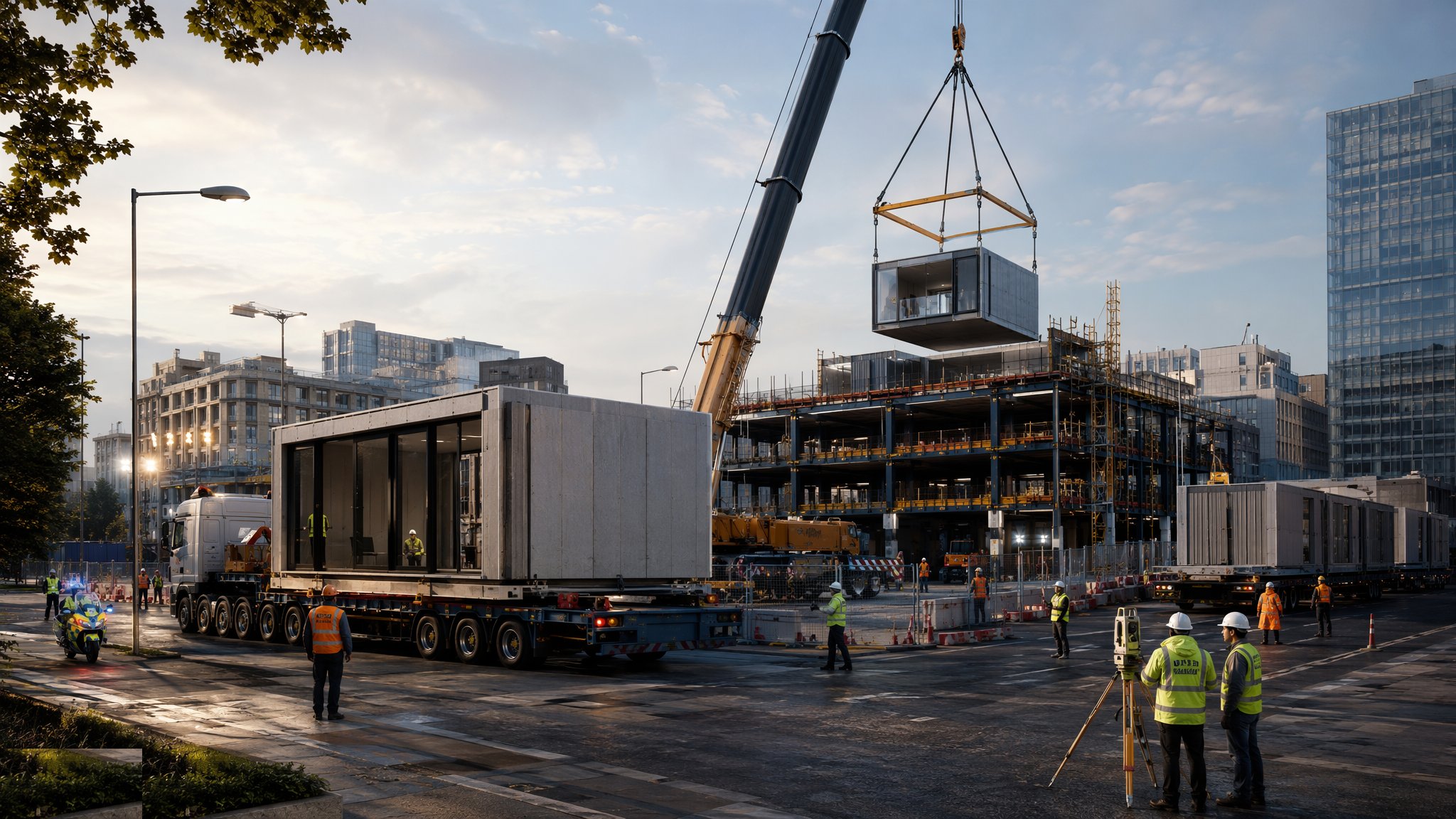
What is Abnormal and escorted loads?
Some off-site components are too large or too heavy to travel as an ordinary delivery. Volumetric modules, long bridge beams, tank sections, plant skids and large precast units routinely exceed the width, length, height or weight that a vehicle may carry without special arrangements. Moving them is a separate discipline with its own vehicles, its own permissions, its own escorting and often its own timing, and it is carried out by hauliers who specialise in nothing else. The load may travel on an extendable trailer, a low loader, a multi-axle trailer or a self-propelled modular transporter depending on its size and mass, and the movement may involve police or private escorts, temporary removal of street furniture, coordination with the operators of bridges and overhead services, and travel at night when the roads are empty.
The single most important thing to understand about abnormal loads is the order in which the decisions are made. On a well-run project the route is investigated before the module is designed, and the module is then dimensioned to the route. Width, height, length and weight limits, the swept path at the tightest junction, the headroom under the lowest structure and the capacity of the weakest bridge together define an envelope, and the designer works inside it. Where that is done, transport becomes a manageable cost. Where the module is designed first and the route is investigated afterwards, projects discover late that their standard module cannot reach the site, and the choices are then all expensive: redesign, split the module, take a longer route, or carry out physical works to the highway.
What the movement itself requires is determined by others, not by the project. The haulier assesses the load and the vehicle and applies for whatever permissions are needed; the relevant highway and police authorities decide what notice, conditions, escorting, routing and timing apply to that movement, and the operators of any structures on the route decide what they will accept over them. Those requirements vary with the load, the route and the authorities involved, and they are not something to be assumed from a previous project. The project's task is to allow time for the process, to build the answer into the programme and the design, and to make sure the arrival end - the gate, the standing area, the crane and the lift plan - is ready for a vehicle that cannot easily manoeuvre, cannot easily wait and cannot easily go round again.
How does Abnormal and escorted loads work, step by step?
- 1
Step 1: Survey the route before the component is designed
A physical route survey is carried out from the factory to the site, usually by the specialist haulier, covering restricted widths, headroom under bridges and overhead services, the capacity and condition of structures, turning radii and swept paths at junctions and roundabouts, gradients, street furniture, and anything on the route that would have to be moved or lifted. The survey produces an envelope - a maximum width, height, length and weight that can realistically reach the gate - and that envelope goes to the designer as a design constraint. Doing this early is the whole discipline: the route is designed before the module is.
- 2
Step 2: Design the component inside the envelope
The designer works to the envelope, deciding how the building is divided into modules, where the joints fall, and how each module is proportioned. Where the envelope is tight the answer may be narrower modules and more of them, or splitting a module and completing the joint on site. The lifting points, the temporary stiffening needed to keep the module square in transit, and the transport restraint arrangement are designed at the same time, because a module that is adequate in the building can be a flexible box on a trailer.
- 3
Step 3: Let the haulier and the authorities determine the permissions
The specialist haulier assesses the completed load - dimensions, mass, axle arrangement and vehicle configuration - and applies for the permissions that movement requires. The relevant highway and police authorities determine what notice is needed, what conditions attach, whether escorts are required and of what kind, what route must be followed and at what times it may be travelled. The operators of bridges and other structures on the route determine what they will accept and on what terms. None of this is assumed or carried over from a previous project, and the programme allows for the process taking time.
- 4
Step 4: Plan the movement in detail
The agreed route is planned movement by movement: the departure time, the running speed, the holding points where the load can stand safely, the junctions requiring a manoeuvre, the points where street furniture must be removed and reinstated, and the arrangements with any utility operator whose overhead lines must be lifted or isolated. Communications are set up between the escort, the driver and the receiving site so the project knows where the load is. A contingency plan covers breakdown, an obstruction on the route and a delay that pushes the movement outside its permitted window.
- 5
Step 5: Prepare the receiving end
The site prepares for a vehicle that cannot improvise. The gate, the approach and the standing position are checked against the swept path of the actual vehicle, temporary works are provided where the vehicle must stand on made ground or near an excavation, and the crane is positioned and its lift plan prepared for that specific component. Where a self-propelled transporter is to be used on site, the surfaces it will run on and the bearing capacity beneath them are designed. Everything that can be done before the load arrives is done before the load arrives, because a large module standing on a public road is a problem measured in minutes.
- 6
Step 6: Load, restrain and check at the factory
The module is loaded at the factory using its designed lifting points, positioned on the trailer as the transport arrangement requires, and restrained to the haulier's scheme. Protection, sheeting and any temporary stiffening is fitted and checked. Dimensions and mass are verified against what the permissions were applied for, because a load that has grown since the application is an unpermitted load. Markings, lighting and any required signage are fitted before departure.
- 7
Step 7: Move the load, commonly at night
The movement runs to the permitted route and timing, which for large loads frequently means overnight or in the early hours when traffic is light and junctions can be worked. Escorts control traffic at the points identified in the plan, street furniture is removed and reinstated as agreed, and progress is reported to the site so that the crane and gang are called in at the right time rather than standing from midnight. The driver and escort stop the movement if anything on the route differs from the survey.
- 8
Step 8: Receive, inspect and lift
On arrival the module is checked against the paperwork and inspected for transit damage and distortion before restraints are released, with particular attention to squareness, to glazing and finishes, and to the lifting points. The lift then proceeds under the lift plan prepared for that component, and the vehicle is released and taken off the highway as quickly as the operation allows. Any damage or dimensional change found is recorded and referred to the designer before the module is built into the works.
What are the benefits of Abnormal and escorted loads?
- Allows genuinely large components - full-width modules, long beams, complete plant skids - to be built off site
- Fewer, larger units mean fewer site joints, less site work and a shorter installation programme
- Night movements avoid traffic and often allow a faster, more controlled run than daytime delivery
- Specialist hauliers bring route knowledge and equipment no general carrier can offer
- Doing the route survey early converts a late crisis into an ordinary design constraint
- Self-propelled transporters can place very heavy units precisely without a crane lift where site conditions allow
What are the limitations of Abnormal and escorted loads?
- The route, not the design, sets the maximum module size - and it is often smaller than the designer wants
- Permissions take time to obtain and are determined by the authorities, so the programme has to allow for them
- Escorting, night working, street furniture removal and utility coordination all carry significant cost
- A late route survey can force redesign, module splitting or physical highway works
- Movements are weather and traffic sensitive, and a missed window may mean waiting for the next permitted slot
- Very limited flexibility on the day - the load cannot easily wait, divert or turn round
- Large modules need substantial temporary stiffening and restraint that adds weight and cost
What is Abnormal and escorted loads best suited for?
What plant does Abnormal and escorted loads need?
- Specialist tractor units with extendable, low loader, multi-axle or steerable trailers to suit the load
- Self-propelled modular transporters where the unit is very heavy or must be positioned without a crane
- Escort vehicles, warning signage, beacons and marker boards as the permitted movement requires
- Crane or jacking and skidding system sized for the component at the required radius
- Component-specific lifting frames, spreader beams and transport restraint gear
- Temporary stiffening and bracing fitted to modules for the transport condition
- Temporary works to gate, hardstanding and standing positions where the vehicle bears on made ground
How is Abnormal and escorted loads quality-checked?
- Physical route survey completed and its dimensional envelope issued to the designer before module design is fixed
- Transport condition designed and checked - lifting points, temporary stiffening and restraint
- Loaded dimensions and mass verified at the factory against what the permissions were applied for
- Permissions, conditions, routing and escorting confirmed by the haulier and the relevant authorities before departure
- Site swept path, standing position, ground bearing and lift plan checked against the actual vehicle and component
- Communication and tracking arrangements in place so the site can call the gang and crane to the real arrival time
- Post-transit inspection for damage and distortion, including squareness, before restraints are released