Just-in-time delivery
Components arrive to a booked slot and go straight from the trailer to the crane hook - nothing is stored, and nothing is forgiven.
Last updated 2026-09-05
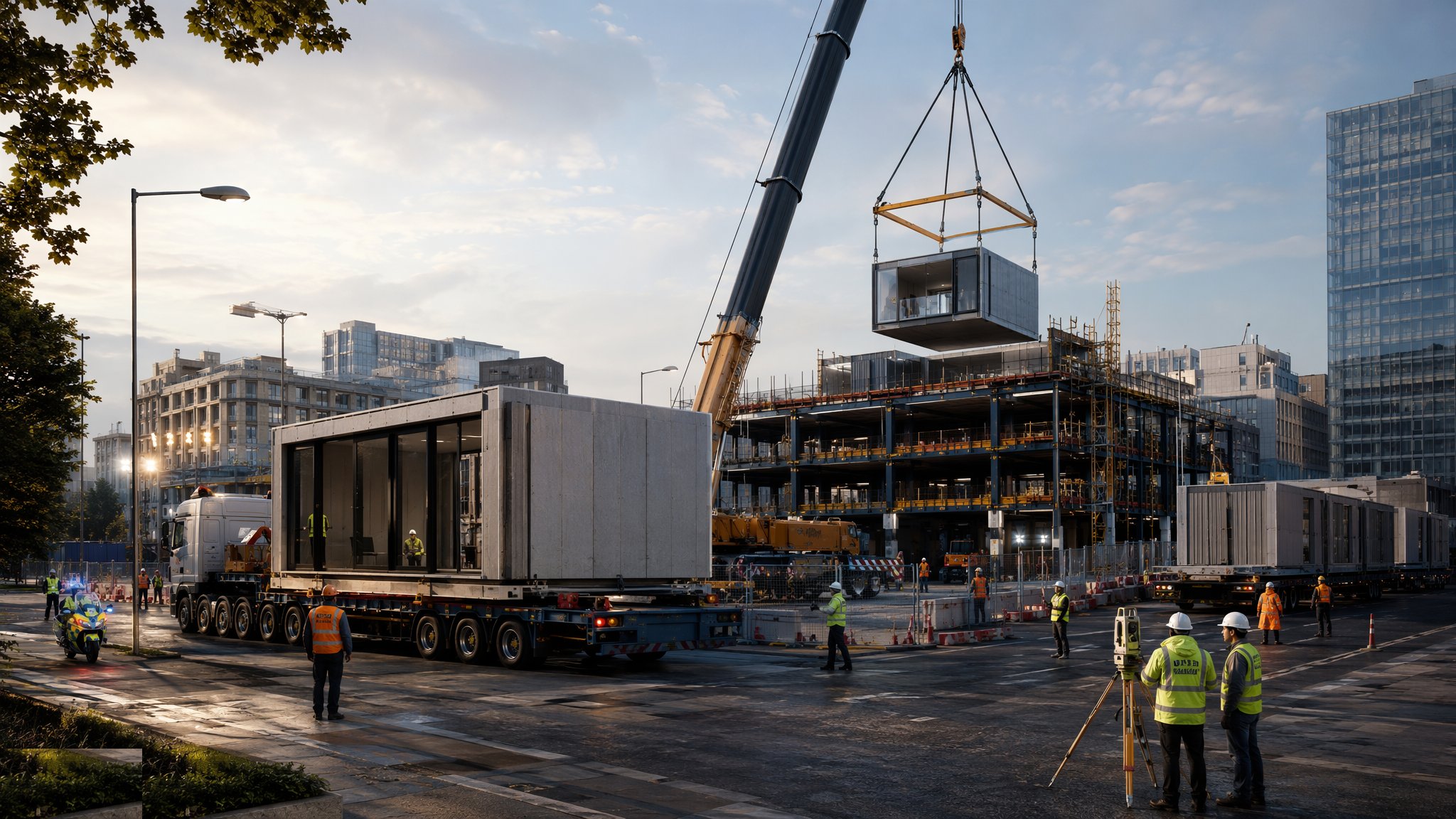
What is Just-in-time delivery?
Just-in-time delivery is the logistics model most off-site projects reach for first. Components are manufactured to a sequence, loaded in the order they will be installed, and delivered to a booked slot at the site gate. The trailer is unloaded directly to the crane and lifted straight into position. There is no laydown area, no stack of modules waiting their turn, and no second handling operation. On a constrained urban project the model is often not a preference at all - there is simply nowhere on site to put a module down, so the only place it can go is the building.
The attraction is that it removes cost and risk that most people never price. Every time a component is set down and picked up again it is exposed to damage, to weather, to being buried behind the next delivery, and to the labour and plant that double handling consumes. It also removes the need to secure, drain, level and protect a laydown area, which on a wet winter project is a genuine works package in its own right. Programme benefits follow: the installation sequence is driven by the delivery schedule, the crane works continuously rather than in bursts, and progress on the frame becomes easy to read from the number of loads that have landed. Where the model runs well, the site behaves less like a construction project and more like an assembly line, which is broadly the point of building off site in the first place.
The cost is total exposure. A just-in-time programme has no buffer, so anything that delays a load delays the building. A factory that misses a shift, a trailer stuck in traffic, a road closure nobody circulated, a wind day that stops the crane, a bay that is not ready to receive the module - each of these arrives as a direct hit on the critical path, and the crane and the installation gang stand while it is resolved. The model also transfers a great deal of responsibility off site: the factory's quality control, its loading sequence and its ability to hold a date now govern site progress. On most projects the logistics manager therefore treats the delivery schedule as a live document rather than a fixed plan, holds a small amount of tolerance somewhere - a spare slot, a nearby holding point, a load that can be brought forward - and keeps a route and a contact list that can be worked at short notice. Pure just-in-time with no fallback is rare on anything but the most tightly controlled projects.
How does Just-in-time delivery work, step by step?
- 1
Step 1: Sequence the build, then sequence the factory
The installation sequence comes first and everything else follows it. The designer and the installation contractor agree the order in which components go into the building - by bay, by core, by floor, by crane radius - and that order becomes the manufacturing and loading sequence in the factory. Components are then identified individually, commonly with a unique mark number carried on the drawing, on the component itself and on the delivery paperwork, so that any load can be reconciled against the position it is going into. Getting this wrong is expensive in a way that is hard to recover from, because a module delivered out of sequence on a project with no laydown has nowhere to go but back onto the road.
- 2
Step 2: Survey the route and the delivery point
The logistics manager surveys the route from the factory to the gate and the movement from the gate to the crane. Height restrictions, weight restrictions, turning radii, street furniture, overhead services, parked-car pinch points and the swept path of an articulated vehicle reversing onto the site are all recorded, usually with a physical drive of the route rather than from a desk. Where the route or the load raises anything beyond an ordinary delivery, the haulier and the relevant highway and police authorities determine what permissions and conditions apply. The output is a route plan and a delivery point layout showing exactly where the vehicle stands, where the crane stands, and where the exclusion zone sits.
- 3
Step 3: Book the slots and hold the gate
Deliveries are booked into timed slots through a delivery management system, and the slot is treated as an appointment rather than a target. Slots are spaced to the time it genuinely takes to unload, lift and release a vehicle, with the interval taken from the installation rate rather than from optimism - on many projects that means one load at a time and a working assumption of somewhere between two and eight lifts a day depending on the component. A gate marshal controls entry, and vehicles arriving early are held off site at an agreed waiting point rather than queueing on the public highway, which is usually a planning condition as much as a courtesy.
- 4
Step 4: Call the load forward
The site calls each load forward when the receiving position is genuinely ready - the previous component landed and released, the bay clear, the connection points accessible, the weather within the crane's working limits. The driver waits at the holding point until called. This single discipline is what separates a working just-in-time operation from a queue of trailers on the street, and it depends on somebody on site having a clear, current view of both the installation face and the vehicles in transit.
- 5
Step 5: Check on arrival, before the load is broken
The component is checked against the delivery paperwork and inspected for transit damage before any restraint is released - the mark number, the orientation, the protection, the condition of faces and edges, and the presence and condition of the lifting points. Damage found at this stage is a supplier issue with a photograph and a signature against it. Damage found after the module is in the building is an argument. The check is quick, but it is not optional, and it is recorded.
- 6
Step 6: Lift straight from the trailer
The lift is planned and carried out under the appointed person's lift plan, using the lifting points, methods and appliances the designer and the lifting specialist have specified for that component. The vehicle is positioned so the component can be lifted without the load travelling over the cab or over anyone. Nothing about the rigging, the capacity or the configuration is decided at the gate - it is set out in the lift plan for that component before the vehicle is called forward, and the lift supervisor stops the operation if what arrives does not match it.
- 7
Step 7: Land, connect, release and turn the vehicle round
The component is landed to the survey, temporarily restrained or propped as the temporary works design requires, and the crane is released only when that restraint is in place. The trailer is cleared of packing and restraint gear, the paperwork is signed, and the vehicle leaves so the next slot can run. Turnaround time is measured, because it is the number that governs how many loads a day the project can absorb.
- 8
Step 8: Review the day and re-plan the schedule
At the end of each day the delivery schedule is reconciled against what actually landed, and the following days are re-planned. Missed slots, late loads, damaged components and lost crane hours are logged with their causes, because the pattern in that log is what tells the logistics manager whether the model is working or whether a buffer needs to be introduced. On most projects the schedule is reissued daily and treated as the controlling document for the following morning.
What are the benefits of Just-in-time delivery?
- No laydown area required, which on a constrained urban site is often the only reason the project can be built off site at all
- Removes double handling and the damage, labour and plant cost that comes with it
- Components go straight from trailer to final position, so protection and weather exposure are minimised
- Crane and installation gang work continuously rather than in bursts
- Progress is easy to measure and report - loads landed against loads planned
- Less site storage means fewer trip hazards, fewer obstructions and a cleaner, safer site
What are the limitations of Just-in-time delivery?
- No buffer at all - any delay to a load is a direct delay to the building
- Total exposure to traffic, weather, factory performance and any incident on the route
- Depends on a factory that can hold both a date and a loading sequence, which not every supplier can
- A component delivered damaged or out of sequence has nowhere to go on a site with no storage
- Requires an experienced logistics manager and a live delivery management system, which is a real overhead
- Vehicles arriving early cause highway and neighbour problems unless a holding point is arranged off site
What is Just-in-time delivery best suited for?
What plant does Just-in-time delivery need?
- Mobile, crawler or tower crane sized and positioned for the heaviest component at its furthest radius
- Articulated trailers, low loaders or extendable trailers appropriate to the component being carried
- Component-specific lifting equipment - spreader beams, frames, slings and shackles - as specified for the lift
- Delivery management system with timed slot booking and live vehicle tracking
- Gate marshal and traffic marshal provision, with signage, barriers and an agreed exclusion zone
- Temporary propping and restraint gear for components landed but not yet permanently connected
How is Just-in-time delivery quality-checked?
- Installation sequence agreed and reflected in the factory loading sequence before manufacture starts
- Unique mark numbers on every component, carried through drawings, labelling and delivery paperwork
- Route survey and delivery point layout recorded, with permissions confirmed by the haulier and the relevant authorities
- Pre-lift inspection of every component for transit damage and lifting point condition, recorded with photographs
- Lift plan in place and matched to the component that has actually arrived before the load is broken
- Setting-out and tolerance survey of each landed component before the crane is released
- Daily reconciliation of loads landed against loads planned, with causes logged for every missed slot
More off-site logistics, craneage and tolerance methods
Next method
Buffered laydown