Consolidation centre
An off-site facility that receives from many suppliers and issues to site in planned, full loads - fewer vehicles, less congestion, one point of control.
Last updated 2026-09-05
What is Consolidation centre?
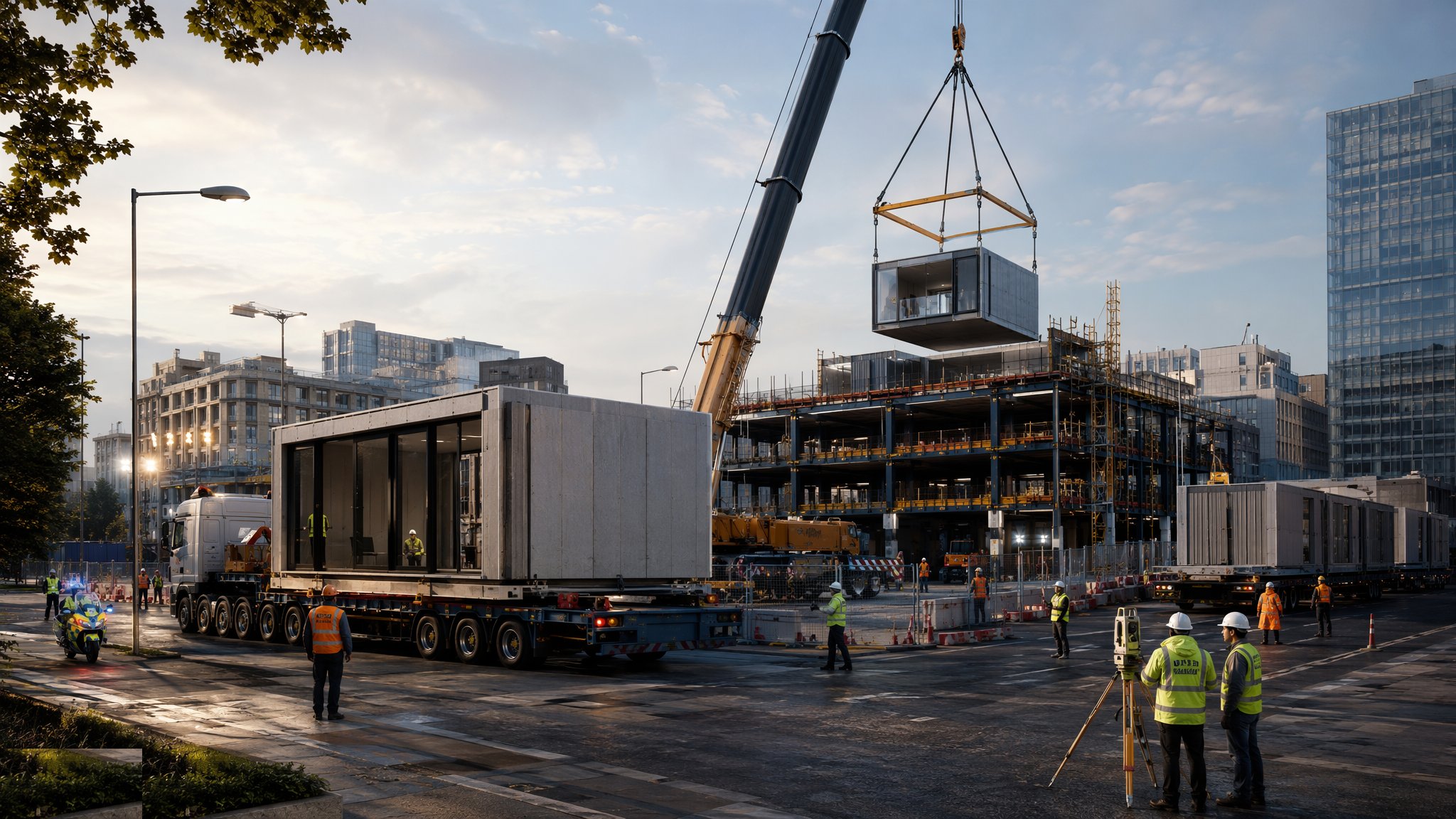
A consolidation centre is a warehouse or yard away from the project that receives materials and components from a large number of suppliers, holds them, and issues them to site in planned loads made up to suit the work in hand. Instead of thirty suppliers each sending a partly loaded vehicle to the gate on their own schedule, the suppliers deliver to the centre and the centre sends a smaller number of full vehicles to the project. The reduction in vehicle movements is the headline benefit and it is usually substantial, but the operational benefit is often larger: the project stops managing thirty separate delivery relationships and starts managing one.
The model suits dense urban work, and that is where it is most commonly found. On a city centre project the gate is often a single lane off a busy street, the site has no storage, deliveries are limited by planning condition to particular hours, and every vehicle that queues on the highway is a problem with the local authority, the neighbours and the traffic. A consolidation centre answers all of those at once. It also allows loads to be made up by work face rather than by supplier - everything the second floor fit-out gang needs on Tuesday arriving together on one vehicle, checked, unpacked and on wheeled stillages ready to be distributed - which cuts the time trades spend chasing materials around the site and dramatically reduces the packaging waste that reaches the project.
The cost is a facility, an operation and an extra handling stage. Somebody has to rent or provide the building, staff it, run its stock system, and pay for the second leg of every delivery. Materials are handled at the centre as well as at site, which adds cost and a damage risk. There is also a management overhead in getting suppliers to deliver to a different address on different terms, which needs to be written into orders and subcontracts from the start rather than requested later. On a single project the economics are often marginal, and consolidation centres are therefore most viable where the cost is spread - across a very large project, across several projects for the same contractor, or across a city-wide or estate-wide facility serving many customers. Where the alternative is a project that cannot get its materials in at all, the calculation is much simpler.
How does Consolidation centre work, step by step?
- 1
Step 1: Establish whether consolidation is justified
The starting point is a count of the vehicle movements the conventional model would generate and an assessment of what the site and the surrounding streets can actually absorb. Gate capacity, permitted delivery hours, queueing space, the number of suppliers, the proportion of part loads and the amount of storage available on site all feed the assessment. Where the movements exceed what the site or the highway can take, or where planning conditions cap them, consolidation moves from an option to a necessity. Where it is a choice, it is a commercial one, and it is made before orders are placed rather than after the first month of gridlock.
- 2
Step 2: Set up the facility and the operation
The centre is a warehouse or yard within reasonable travelling distance of the project, with loading doors, racking or floor storage, handling plant, a stock control system and staff. It may be a dedicated facility for one large project, a shared facility run for several projects, or a commercially operated centre serving many customers. Its capacity is set against the peak flow rather than the average, because consolidation centres fail when they are full. Security, fire arrangements and the storage requirements of any material with particular handling needs are designed into the facility from the outset.
- 3
Step 3: Write consolidation into the orders
Suppliers deliver to the centre, not to the project, and the delivery address, the booking process, the labelling requirements and the packaging expectations are written into orders and subcontracts. This is the step most often skipped, and skipping it produces a centre that half the supply chain ignores. The requirements are specific: how loads are labelled and referenced to the project and the work package, what packaging will be accepted, what documentation accompanies a delivery, and how a supplier books a slot at the centre.
- 4
Step 4: Receive and book in at the centre
Incoming loads are received at the centre against the order, checked for quantity and condition, and booked into stock against a location. Damage and shortages are identified here, away from the project, and raised with the supplier while there is still time to replace the item - which is one of the quieter benefits of the model. Packaging is stripped at the centre where it is not needed for onward protection, and waste is segregated and disposed of by the centre rather than being carried into a site with no room for a waste compound.
- 5
Step 5: Build loads to the work, not to the supplier
The project issues a call-off - typically a few days ahead, and refined daily - stating what is needed, where it is going and when. The centre picks the items from stock across all suppliers and makes up a single load for that work face, often on wheeled stillages or in cages that can be taken straight to the point of use. Loads are built to fill the vehicle and to match the sequence in which the site will unload them, so the last thing on is the first thing off. This is where the movement reduction is actually achieved.
- 6
Step 6: Deliver to a booked slot
The made-up load is delivered to the project against a booked slot in exactly the same way as any other delivery, with a route plan and a gate marshal. Because the centre is close and under the project's control, the slot is far more reliable than one dependent on a supplier hundreds of miles away, and a load can be held or re-timed at short notice without a vehicle standing on the highway. On many urban projects this is what makes a tightly conditioned delivery timetable workable.
- 7
Step 7: Distribute to the work face and close the loop
On site the load is broken down and distributed to the work face, and the stillages or cages are returned to the vehicle for the return trip. Returns, surplus and reusable packaging go back to the centre rather than accumulating on site. The call-off is reconciled against what was actually delivered, and any shortfall is picked up in the next load rather than triggering an emergency order.
- 8
Step 8: Measure the operation and adjust it
The operation is measured on the things it was set up to improve: vehicles arriving at the gate, average load fill, queueing time, damage and loss, waste leaving the site, and the number of times a trade waited for materials. Those measures tell the logistics manager whether the centre is paying for itself and where the flow is failing. On long projects the model is adjusted repeatedly - call-off lead times shorten as confidence grows, and the mix of what goes through the centre changes as the work moves from frame to fit-out.
What are the benefits of Consolidation centre?
- Substantially fewer vehicle movements to the site, which is often the deciding factor in dense urban work
- Reduces queueing on the public highway and the neighbour and authority problems that come with it
- Loads are made up by work face rather than by supplier, so trades receive what they need together
- Damage and shortages are found at the centre, where there is still time to put them right
- Most packaging is stripped and disposed of off site, cutting site waste handling to a fraction
- The project manages one delivery relationship instead of dozens
- Fuller loads and fewer trips reduce fuel use and emissions per unit delivered
What are the limitations of Consolidation centre?
- Requires a facility, staff and a stock system - a real and continuing cost
- Adds a second leg to every delivery and an extra handling operation, with its own damage risk
- Only economic where the cost is spread across a large project, several projects or many customers
- Suppliers have to be contracted to deliver to the centre, which must be set up before orders are placed
- A centre that fills up becomes the constraint it was built to remove
- Not suited to very large or abnormal components, which usually travel direct from the factory
- Adds a step to the chain of custody, so labelling and stock discipline have to be exact
What is Consolidation centre best suited for?
What plant does Consolidation centre need?
- Warehouse or yard with loading doors, racking or floor storage and adequate circulation
- Forklifts, pallet trucks and handling plant appropriate to the goods being consolidated
- Stock control system linking supplier deliveries, storage locations and project call-offs
- Rigid or articulated delivery vehicles with tail lifts, sized for the site rather than the centre
- Wheeled stillages, cages and roll pallets for direct distribution to the work face
- Waste segregation, baling and disposal facilities at the centre
- Delivery management system shared between the centre, the project and the suppliers
How is Consolidation centre quality-checked?
- Consolidation requirements written into orders and subcontracts, including delivery address and labelling
- Goods inward check against the order for quantity, condition and documentation at the centre
- Stock records tying every item to an order, a project, a work package and a physical location
- Call-off procedure with an agreed lead time, refined daily against the programme
- Load build checked against the call-off and against the unloading sequence before dispatch
- Reconciliation of each delivered load against the call-off, with shortfalls carried into the next load
- Performance measured on gate movements, load fill, queueing, damage, waste and materials waiting time