Buffered laydown
A holding area on or beside the site that absorbs the variability just-in-time cannot - and charges you in land, handling and damage for doing it.
Last updated 2026-09-05
What is Buffered laydown?
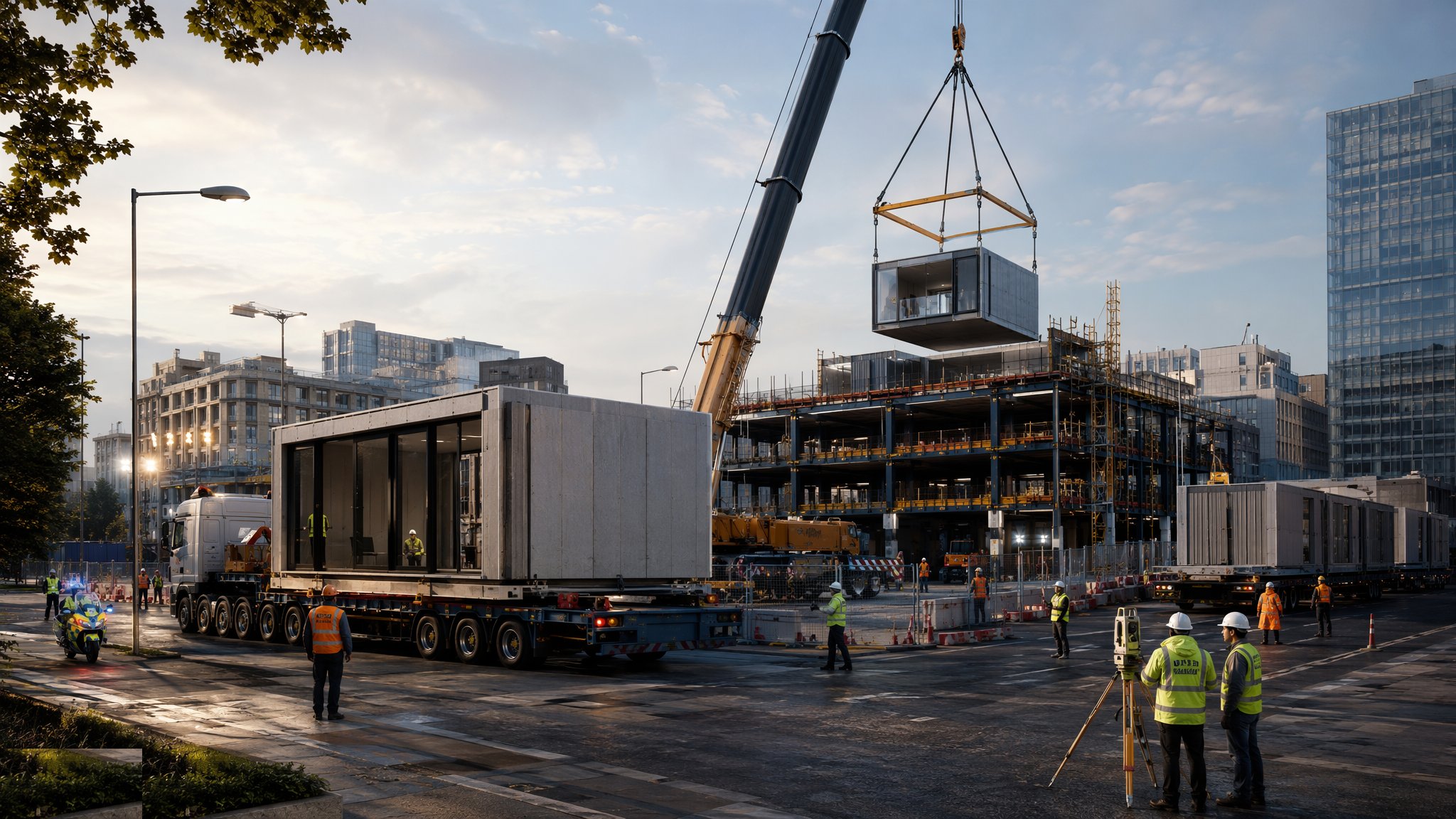
Buffered laydown accepts that deliveries and installation will never run in perfect step, and provides somewhere to hold the difference. Components are delivered ahead of need into a laydown area on the site or immediately adjacent to it, and drawn from that stock as the installation face is ready for them. The buffer is usually small - a few days of work, sometimes only a shift - but it is enough to decouple the factory and the road from the crane. A late load stops costing crane hours because the crane is working from stock, and a good day at the installation face is no longer capped by the number of trailers that happen to arrive.
The value of a buffer is that it converts unpredictable interruptions into a manageable stock level. On projects where the supply chain is new, where the route is unreliable, where the factory is a long distance away, or where weather regularly stops movements, the buffer is what keeps the installation gang productive. It also allows deliveries to be made at times that suit the road rather than the crane - overnight or outside peak hours, for example - and then unloaded and used during the working day. The logistics manager can build stock ahead of a period of known disruption, which is often the only practical answer to a planned closure or a seasonal weather risk.
What it costs is land, handling and condition. The area itself has to be found, which on a dense urban site may be impossible or may mean renting ground nearby at a real price. It has to be built - a drained, level, load-bearing surface with defined stacking positions, access for the delivery vehicle and for whatever lifts components out again, and lighting and security if it will be used outside working hours. Every component in the buffer is handled at least twice, and each handling operation is an opportunity for damage to faces, edges, seals, glazing and services already installed in the factory. Components sitting outside are exposed to weather, and a module that has been open to rain for a fortnight may need drying and remedial work before it can be closed up. On most projects the decision is therefore a straightforward trade: the buffer is worth having when the cost of the land, the handling and the protection is less than the cost of the crane and gang standing idle without it.
How does Buffered laydown work, step by step?
- 1
Step 1: Decide how much buffer the project actually needs
The size of the buffer follows the variability it has to absorb, not a rule of thumb. The logistics manager assesses the reliability of the factory, the length and exposure of the route, the frequency of weather stoppages, the installation rate and the consequence of a stopped crane, and sets a target stock in terms of work - typically expressed as a number of days or shifts of installation held on the ground rather than as a number of units. Holding more than that ties up land and money and increases handling and damage; holding less leaves the project exposed. The target is reviewed as the project settles down, and on a well-behaved supply chain it is usually reduced.
- 2
Step 2: Find and design the laydown area
The area is chosen for its access as much as its size - a laydown that a trailer cannot get into or that the crane cannot reach is not a laydown. It is then designed: formation and surfacing capable of carrying the delivery vehicles and the handling plant in wet weather, falls and drainage so it does not become a bog, a defined layout of stacking positions with circulation between them, and separate routes for vehicles and pedestrians. Where the ground is soft or made up, a working platform is designed and certified in the same way as for any other tracked plant. Lighting, security fencing and CCTV follow if components will be held overnight, because modules and their fit-out are attractive to thieves.
- 3
Step 3: Plan the stacking arrangement before anything arrives
How components are stacked determines whether the buffer works. Positions are allocated by the sequence in which components will be called off, so nothing needed early is buried behind something needed late. Bearing points, packing, stacking heights and whether components may be stacked at all are matters for the designer and the manufacturer, and the arrangement they specify is followed rather than improvised on the day. Stacks are laid out so that the handling plant can reach any position without moving three other components first, which usually means more space and fewer tiers than the first sketch assumes.
- 4
Step 4: Receive, check and book components in
Each component is checked against the delivery paperwork and inspected for transit damage on arrival, before it is set down, and then booked into a stock record against its allocated position. The record is the whole point of the buffer - a stock of components nobody can locate is not a buffer, it is an obstruction. Condition on arrival is photographed and recorded, so that damage arising later in the laydown is distinguishable from damage that arrived with the load.
- 5
Step 5: Protect what is stored
Components are protected to the manufacturer's requirements once landed - factory protection left in place, coverings secured against wind, open ends and service penetrations sealed, and standing water kept out of floor cassettes and module bases. Components with fit-out, insulation or finishes already installed are the vulnerable ones, and on many projects they are the reason the buffer is under cover or wrapped rather than simply stacked in the open. Protection is inspected on a routine cycle, because a cover that has blown off in week one and is noticed in week four has already done the damage.
- 6
Step 6: Call components off in sequence
Components are drawn from the buffer as the installation face is ready, lifted from their stacking position and either taken directly to the crane or trans-shipped to the delivery point. Each call-off is recorded against the stock so the level is always known, and the delivery schedule is adjusted to keep the stock near its target. In practice this is where a buffer earns its keep: the installation gang works to its own rhythm, and the deliveries are managed to keep the stock topped up rather than to keep the crane fed hour by hour.
- 7
Step 7: Re-inspect before installation
A component that has been stored is inspected again before it is lifted into the building - for weather damage, for movement or distortion at the bearing points, for water where water should not be, and for the condition of lifting points and protection. Anything found is dealt with on the ground, where access is easy and cheap. This inspection is the main defence against the buffer's central risk, which is that stored components quietly deteriorate and the problem is only discovered once they are in the building.
- 8
Step 8: Run the area down and reinstate it
As installation nears completion the buffer is deliberately run down rather than allowed to end with a scatter of leftovers, and the area is cleared, its packing and protection removed and disposed of, and the ground reinstated or handed back. On rented ground this is a contractual obligation with a date attached, and on site it usually frees an area that the following trades want for their own use.
What are the benefits of Buffered laydown?
- Absorbs factory, traffic and weather variability so the crane and installation gang keep working
- Allows deliveries at times that suit the road rather than the installation face, including outside peak hours
- Lets the project build stock ahead of a known disruption such as a planned closure or a bad weather window
- Reduces the pressure on slot booking and the cost of failed or missed deliveries
- Gives an opportunity to inspect and rectify components on the ground rather than at height
- Makes the installation rate independent of the delivery rate, which usually raises both
What are the limitations of Buffered laydown?
- Needs land - often the one thing a constrained project does not have, and expensive to rent nearby
- Every component is handled at least twice, with the labour, plant and damage risk that follows
- Stored components are exposed to weather, and finished or fitted-out modules are the most vulnerable
- The laydown itself is a works package - formation, surfacing, drainage, lighting and security all cost money
- Poorly sequenced stacking buries components and can be worse than having no buffer at all
- Stock held on the ground is money spent ahead of need, and a theft and vandalism target
What is Buffered laydown best suited for?
What plant does Buffered laydown need?
- Handling plant sized for the components - telehandler, rough terrain forklift, crawler crane or a second mobile crane
- Trailers or site transport for trans-shipping components from the laydown to the delivery point
- Designed and certified working platform or surfacing, with drainage and defined stacking positions
- Timber packing, bearers, chocks and proprietary stillages to the manufacturer's bearing requirements
- Covers, wrapping, end caps and sealing materials for weather protection of stored components
- Lighting, security fencing and CCTV where components are held outside working hours
- Stock control system linking mark numbers to physical positions in the laydown
How is Buffered laydown quality-checked?
- Buffer size set against assessed variability and reviewed as delivery performance becomes known
- Laydown formation, surfacing and drainage designed and certified before components arrive
- Stacking arrangement, bearing points and stacking heights taken from the designer and the manufacturer
- Condition inspection and photographic record on arrival, before each component is set down
- Stock record maintained so every component can be located and its call-off date is known
- Routine inspection cycle for protection, covers, drainage and standing water in stored components
- Second condition inspection immediately before each component is lifted into the building