Backhoe and grab dredging
Mechanical digging from a pontoon, where precision matters more than production.
Last updated 2026-09-06
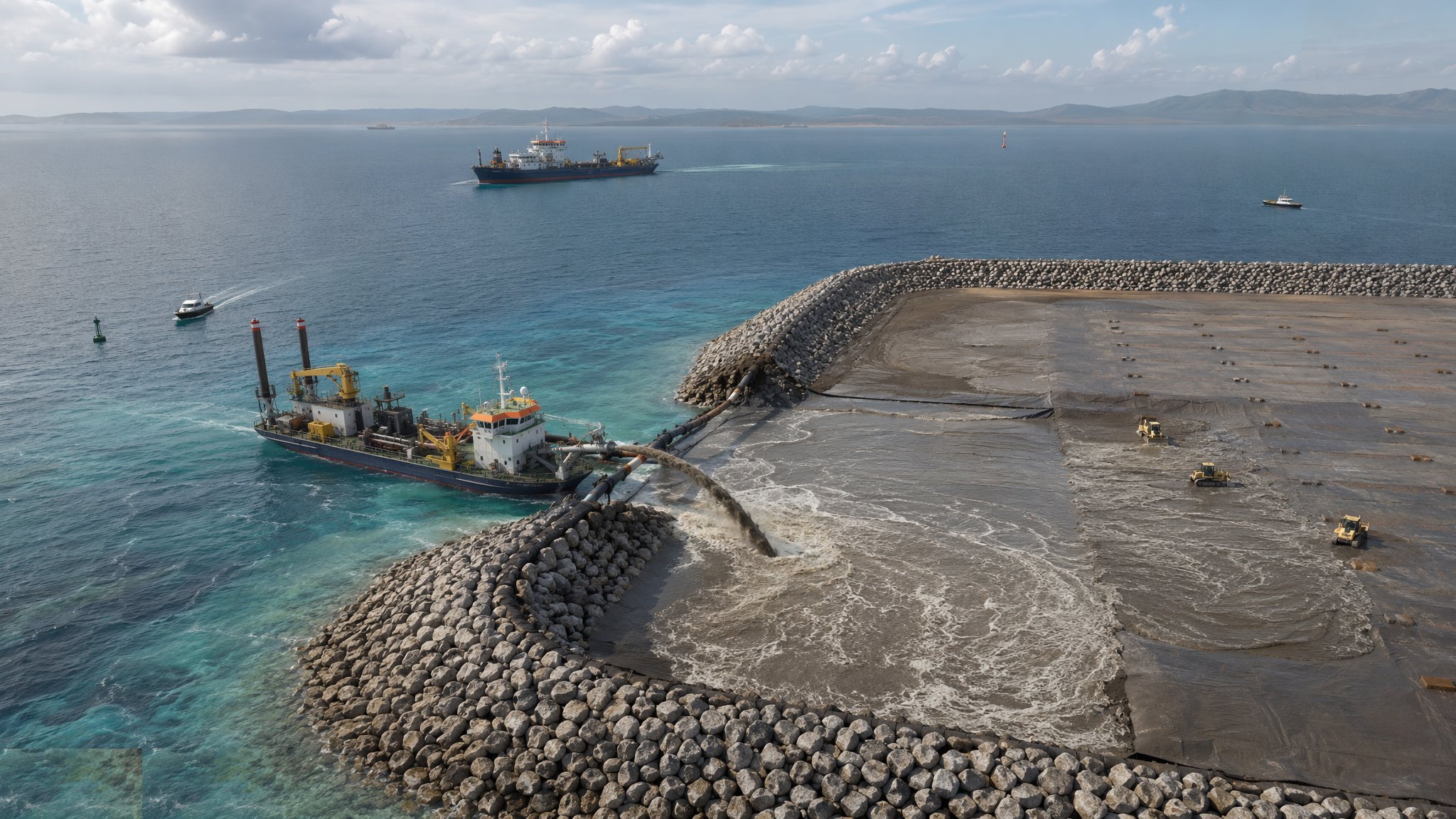
What is Backhoe and grab dredging?
Mechanical dredging is dredging with a digging machine rather than a pump. A backhoe dredger is a large hydraulic excavator mounted on a pontoon, usually held on spuds, digging material out and placing it into a barge alongside. A grab dredger uses a crane with a clamshell or orange-peel grab, lowering it open, closing it on the material and lifting it out. Neither moves anything like the volume a suction dredger moves. What they offer instead is control: the operator can see where the bucket is going, can work to a line, and can stop short of a structure by the distance the designer has set.
That makes mechanical plant the tool for the awkward work. Cleaning out a berth pocket right against a quay wall, dredging around piles and fenders, trimming a trench, working in a lock or a dock basin, digging in a confined harbour where a cutter dredger could not swing and a trailer could not turn - all of it is backhoe and grab work. It also handles material that would trouble a pump: debris, rubble, cobbles, old moorings, and the general accumulation of a working port's history. A backhoe can dig stiff and hard material within the reach of its arm, and a heavy grab can take on obstructions that would damage a cutter head.
The other advantage is contained handling, which matters most with contaminated sediment. A closed grab or a carefully worked backhoe bucket lifts material with far less loss to the water column than a suction operation with overflow, and the material goes straight into a barge for controlled disposal or treatment. Against that, production is low, the plant occupies a fixed position and needs barges cycling to and from it, and the depth of work is limited by the reach of the arm or the length of the wire and by the pontoon's stability. Weather stops mechanical dredging quickly, because a pontoon on spuds in a swell is not a place to be swinging a loaded bucket.
How does Backhoe and grab dredging work, step by step?
- 1
Step 1: Define the work and its constraints
Mechanical dredging is usually chosen because of a constraint, so the constraint is defined first: the structure to be worked around, the confined space, the contaminated material, the debris expected. The designer sets the stand-off from any structure and the sequence in which material may be removed, since taking material from in front of a wall changes what that wall carries. Consents cover the disposal route, and contaminated material takes a route of its own.
- 2
Step 2: Position the pontoon and set the spuds
The dredger is towed into position and set down on its spuds, with moorings arranged so it can be moved along the work without disturbing shipping. The working position is surveyed, and the machine's position and bucket position are tied into a positioning and depth display so that the operator is digging to a level rather than to a feel. In a confined dock or lock, the arrangement is agreed with the port authority in advance because it will block the space while it works.
- 3
Step 3: Dig to the design level
The backhoe cuts in benches, working the face down to the design level with the bucket, or the grab is lowered, closed and lifted repeatedly on a set pattern. Progress is tracked against the positioning display and against interim surveys. Overdredging near a structure is avoided by working to the stand-off the designer set, and the operator does not exceed it on the grounds that the material there is easy to reach.
- 4
Step 4: Load barges and manage the cycle
Material is placed into a hopper barge or a split barge alongside. Loading is controlled so the barge is not overfilled and so material is not spilled back into the water, which matters for both production and consent compliance. Barges are cycled to the disposal ground, the reclamation or the treatment facility by tug, and the barge fleet is sized so the dredger never waits - the barge cycle, not the digging, usually sets the production rate.
- 5
Step 5: Handle obstructions and debris
Mechanical dredging is where obstructions surface: old chains, moorings, ordnance, rubble, sunken timber, abandoned services. Anything unexpected is stopped on and reported rather than lifted blind. Where ordnance is a credible risk the survey and clearance regime is settled before dredging starts, not improvised when something is snagged. Recovered debris is separated and disposed of by the appropriate route.
- 6
Step 6: Control turbidity where contamination is present
Where the sediment is contaminated, the method is adjusted to limit release: closed or environmental grabs, slow and controlled lifting, silt curtains where the regulator requires them, and no overflow from barges. Monitoring runs to the trigger levels in the consent with defined actions. The disposal or treatment route for the material is fixed in advance and tracked load by load, because contaminated sediment has to be accounted for from the seabed to its final destination.
- 7
Step 7: Survey and trim to tolerance
Interim multibeam and single-beam surveys check the achieved level, and the remaining high spots are trimmed. Mechanical dredging is often the finishing operation after a suction dredger has taken out the bulk, so the tolerance is tighter than for the bulk work. Around structures the survey also confirms that the stand-off has been respected and that the wall or piles have not been struck.
- 8
Step 8: Close out and demobilise
A final survey is issued as the acceptance record, with volumes reconciled against barge loads and disposal records. Where the work was against a structure, a condition survey or diver inspection of that structure is included so that there is a record of its state at completion. The pontoon, spuds and moorings are recovered and the area is handed back to the port authority.
What are the benefits of Backhoe and grab dredging?
- Precise, controlled digging that can work close to walls, piles and fenders within the set stand-off
- Works in confined areas - docks, locks, small harbours - where suction plant cannot operate
- Handles debris, rubble, cobbles and obstructions that would damage a pump or a cutter head
- Contained handling of contaminated sediment with far less release than an overflowing suction operation
- Material goes straight into barges for a controlled disposal or treatment route
- Relatively low mobilisation cost and widely available plant compared with large dredgers
What are the limitations of Backhoe and grab dredging?
- Low production - unsuitable for large-volume capital dredging
- Depth is limited by the arm reach or wire length and by the stability of the pontoon
- Needs a cycling barge fleet and tugs, and the barge cycle usually governs output
- Stops quickly in swell or wind, since a spudded pontoon is weather-sensitive
- Occupies and obstructs the working area, which matters in a live berth or lock
- Grab dredging leaves an uneven bed unless carefully worked and surveyed
What is Backhoe and grab dredging best suited for?
What plant does Backhoe and grab dredging need?
- Backhoe dredger - long-reach hydraulic excavator on a spudded pontoon
- Grab dredger or crane barge with clamshell, orange-peel or environmental grabs
- Hopper and split barges with attendant tugs for the disposal cycle
- Positioning and bucket depth display systems tied to survey control
- Silt curtains and turbidity monitoring where contaminated material is handled
- Multibeam and single-beam survey equipment, with diver or remote inspection capability
How is Backhoe and grab dredging quality-checked?
- Stand-off from structures agreed with the designer and enforced through the depth display
- Bucket or grab position and level logged against survey control rather than judged by eye
- Barge loads recorded and tracked to their disposal, treatment or reuse destination
- Turbidity and containment measures monitored to the consent where contamination is present
- Interim surveys used to trim high spots, with the finished bed surveyed to the specified tolerance
- Condition survey of adjacent structures recorded at completion of the works alongside them