Hydraulic fill reclamation behind bunds
Land made by pumping sand into contained cells and letting the water run back out.
Last updated 2026-09-06
What is Hydraulic fill reclamation behind bunds?
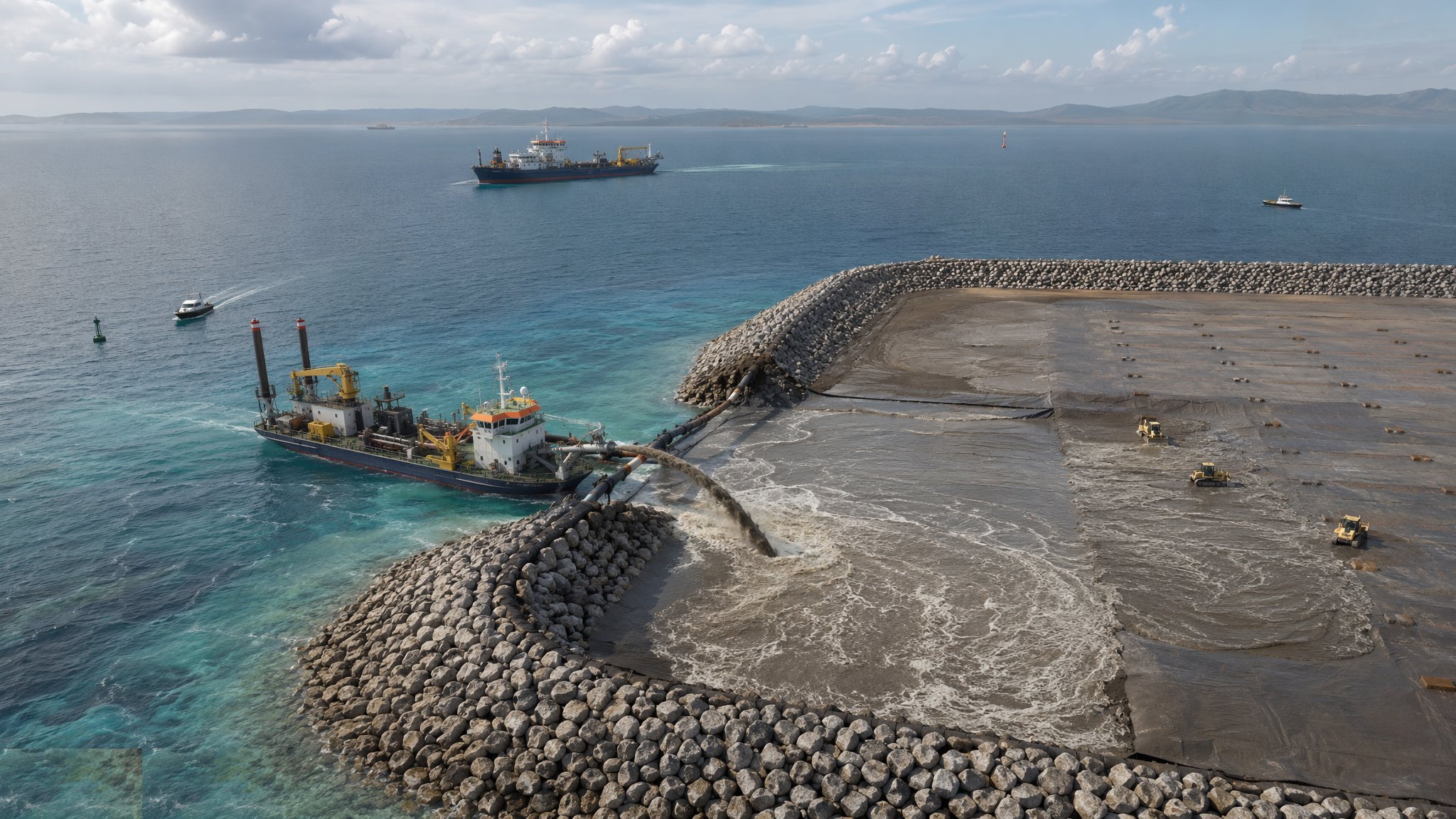
Hydraulic fill reclamation makes new land out of dredged sand. A bund - a rock or sand embankment - is first built around the area to be reclaimed, dividing it into cells. Sand won from a borrow area or from capital dredging is then pumped in as a slurry, either through a pipeline from a cutter dredger or discharged from a trailer, and the sand settles out inside the cell while the surplus water is decanted back to the sea through weirs. Cell by cell and layer by layer, the water is displaced and the ground rises until it emerges above water and can be worked by land plant. It is a simple idea executed at very large scale.
The bund is the enabling structure and the part that decides whether the reclamation succeeds. It has to retain the fill, contain the fine material so it does not simply wash away, resist wave action while it is exposed, and let water out in a controlled way through the weirs so that the cell does not overtop. Its section, its armour, its filter layers and its founding all come from the designer, and on soft seabeds the bund itself may need ground treatment or displacement before it will stand. A bund breach part way through filling is one of the more expensive failures available on a marine project.
The fill matters almost as much. Clean, well-graded sand settles quickly, drains freely and makes good ground. Silty or fine material carries a long way inside the cell before it settles, collects at the far end near the weirs, and leaves soft pockets that will cause trouble for years. That is why the borrow source is characterised carefully and why the discharge and weir positions are arranged to control where the fines end up. Whatever the fill, it arrives loose. Hydraulically placed sand is not compacted ground, so a ground treatment stage follows before anything is built on it, and that is a separate operation with its own design.
How does Hydraulic fill reclamation behind bunds work, step by step?
- 1
Step 1: Establish the seabed and design the reclamation
The investigation covers the seabed the reclamation will sit on as well as the borrow area the fill comes from. Soft material under the footprint will consolidate under the weight of the new land, and the designer decides whether it is removed, displaced or left to consolidate under the fill. The reclamation design covers the final level, the cell layout, the bund arrangement, the fill source and the treatment that will follow. Consents cover the borrow area, the works and the water quality conditions the environmental regulator imposes.
- 2
Step 2: Build the bunds and form the cells
Bunds are built by placing rock or sand from barges, from a floating crane, or by end-tipping from land as the bund advances. Filter layers and armour are placed to the designer's section so that the bund neither loses fill through itself nor is eroded by wave action. The reclamation is divided into cells so that filling can be controlled, so that fines can be managed, and so that a problem in one cell does not affect the rest. Weir structures are built into the bunds at the positions the designer sets.
- 3
Step 3: Set up the discharge arrangement
Fill is delivered either by pipeline from a cutter dredger or a booster station, or by a trailer discharging through a bow connection or rainbowing over the bund. The discharge point inside the cell is chosen and moved as filling proceeds, because where the slurry enters decides where the coarse material drops and where the fines travel. Pipeline routes across the water are agreed with the port authority and marked, since they are a navigational hazard.
- 4
Step 4: Fill the cell and decant the water
Slurry is pumped in continuously. The sand settles near the discharge, and the water with the finest material in suspension travels across the cell to the weirs and is decanted back to the sea. Weir levels are adjusted as the fill rises to keep the retention time long enough for solids to settle before the water leaves. The discharge from the weirs is monitored against the water quality conditions in the consent, and this - not the pumping - is usually what limits how fast a cell can be filled.
- 5
Step 5: Manage the fines and move the discharge
The discharge point is moved around the cell so that the fill builds evenly and so that fine material does not all accumulate in one corner. Where fines are unavoidable, the design plans for where they will end up and treats that area accordingly. Bulldozers and excavators work the emerged sand to spread and level it as soon as the surface is above water and will carry plant.
- 6
Step 6: Bring the fill above water and regulate the surface
As the cell fills, the fill emerges and the operation changes character - from a pumping operation to an earthworks operation. Land plant spreads and levels the material, temporary drainage is cut so that the surface sheds water rather than ponding, and the final level is worked to the design allowing for the settlement that is going to occur. That settlement allowance is the designer's figure and is based on the ground beneath and the fill placed.
- 7
Step 7: Monitor settlement and the bunds
Settlement plates, piezometers and survey monitoring are installed and read from early in the filling. The seabed beneath is consolidating under the new load, and the record of how fast that is happening is what tells the designer when the ground is ready for the next stage. The bunds are inspected and surveyed throughout, particularly after storms, because a bund that is being eroded is a bund that will eventually fail.
- 8
Step 8: Hand over for ground treatment
When filling is complete the reclamation is surveyed, the volumes are reconciled against the material dredged and placed, and the monitoring record is issued. The land is not yet buildable - hydraulically placed sand is loose and the ground beneath is still settling - so the reclamation is handed on to the ground treatment stage with the survey, the monitoring data and a record of where the fines ended up, which is the single most useful thing the treatment designer can be given.
What are the benefits of Hydraulic fill reclamation behind bunds?
- Creates large areas of new land quickly where no land exists
- Uses material won from capital dredging, turning spoil into an asset rather than a disposal problem
- Very high placement rates once the bunds are complete and the pipeline is running
- Cell layout gives control over filling, over fines and over water quality at the weirs
- Clean sand fill drains freely and makes good ground once it has been treated
- The operation is simple and repeatable at scale with well-understood plant
What are the limitations of Hydraulic fill reclamation behind bunds?
- The bund is a substantial marine structure in its own right and a serious failure risk while filling
- Fine material in the fill travels across the cell and leaves soft pockets that cause long-term trouble
- Decant water quality is consent-controlled and often limits the rate of filling
- Soft seabed beneath the reclamation consolidates for a long period, so settlement continues after filling
- The resulting ground is loose and always needs a separate ground treatment stage before development
- Heavily dependent on a suitable borrow source and on the consents that go with it
What is Hydraulic fill reclamation behind bunds best suited for?
What plant does Hydraulic fill reclamation behind bunds need?
- Cutter suction or trailer dredgers with pipeline, booster pumps and bow discharge connections
- Rock placement barges, floating cranes and land plant for building and armouring the bunds
- Weir structures and discharge control arrangements built into the bunds
- Bulldozers, excavators and dump trucks for spreading and levelling emerged fill
- Survey vessels and land survey equipment for progressive volume control
- Settlement plates, piezometers and water quality monitoring instrumentation
How is Hydraulic fill reclamation behind bunds quality-checked?
- Borrow material characterised and checked on delivery so that fill quality matches the design assumption
- Bund section, filter layers and armour inspected and surveyed as built, and re-inspected after storms
- Weir discharge water quality monitored continuously against the consent conditions
- Discharge point moved to a planned regime, with the location of fines recorded for the treatment designer
- Progressive surveys reconciling placed volume against dredged volume
- Settlement and pore pressure monitoring installed early and read to a defined schedule