Trailer suction hopper dredging (TSHD)
A self-propelled ship that dredges on the move, fills its own hold and sails away with the spoil.
Last updated 2026-09-06
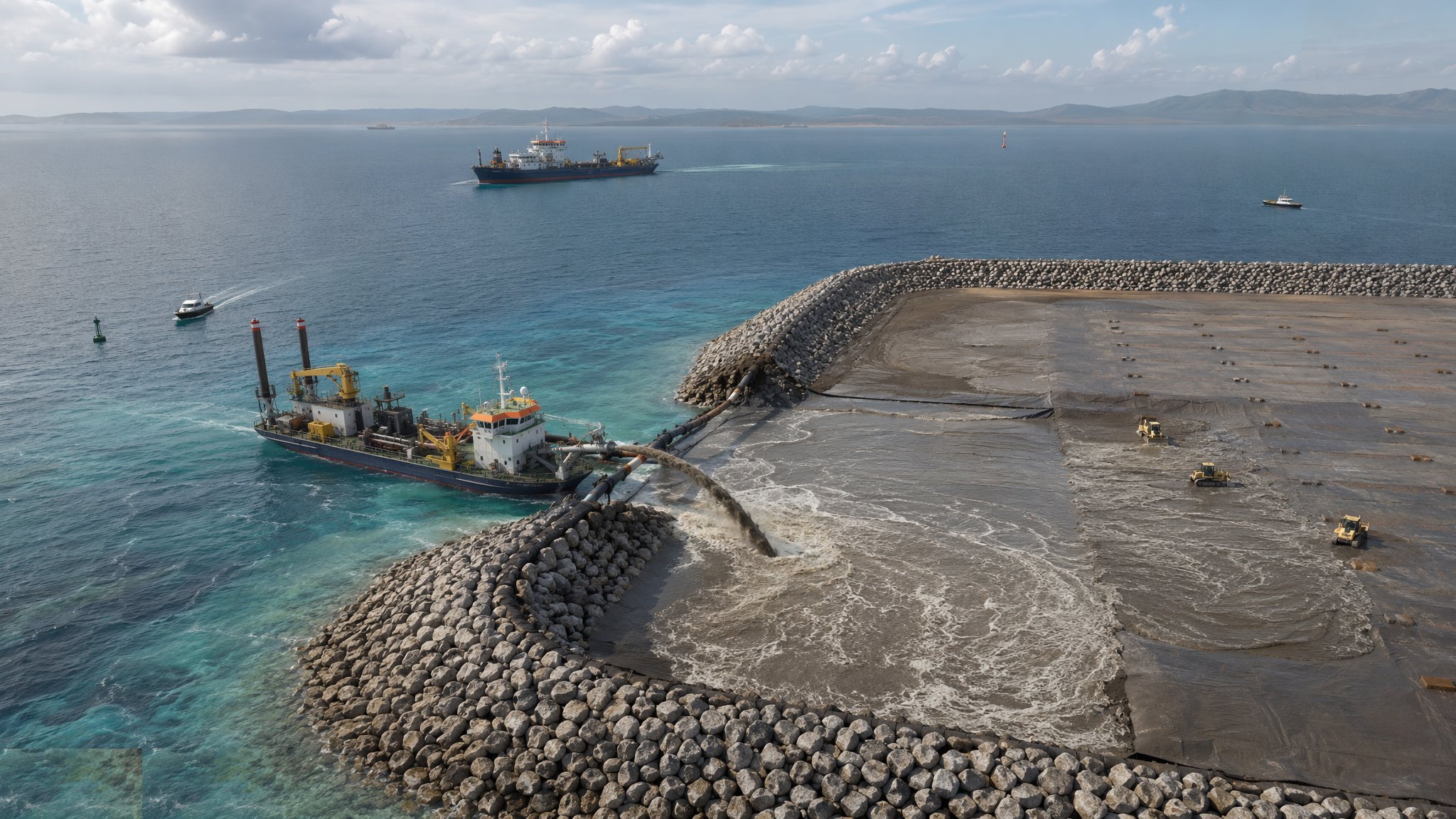
What is Trailer suction hopper dredging (TSHD)?
A trailer suction hopper dredger is a ship with a dredging plant built into it. One or two suction pipes - the drag arms - hang over the side and trail along the seabed while the vessel steams slowly ahead. A draghead at the end of each arm loosens the material, powerful dredge pumps draw up a mixture of sediment and water, and the mixture is discharged into a hopper in the hull. The water overflows away and the solids settle, so the hopper gradually fills with spoil. When it is full the arms come up and the ship sails to the disposal ground or the reclamation site to discharge, then comes back and starts again. That loading, sailing, discharging and returning is the cycle around which the whole operation is planned.
What makes the type indispensable is that it is a ship. It is self-propelled, it can work in open water and in swell that would stop a stationary dredger, it does not need anchors or spuds or attendant barges, and it can carry its own spoil a long way. That combination makes it the standard tool for maintenance dredging of approach channels and berth pockets, for capital dredging in soft to medium material, and for winning sand for reclamation from a licensed borrow area offshore. It moves out of the way of traffic rather than blocking it, which matters enormously in a working port.
It has clear limits. The drag arm and the draghead can only do so much: soft silts, sands and loose gravels come up readily, stiff clays are hard work, and rock has to be broken by other means first. Precision is limited, because a trailer is a moving ship dredging a swathe rather than a fixed machine cutting to a line, so it is not the tool for working tight against a quay wall or around a structure. Discharge is by bottom door, by pumping ashore through a pipeline, or by rainbowing the spoil through a nozzle over the bow, and which of those is allowed at a given site is set by the environmental regulator and the port authority rather than by the marine contractor. Overflow during loading is the other consent-governed issue, since it releases fine sediment into the water column, and the conditions on it commonly shape the working method more than the dredging itself.
How does Trailer suction hopper dredging (TSHD) work, step by step?
- 1
Step 1: Survey, characterise and consent the work
A pre-dredge bathymetric survey and sampling establish what is there, how much of it and what it consists of, including any contamination, because contaminated material changes both the method and the disposal route entirely. The consents follow: the dredging permission, the disposal or reuse route, the conditions on overflow and turbidity, the environmental windows protecting fish and other receptors, and the navigational arrangements agreed with the port authority. On most projects the consents, not the plant, define what the programme can be.
- 2
Step 2: Plan the cycle and mobilise
The marine contractor plans the work around the cycle time - load, sail loaded, discharge, sail back - because that is what production actually depends on. Sailing distance to the disposal ground or the reclamation site is usually the dominant variable, which is exactly why a trailer is chosen when the distance is long. Dredging areas are divided into tracks, the vessel is mobilised with the right dragheads for the material, and the traffic management with the port authority is put in place.
- 3
Step 3: Lower the arms and load the hopper
The vessel steams slowly along a planned track with the drag arms lowered to the seabed. The draghead loosens the material, assisted by water jets in sand, and the pumps draw the mixture into the hopper. The bridge team controls speed, arm position and pump settings to keep the mixture at the density that gives best production. Loading continues while the overflow runs, with the overflow arrangement operated within whatever the consent allows, until the hopper is loaded to the economic point rather than simply full of water.
- 4
Step 4: Raise, sail and discharge
The arms are raised and secured and the vessel sails to the discharge point. Three routes are used. Bottom doors or split hulls dump the load at a licensed disposal ground. A pipeline connection lets the vessel pump the load ashore into a reclamation. Rainbowing sprays the mixture over the bow to build up shallow ground or a beach. The route is fixed by the consent and by the intended use of the material, and the reuse route is preferred wherever the material and the permission allow it.
- 5
Step 5: Repeat the cycle and manage the fleet
The vessel returns and starts the next load. Where more than one trailer is working, or where a trailer feeds a reclamation alongside other plant, the cycles are sequenced so that the discharge point is not the bottleneck. Production is logged load by load - volume, density, position, time - and the log becomes both the payment record and the evidence of what was removed from where.
- 6
Step 6: Monitor the environment continuously
Turbidity monitoring runs at the locations and to the trigger levels the consent sets, with defined actions when a trigger is reached. Marine mammal or other ecological observation is carried out where required. Positions and volumes at the disposal ground are recorded and reported. Environmental monitoring on a dredging project is a continuous obligation with real consequences, not a report written at the end.
- 7
Step 7: Survey progress and control the level
Interim multibeam surveys track progress and show where the required level has been reached and where it has not. The plan for subsequent passes is adjusted from the survey rather than from the plant log. Because a trailer dredges a swathe, the surveyor watches for ridges between tracks and for high spots, and the tracks are overlapped accordingly. Overdredging is avoided as carefully as underdredging, since it costs money and can breach the consent.
- 8
Step 8: Close out with an acceptance survey
A final multibeam survey of the whole area is issued as the acceptance record, with volumes reconciled against the load logs and the disposal records. The port authority receives the as-dredged bathymetry as the new baseline. Where the work is maintenance dredging, the survey also informs when the next campaign will be needed, because a channel that has just been cleared begins silting again immediately.
What are the benefits of Trailer suction hopper dredging (TSHD)?
- Self-propelled and seaworthy, so it works in open water and moves clear of shipping
- Carries its own spoil, which suits long sailing distances to disposal or reclamation
- No anchors, spuds or attendant barges required, so it does not obstruct the navigation
- High production in soft to medium material such as silts, sands and loose gravels
- Can discharge by bottom door, pipeline or rainbow, giving flexibility over the reuse route
- The standard tool for maintenance dredging of channels and berth pockets in an operating port
What are the limitations of Trailer suction hopper dredging (TSHD)?
- Cannot work hard material - stiff clays are slow and rock must be broken first
- Limited precision, so it is unsuited to working tight against walls or around structures
- Needs sufficient water depth to float and manoeuvre, which restricts it in shallow areas
- Overflow releases fine sediment and is tightly controlled by the environmental regulator
- Production is dominated by cycle time, so it is inefficient over very short sailing distances
- Large capital plant with limited availability, so mobilisation has to be planned well ahead
What is Trailer suction hopper dredging (TSHD) best suited for?
What plant does Trailer suction hopper dredging (TSHD) need?
- Trailer suction hopper dredger with one or two drag arms and interchangeable dragheads
- Water jetting systems on the dragheads for working in sand
- Bottom doors or split hull, bow coupling for pipeline discharge, and rainbow nozzle
- Floating and shore pipeline with booster pumps where discharge is ashore
- Multibeam survey vessel and processing capability
- Turbidity monitoring buoys and sampling equipment for the environmental regime
How is Trailer suction hopper dredging (TSHD) quality-checked?
- Pre-dredge survey and sampling completed and agreed as the baseline before work starts
- Load-by-load records of volume, density, position and time kept as the production and payment record
- Interim multibeam surveys used to plan subsequent passes rather than relying on plant logs
- Overflow, turbidity and ecological monitoring carried out to the consent with recorded trigger responses
- Disposal positions and volumes recorded and reported against the licence conditions
- Final acceptance survey issued with volumes reconciled against loads and disposal records
More dredging & land reclamation methods
Next method
Cutter suction dredging (CSD)