Ground treatment of reclaimed land
Reclaimed sand arrives loose - it is densified, surcharged and monitored before anything is built on it.
Last updated 2026-09-06
What is Ground treatment of reclaimed land?
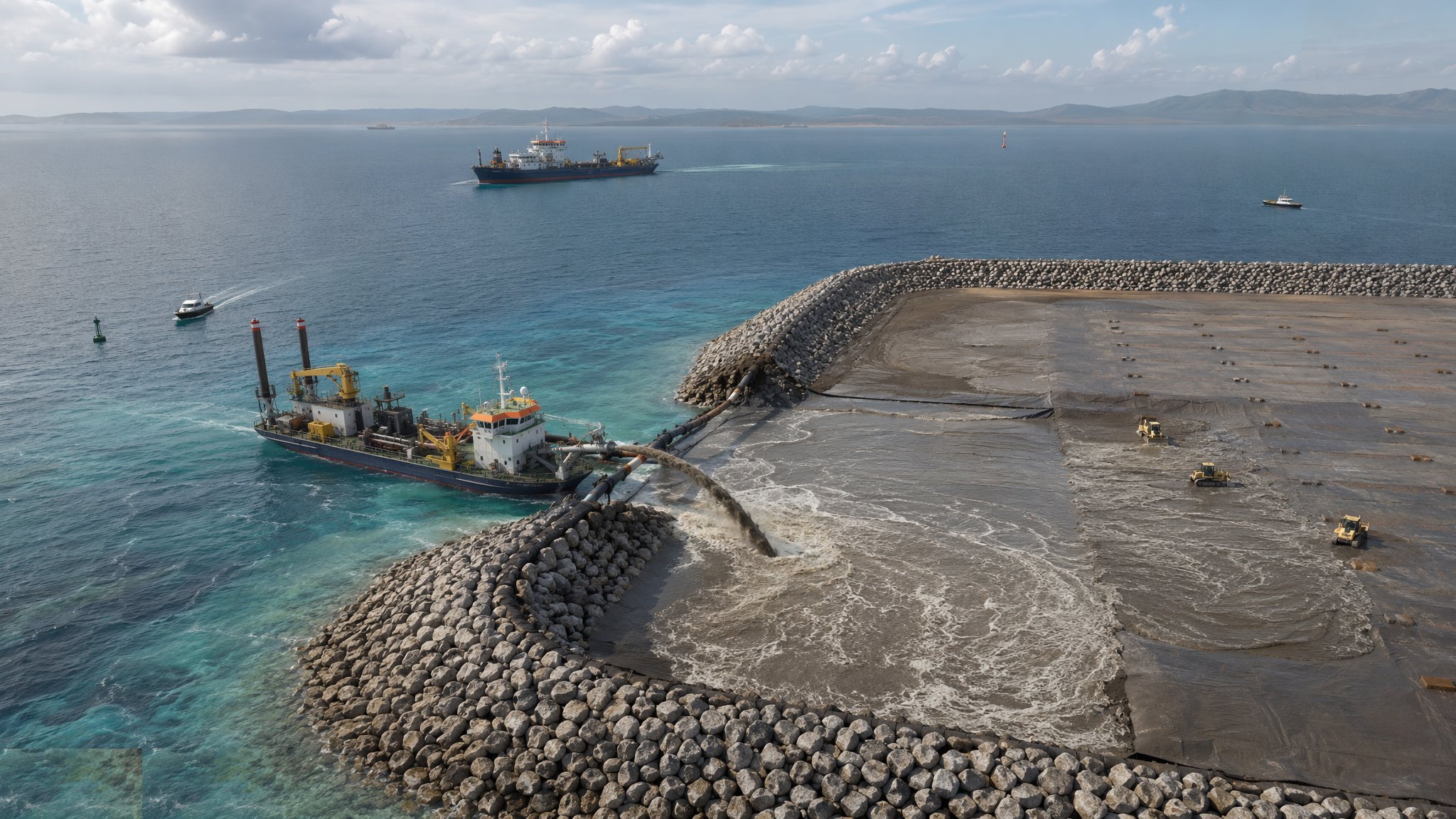
Land made by hydraulic filling is not ready to build on. The sand has been placed as a slurry and has settled out loose, so it will densify under load, under vibration and under an earthquake if the location is one where that matters. Underneath it, the original seabed - often soft marine clay - is consolidating under the weight of the new land and will keep doing so for a long time. Ground treatment is the stage that deals with both problems: the loose fill is densified, the soft ground beneath is made to consolidate faster and further, and the whole thing is monitored until the designer is satisfied that the movement left in it is within what the development can tolerate.
The techniques divide by what they are treating. For the loose granular fill, deep compaction methods are used - vibrocompaction, which uses a depth vibrator to shake the sand into a denser packing, dynamic compaction, which drops a heavy weight on a grid, and rapid impact compaction for the shallower layers. These act on the fill itself and their effective depth is limited by the energy that can be delivered. For the soft ground beneath, the answer is consolidation: a surcharge of additional fill is placed to squeeze the water out, and vertical drains installed through the soft layer give that water a short path to escape, so what would otherwise take decades happens in months. Vacuum consolidation achieves something similar without the surcharge weight. Often both families are used on the same reclamation, in sequence.
What makes this stage different from ground improvement on a normal site is time and evidence. Consolidation cannot be hurried beyond what the drains allow, so the surcharge sits and the instruments are read while nothing appears to happen, and that waiting is programme, not delay. The whole stage is governed by monitoring - settlement plates, extensometers, piezometers and inclinometers - and the decision to remove a surcharge is a decision made from the instrument readings by the geotechnical engineer, not from the calendar. All the values involved, from the surcharge height to the drain spacing to the acceptance criteria for the treated ground, are that engineer's work for that reclamation.
How does Ground treatment of reclaimed land work, step by step?
- 1
Step 1: Investigate the reclamation as built
The treatment is designed off an investigation of what is actually there, not off what was meant to be placed. Penetration testing through the fill establishes how loose it is and how that varies across the area, particularly in the zones where fines accumulated during filling. Boreholes through to and into the original seabed characterise the soft layer beneath. The filling records and the monitoring data from the reclamation stage feed straight into this, which is why they are handed over.
- 2
Step 2: Select the treatment and set the acceptance criteria
The geotechnical engineer selects the methods and their extent: which areas need deep compaction, which need consolidation, which need both, and which need neither because nothing will be built there. The acceptance criteria are fixed at this stage - what the treated ground has to achieve and how that will be demonstrated - because a treatment programme without an agreed test of success cannot be closed out. Every dimension in the design, from treatment depth to grid spacing to surcharge, comes from this work.
- 3
Step 3: Install vertical drains where consolidation is needed
Where the soft layer beneath must be consolidated, prefabricated vertical drains are installed on a grid by a stitcher rig, driven down through the fill and into the soft stratum and left in place. A drainage blanket of free-draining granular material is placed over the area so that the water arriving at the drain heads has somewhere to go and can be collected and discharged. Drain depth and spacing are set by the designer from the consolidation analysis.
- 4
Step 4: Place the surcharge and let it work
Additional fill is placed over the treatment area to load the ground beyond what the finished development will impose, squeezing water out of the soft layer through the drains. The surcharge is placed in a controlled sequence, because loading soft ground too quickly can cause a stability failure rather than consolidation, and the rate is set by the designer and checked against the piezometers as it goes on. Then it sits. Vacuum consolidation is used instead where the surcharge fill is unavailable or where the stability of a large surcharge is doubtful.
- 5
Step 5: Densify the granular fill
The loose reclaimed sand is treated by vibrocompaction, dynamic compaction or rapid impact compaction according to the depth and the design. Each works on a set-out grid with recorded parameters, and each leaves the surface disturbed and settled - total surface settlement across a treated area is often substantial and is surveyed and made up with additional fill. Where the reclamation is near existing structures, the vibration assessment governs the stand-off and may rule a method out entirely.
- 6
Step 6: Monitor continuously and decide from the instruments
Settlement plates, extensometers, piezometers and inclinometers are read to a schedule and the results plotted as they come in. The plots show whether settlement is decelerating as predicted and whether pore pressures are dissipating. The decision to stop surcharging is made from those plots by the geotechnical engineer against the design prediction. This is the heart of the stage: the instruments are not paperwork, they are the control mechanism.
- 7
Step 7: Remove the surcharge and verify the treated ground
When the monitoring shows the required consolidation has been achieved, the surcharge is removed and reused elsewhere. Verification testing then demonstrates the treated ground against the acceptance criteria: penetration testing profiles compared with the pre-treatment baseline, plate or zone load testing where specified, and further settlement monitoring during a defined period. Areas that fall short are re-treated rather than argued about.
- 8
Step 8: Hand over the platform with its record
The treated area is surveyed, regulated to level and protected, since treated ground left open to weather and construction traffic is treated ground being spoiled. The handover pack carries the treatment records, the verification testing, the full monitoring history and the residual settlement the designer expects the development to experience. That residual figure is what every subsequent foundation, pavement and service design on the reclamation will be built around.
What are the benefits of Ground treatment of reclaimed land?
- Turns loose, unbuildable reclaimed fill into a platform that structures and pavements can use
- Brings decades of consolidation settlement forward into the construction programme
- Reduces or removes the need for piling across large areas of a reclamation
- Densification also reduces the risk of the loose fill losing strength under vibration or seismic loading
- Surcharge fill can usually be moved on and reused on the next area rather than being lost
- The monitoring record gives the development a defensible basis for residual settlement design
What are the limitations of Ground treatment of reclaimed land?
- Consolidation takes time that cannot be compressed beyond what the drains allow
- Requires large volumes of surcharge fill and the plant and space to move it repeatedly
- Deep compaction methods reach only a limited depth into the fill
- Vibration from compaction restricts working near existing structures and services
- Areas where fines accumulated during filling respond poorly and often need different treatment
- The whole stage depends on instrumentation that must survive construction traffic to be of any use
What is Ground treatment of reclaimed land best suited for?
What plant does Ground treatment of reclaimed land need?
- Depth vibrators on crawler rigs for vibrocompaction, with water flush and containment
- Crawler cranes with drop weights for dynamic compaction, or rapid impact compaction rigs
- Stitcher rigs for prefabricated vertical drain installation
- Dump trucks, dozers, excavators and scrapers for placing and moving surcharge fill
- Drainage blanket material, collection drains and discharge arrangements
- Penetration testing rigs, plate load equipment, settlement plates, extensometers, piezometers and inclinometers
How is Ground treatment of reclaimed land quality-checked?
- Post-reclamation investigation completed and reconciled against the filling records before design
- Acceptance criteria agreed in writing before treatment begins
- Drain installation depth, spacing and position recorded rig by rig
- Surcharge placement rate controlled against pore pressure readings rather than plant availability
- Compaction parameters recorded per point and surface settlement surveyed and made up
- Monitoring read to schedule, plotted against prediction, and used as the basis for surcharge removal
- Verification testing compared with the pre-treatment baseline, with shortfall areas re-treated