Berthing and mooring dolphins
Isolated structures in open water - one takes the impact of the ship, the other holds the ropes.
Last updated 2026-09-06
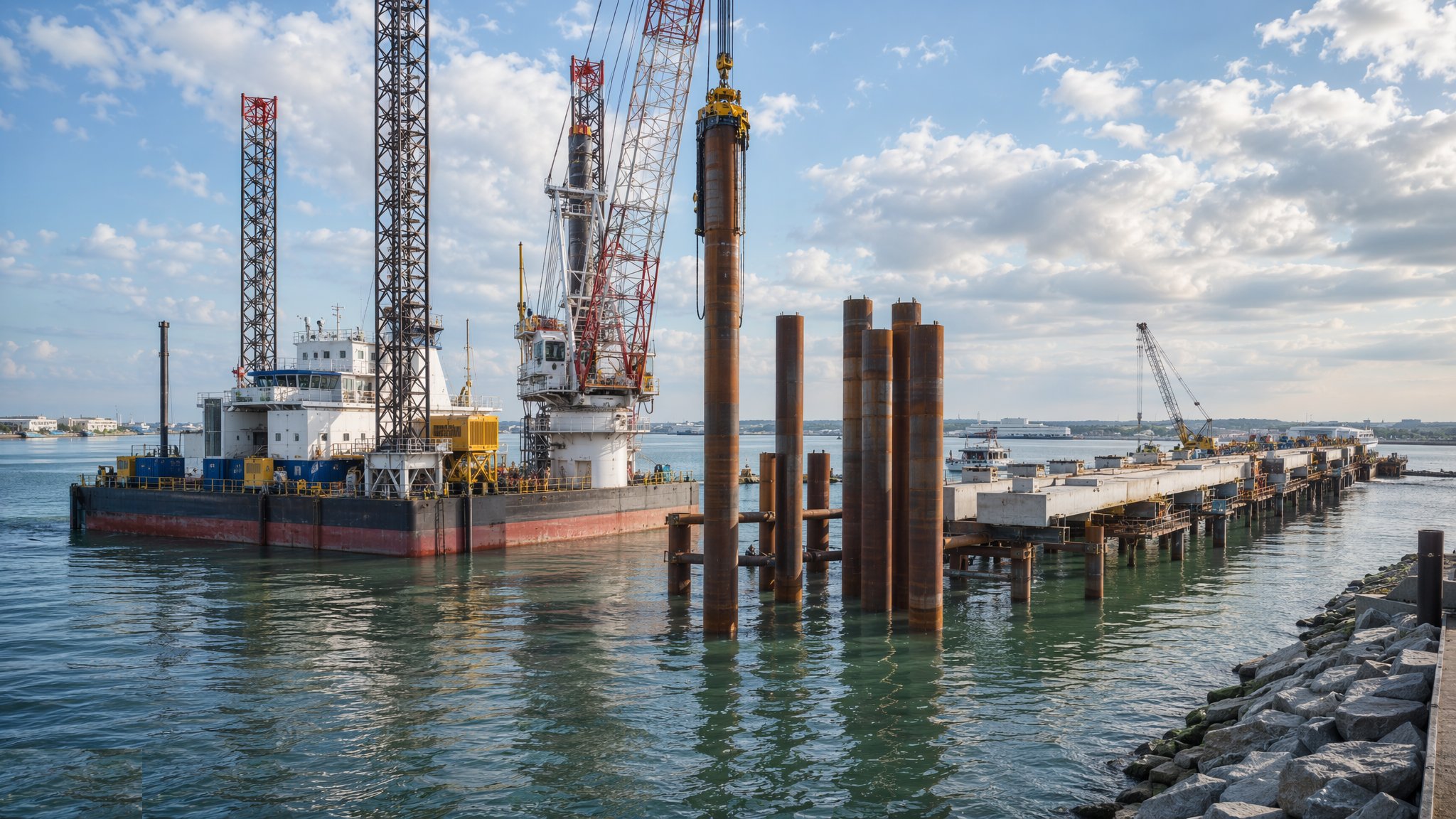
What is Berthing and mooring dolphins?
A dolphin is a small structure standing on its own in the water, doing one job very well. Berthing dolphins take the impact of a vessel coming alongside, absorbing that energy through fenders mounted on their face. Mooring dolphins take no impact at all but hold the mooring lines that keep the vessel in position against wind, current and the pull of cargo operations. On most projects they are used instead of a continuous quay because a large vessel only actually touches the structure at a few points, and building a continuous wall along its whole length would be paying for structure that never does anything.
The engineering is concentrated rather than spread out. A dolphin is typically a group of driven piles, often heavily raked, tied together by a concrete or steel head, and the load path from the fender or the mooring point down into the ground is short, direct and highly loaded. That concentration is what makes dolphins efficient and also what makes them unforgiving - there is very little redundancy, and every element is working. The designer sets the loads from the vessels the port operator expects to handle, and the fender system, the mooring equipment and the pile group are all sized from that. Those figures are project-specific and come from the marine designer, never from a comparable structure elsewhere.
Because dolphins stand alone in the water they need access, and on most projects that means walkways or catwalks linking them to each other and to the shore or the jetty head. Those walkways are usually lightweight steel structures with their own foundations or hung between the dolphin heads, and they carry not just people but services, lighting and sometimes hoses and cables. Dolphins are also, by nature, the structures that get hit, so the operator inherits a maintenance obligation: fender inspection and replacement, mooring hook and quick-release equipment servicing, and monitoring of the pile group for the accumulated effects of impacts over a long life.
How does Berthing and mooring dolphins work, step by step?
- 1
Step 1: Establish the vessel and operating requirements
The port operator sets out the range of vessels the berth will serve, the approach and berthing procedures, whether tugs will be used, and the environmental conditions the berth must remain workable in. The marine designer converts this into the layout - where the berthing dolphins sit along the berthing line and where the mooring dolphins sit to give the required line angles - and into the design loads. On most projects the layout is checked against the full range of vessel sizes, because a berth designed only for the largest ship can leave the smallest one badly held.
- 2
Step 2: Fix the structural arrangement and the pile group
The designer then decides the form: a single large-diameter monopile head, a small group of vertical and raked piles, or a piled block, depending on water depth, ground conditions and the loads. Raking is the usual answer to horizontal load because it puts the force down the axis of a pile rather than bending it, but raked piles are harder to install and the arrangement is always a compromise between structural efficiency and buildability. The pile sizes, rakes and penetrations are all the marine designer's, arrived at from the ground model and the design loads together.
- 3
Step 3: Set up the marine spread and the template
Dolphins are usually small in plan and highly tolerance-sensitive, so a purpose-made piling template is almost always used. The template is set and surveyed into position from the marine plant, holding every pile at its designed position and rake while it is pitched and driven. Because the structure has few piles and little redundancy, the tolerance on each one is tighter than on a long jetty where the deck can absorb small errors. The template design, its own restraint, and how it is recovered after driving are all worked out in advance as temporary works.
- 4
Step 4: Drive the piles and record the drive
Piles are pitched through the template and driven to the designer's founding criteria, commonly with a vibratory hammer for the free-running section and an impact hammer for the final penetration. Rake is monitored throughout, because a raked pile that wanders is difficult to correct once it has taken ground. Driving records are kept blow by blow and dynamic testing is carried out where the design calls for it. The same marine environmental controls apply as for any driven piling over water - exclusion zones, soft start and observation where the licence requires them.
- 5
Step 5: Build the head
Pile heads are cut to level and prepared, and the head structure is formed - either precast units landed and stitched, or in situ concrete cast on hanging formwork supported from the piles. All the cast-in items go in at this stage: fender fixings, mooring equipment holding-down assemblies, walkway bearings, ladder and access fixings, lighting and service routes, and anode brackets. Getting them right matters disproportionately, because retrofitting a heavily loaded fixing into a finished dolphin head over open water is an expensive and unwelcome operation.
- 6
Step 6: Install the fender system
On a berthing dolphin the fenders are the working parts. Rubber or pneumatic units are fitted with their frontal panels, chains and fixings, all set out precisely against the berthing line so that the panel presents flat to the vessel's hull. The fender type and capacity are selected by the marine designer from the vessel data and the berthing procedures, and the installation is checked against the design geometry rather than adjusted to suit what was built. Fixings are torqued and recorded, and the corrosion protection of every fitting is completed, because fender fixings live permanently in the splash zone.
- 7
Step 7: Install the mooring equipment and the walkways
On a mooring dolphin the equipment is bollards, hooks and, at many terminals, quick-release hook assemblies with capstans and load monitoring. These are set, aligned to the intended line directions, bolted down and, where they are powered or monitored, connected and commissioned. The catwalks are then installed between the dolphins and back to the shore or the jetty head, complete with handrails, lighting, services and safe access arrangements. Access is not an afterthought on a dolphin - it is what makes inspection and maintenance possible at all.
- 8
Step 8: Test, commission and set the maintenance baseline
Mooring equipment is proof-loaded or tested as the specification requires, quick-release and monitoring systems are commissioned with the operator present, and the fender geometry is surveyed against the berthing line. Cathodic protection is bonded and commissioned. The as-built survey, the driving records, the fender and mooring equipment certificates and the protection readings are handed over as the baseline for the inspection regime, because a dolphin is a structure whose whole working life is a record of impacts.
What are the benefits of Berthing and mooring dolphins?
- Puts structure only where the vessel actually touches, avoiding the cost of a continuous quay
- Small footprint in the water, so flow, siltation and environmental disturbance are limited
- Loads travel a short, direct path from fender or hook into the pile group
- A single dolphin can be built, damaged and rebuilt without taking the whole berth out of use
- Suits deep water and steeply shelving seabeds where a quay wall would be very costly
- Layout can be adjusted to serve a range of vessel sizes at the same berth
What are the limitations of Berthing and mooring dolphins?
- Little structural redundancy - every pile in a small group is fully working
- Tolerances are tight because there is no long deck to absorb setting-out error
- Access is only by walkway or boat, which makes inspection and maintenance costly
- Fenders and mooring equipment are consumable items with a real replacement programme
- Repeated berthing impacts accumulate over a long life and have to be monitored
- Small isolated pours and lifts over open water carry a poor unit rate compared with continuous structures
What is Berthing and mooring dolphins best suited for?
What plant does Berthing and mooring dolphins need?
- Jack-up platform or piling barge with crane, leaders and anchor spread
- Purpose-made piling template with its own restraint and recovery arrangement
- Vibratory and impact hammers, with dynamic testing instrumentation
- Hanging formwork, floating access platforms and a concrete supply arrangement over water
- Lifting equipment for fender units, frontal panels and mooring equipment
- Survey and inclinometer equipment for position, rake and final fender geometry
How is Berthing and mooring dolphins quality-checked?
- Template position and level surveyed and recorded before any pile is pitched
- Rake and position of every pile monitored during driving and recorded as built
- Driving records and dynamic testing results reviewed against the designer's founding criteria
- Cast-in fixing positions checked against the fender and mooring layout before concreting
- Fender frontal geometry surveyed against the berthing line after installation
- Mooring equipment test certificates, commissioning records and protection readings handed over