Driven tubular steel piles
A steel tube driven from floating or jacked-up plant - the foundation almost every marine structure is built on.
Last updated 2026-09-06
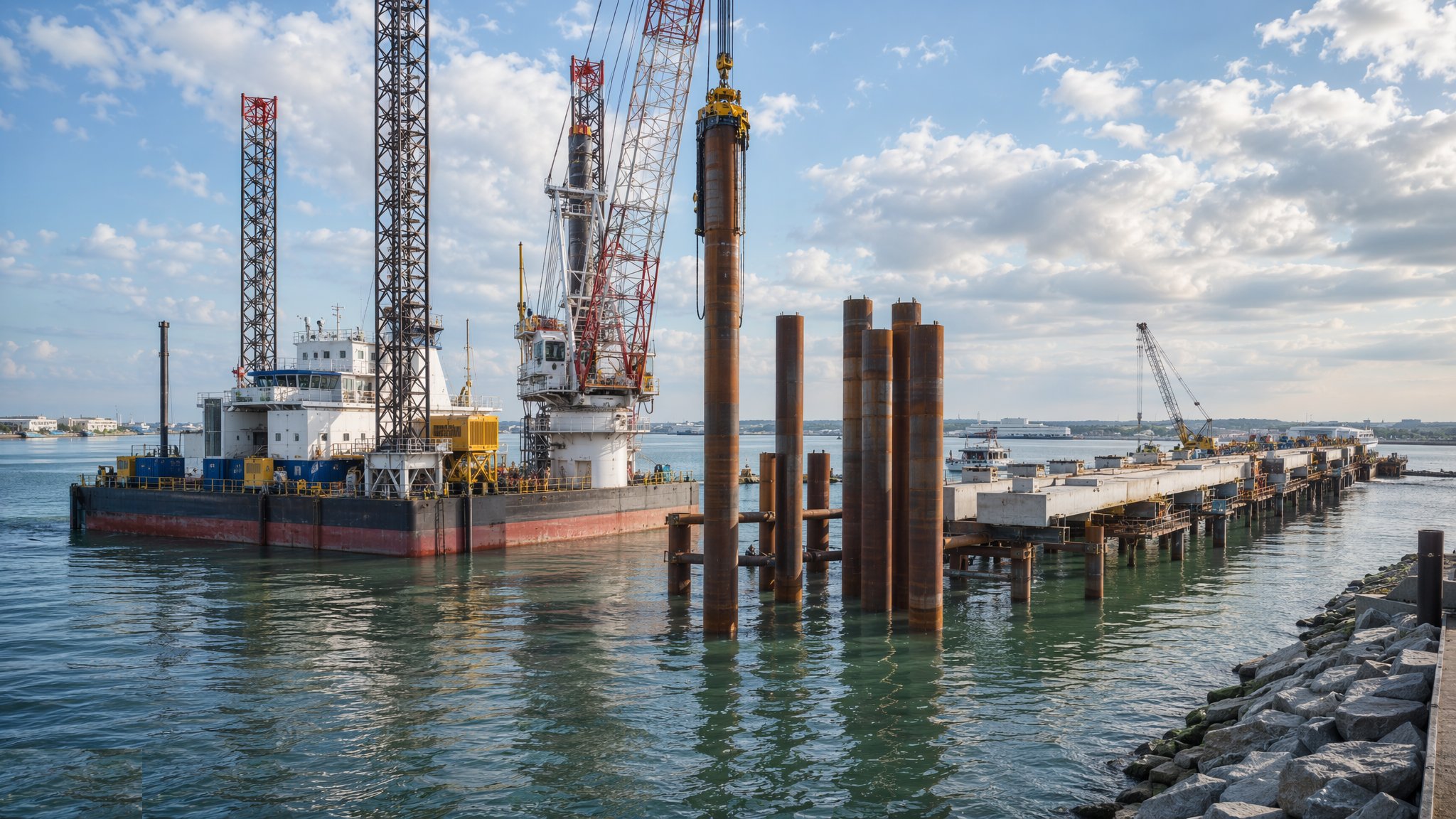
What is Driven tubular steel piles?
The driven tubular steel pile is the workhorse of marine construction. It is a rolled or spirally welded steel tube, closed at the toe on some projects and left open on most, pitched into position over water and driven until the designer's founding condition is met. Sizes across the industry run from a few hundred millimetres for light access structures up to well over two metres for jetty heads and berthing structures, and lengths are made up from shorter cans welded together as the pile goes down. The appeal is simple. A tube is stiff in every direction, it takes bending as readily as compression, it can be raked to pick up horizontal load, it can be spliced to almost any length, and it can be handled by plant that is already floating. On most marine projects the tube is also the only foundation that can be installed in deep water without a cofferdam, a dry dock or a temporary island.
What separates marine piling from land piling is that everything is happening on a moving platform in a moving sea. The pile has to be pitched through a template or a set of leaders, held to a position and a rake while the plant rides the swell, and driven within a weather window that the marine contractor has planned around the tide and the forecast. Driveability governs the whole operation: the designer and the specialist contractor assess in advance whether the tube can be driven to the required founding level without damage, whether a drive-drill-drive sequence will be needed through harder material, and what plant will be mobilised. On most projects a vibratory hammer is used for the free-running upper section and an impact hammer takes the pile down to the founding condition, with the driving record kept blow by blow. The founding criteria, the acceptable driving stresses and the tolerances all come from the designer, and the operator does not vary them on the day.
The other two conversations that dominate a tubular piling campaign are noise and corrosion. Driving steel into the seabed puts a great deal of energy into the water column, and marine mammals and fish are sensitive to it, so on most projects the works are planned around a marine licence, a soft-start procedure, marine mammal observation and often a noise mitigation system deployed around the pile. That planning is done long before the plant is mobilised, and it shapes the programme as much as the tide does. Corrosion then shapes the whole design life. Steel in seawater loses thickness fastest in the splash and tidal zones, so the designer typically combines a protective coating over the upper section, a sacrificial thickness allowance in the steel, and cathodic protection below water using anodes or an impressed current system. The port operator inherits all of it, which is why the inspection and replacement regime is agreed as part of the design rather than after handover.
How does Driven tubular steel piles work, step by step?
- 1
Step 1: Confirm the ground model and the driveability assessment
Marine ground investigation is expensive and always thinner than anyone would like, so the first move is to reconcile the boreholes, the geophysics and the seabed survey into a single ground model the whole team works to. The designer and the specialist contractor then run the driveability assessment: whether the tube as designed can reach the founding level with the plant proposed, where refusal is likely, and what the contingency is if the pile stops high. Obstructions, boulder horizons, buried debris and old structures are all mapped as far as the data allows. The wall thickness, the toe detail and the driving plant all come out of that assessment rather than out of a rate.
- 2
Step 2: Fabricate, coat and mark the piles ashore
Tubes arrive as cans and are welded into pile sections in a fabrication yard where the welding can be done properly and tested. Circumferential welds are inspected, the coating is applied to the specified extent in controlled conditions, and lifting points, driving shoes, internal stiffeners and anode brackets are fitted while the pile is still on land. Each pile is marked with a graduated scale so that penetration can be read off during driving, and the marks are checked against a tape before it goes to the water. Everything that can be done ashore is done ashore, because the same operation over water costs several times as much and is harder to prove.
- 3
Step 3: Set up the marine plant and the position control
The marine contractor either moors a piling barge on an anchor pattern or jacks a platform down onto the seabed. A jack-up is steady and precise once its legs are proven, but slow to move; a floating spread moves quickly and works within tighter weather limits. Positioning runs on satellite positioning checked against shore control, with pile positions translated into the working frame of the plant. The daily plan carries the tide windows, the wave and wind limits for each operation, and the point at which work stops. On most projects the seabed at each pile position is re-confirmed by survey before the pile is pitched.
- 4
Step 4: Pitch the pile and hold it to line and rake
The pile is lifted by crane and pitched into a template frame, into the leaders, or into a gate arrangement fixed to the plant. The template is the single most important piece of temporary works on the project, because it holds position and rake while the tube takes its own weight and starts to run under self-penetration. Verticality and rake are checked by inclinometer and by survey before driving starts, and are re-checked as the pile goes down. Raked piles are harder in every respect - the lift is awkward, the hammer has to be supported in line with the pile, and small errors at the top become large errors at the toe.
- 5
Step 5: Run the soft start and the noise mitigation
Before full driving energy is applied, the marine environmental controls are put into effect. On most projects that means a monitored exclusion zone around the pile, a period of observation before work starts, a soft start in which energy is introduced gradually so that mobile species can move away, and a noise mitigation system deployed around the pile where the marine licence calls for one. Observers have the authority to stop the operation. These controls are set by the marine licence and the project's environmental team, and the piling crew works to them without discretion.
- 6
Step 6: Drive the pile and record the drive
Driving usually begins with a vibratory hammer while the pile is running freely, then changes to an impact hammer for the final penetration. The blow count is logged against penetration for the whole drive, and dynamic testing is carried out on a proportion of the piles so that capacity and driving stresses can be assessed. Where the pile meets material it will not penetrate, the sequence agreed in advance is followed - commonly drilling out the plug, advancing and re-driving. Refusal criteria, maximum driving stresses and the acceptable range of blow counts are set by the designer, and any pile that behaves unexpectedly is stopped and reported rather than driven harder.
- 7
Step 7: Splice, clean out and complete the pile
Where the pile is longer than a single section, the next can is lifted, aligned and welded on with the drive paused, and the weld is tested before driving resumes. Once the pile is at founding level the top is cut to the design level, usually by burning from a floating access platform, and every cut edge and site weld in the splash zone is made good to the coating specification. Where the design requires it the plug is cleaned out by airlift or grab, reinforcement is lowered in and the pile is concreted, which turns the tube into a composite section and closes the top against the sea.
- 8
Step 8: Fit the corrosion protection and hand over the records
Anodes are fitted and bonded, or the impressed current system is installed and commissioned, and the continuity of the protection is tested. Coating damage from handling and driving is repaired to the specification, with particular attention to the tidal and splash zones where loss is fastest. The pile record - as-built position, rake, founding level, driving log, weld tests, coating inspection and protection commissioning - is handed to the designer and to the port operator as the baseline against which every future inspection will be read.
What are the benefits of Driven tubular steel piles?
- Installs in deep water from floating or jacked-up plant with no cofferdam and no dry working
- Very high capacity in compression, tension and bending from a single simple element
- Rakes readily, so horizontal loads from vessels and mooring lines are taken directly
- Splices to almost any length, so uncertain founding depths can be accommodated on the day
- Driving gives immediate feedback - every pile is effectively load-tested as it goes in
- Fabrication, coating and testing happen ashore where quality can be controlled and proved
What are the limitations of Driven tubular steel piles?
- Weather-dependent - a marine spread can lose more days to sea state than to any other cause
- Underwater noise is a major constraint, with licensing, observation and mitigation shaping the programme
- Boulders, obstructions and hard horizons can stop a pile high, and the recovery is slow and expensive
- Corrosion is a permanent liability - the structure needs a protection regime and inspection for its whole life
- Site welds and cut edges over water are the weakest points and the hardest to inspect
- Mobilisation costs are high, so small quantities of piling carry a very poor unit rate
What is Driven tubular steel piles best suited for?
What plant does Driven tubular steel piles need?
- Jack-up platform or piling barge with an anchor spread, crew transfer and standby vessels
- Crawler or pedestal crane with leaders, gates or a piling template for pitching and holding
- Vibratory and impact hammers with power packs, plus dynamic testing instrumentation
- Welding and non-destructive testing spread, burning gear and floating access platforms
- Satellite positioning with shore control, inclinometers and survey equipment
- Noise mitigation equipment and marine mammal observation provision where the licence requires it
How is Driven tubular steel piles quality-checked?
- Fabrication and coating records for every pile, with weld testing before despatch
- As-pitched position and rake surveyed and recorded before driving starts
- Blow count against penetration logged for the full drive, with dynamic testing on the agreed proportion
- Site splice welds tested before driving resumes, with records tied to the pile reference
- Cut-off levels surveyed and coating made good over every cut edge and weld in the splash zone
- Cathodic protection continuity tested and commissioned, with baseline readings handed to the operator
More marine piling & jetty construction methods
Next method
Piled jetties with precast decks