Linkspans and ro-ro bridges
Part structure, part machine - the moving bridge that lets vehicles drive on and off whatever the tide is doing.
Last updated 2026-09-06
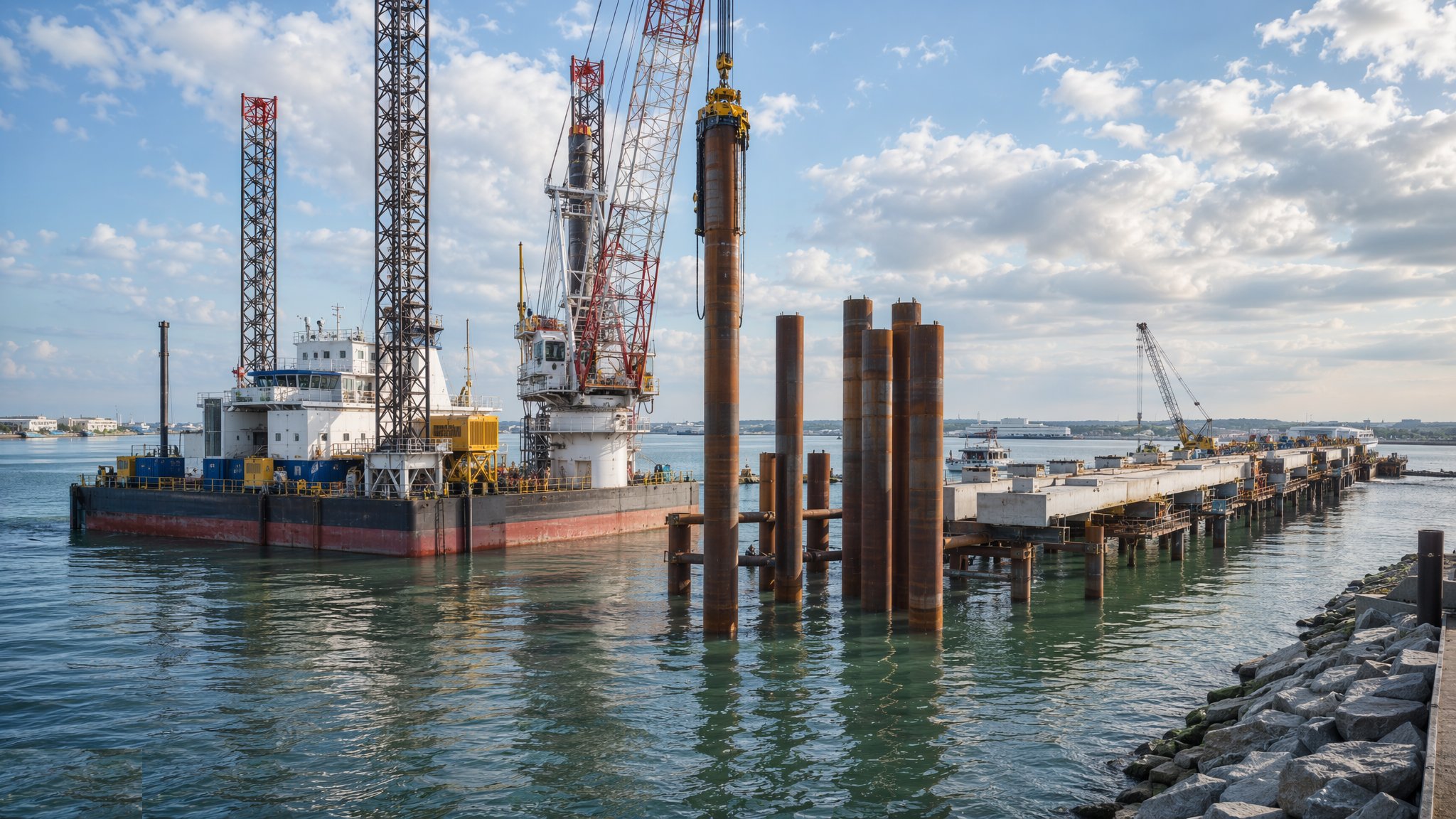
What is Linkspans and ro-ro bridges?
A linkspan is the moving bridge between the shore and a roll-on roll-off vessel. Because the tide moves and the vessel's deck moves with its loading, the bridge has to change its angle continuously while vehicles drive across it. On most projects it consists of a steel bridge deck hinged at a shore abutment, supported at its outer end either by a floating pontoon that rises and falls with the tide, or by lifting machinery - hydraulic cylinders, winches and ropes, or counterweights - carried on a piled support structure. Either way the outer end is free to move, and the whole point of the design is that it moves in a controlled and reliable way many times a day for decades.
This makes a linkspan a genuinely hybrid project. The civil half is familiar - marine piling, an abutment, a support tower, a pontoon mooring arrangement - and it is built by a marine contractor in the ordinary way. The mechanical and electrical half is not: hydraulic power packs, cylinders, ropes and sheaves, control systems, position sensing, interlocks, safety barriers, traffic signals and emergency operation. These come from a specialist supplier, are usually assembled and tested in a works before delivery, and are installed and commissioned as a machine. The interface between the two halves - foundation loads, bearing and hinge details, embedded items, power and control routes - is where most linkspan projects find their difficulties, and it is fixed early or it is paid for later.
The other thing that distinguishes a linkspan is its tail. A fixed jetty is handed over and largely forgotten; a linkspan has an operations and maintenance regime from day one. It carries a duty cycle, planned maintenance intervals, spares holdings, periodic examination of the lifting equipment, and an operator training requirement. On most projects there is also a commissioning period during which the linkspan is proved against real vessels at real states of tide, and the port operator will want the works programme to allow for that rather than assume it happens on the last day. The marine contractor who prices a linkspan as a bridge over water and not as a machine handover discovers the difference during commissioning.
How does Linkspans and ro-ro bridges work, step by step?
- 1
Step 1: Define the operating envelope with the port operator
Everything begins with what the linkspan has to do: the vessels it serves, their ramp geometry and freeboard range, the tidal range at the berth, the vehicle types and axle loads, the required loading rate and turnaround time, and the wind and wave conditions the operator expects to keep working in. The designer converts this into the movement envelope - how far the outer end has to travel, at what gradient limits vehicles can still be driven, and how quickly the bridge must adjust. Every later decision hangs off this envelope, so it is agreed and frozen before the structure is designed.
- 2
Step 2: Choose the type and fix the civil and mechanical interfaces
The designer and the operator then choose between a pontoon-supported linkspan, which follows the tide passively, and a machinery-supported one, which is lifted and held. Pontoons are simple in principle but bring their own mooring, freeboard and maintenance issues; lifting machinery gives control but adds a substantial mechanical system. Once chosen, the interface schedule between the civil and mechanical packages is written: foundation loads, hinge and bearing details, embedded plates and pockets, service routes, control room provision and access for maintenance. This schedule is the project's most important document.
- 3
Step 3: Build the abutment and the marine foundations
The shore abutment carries the hinge and takes the horizontal load of vehicles braking on the bridge, and it is usually a piled reinforced concrete structure built partly in the tidal zone. The support tower or pontoon anchor foundations are piled from marine plant in the ordinary way. Embedded items - hinge assemblies, holding-down bolt groups, ducts, drainage and earthing - are set with survey control and cast in, because their positional tolerance is set by the machine that will bolt to them and not by ordinary civil tolerances.
- 4
Step 4: Fabricate and trial-assemble the bridge and machinery
The bridge deck steelwork and the mechanical assemblies are fabricated in a works, where welding, non-destructive testing and coating can be controlled. On most projects the machinery is trial-assembled and function-tested at the works before delivery, so that fit and operation problems are found where they are cheap to fix. Steelwork is coated to the marine specification with careful attention to the areas that will be inaccessible once erected. Delivery is planned as a marine transport operation with its own lift plan and sea fastenings.
- 5
Step 5: Erect the bridge and install the support system
The bridge deck is delivered and lifted into place, landed on its hinge at the abutment and supported temporarily at its outer end while the permanent support is completed. Where a pontoon is used it is towed in, moored and connected; where lifting machinery is used the tower steelwork, cylinders or winches, ropes and sheaves are installed and aligned. Alignment tolerances for the mechanical elements are much tighter than for the structure around them, so the installation is surveyed and adjusted rather than simply bolted down.
- 6
Step 6: Install the controls, safety systems and traffic equipment
Hydraulic power packs, control panels, position sensors, limit switches, interlocks and the operator control station are installed and wired, along with the traffic signals, barriers, edge protection, lighting and any vehicle detection. The safety logic - what prevents the bridge moving while vehicles are on it, what happens on power failure, how the bridge is operated manually in an emergency - is installed and then tested rather than assumed. Cable routes and terminations in a marine environment are detailed for salt and water ingress from the outset.
- 7
Step 7: Commission through the full movement range and against real vessels
Commissioning runs the linkspan through its whole movement envelope, empty and then loaded, checking gradients, deflections, speeds, hydraulic pressures, alignment and the behaviour of every interlock and emergency function. Loaded trials with representative vehicle weights confirm the structural and mechanical behaviour under traffic. On most projects the final proving is done against an actual vessel at several states of tide, with the operator's crew involved, because that is the only test that resembles service.
- 8
Step 8: Train the operator and hand over the maintenance regime
Handover of a linkspan is a machine handover. The operator's staff are trained in normal operation, in the emergency and manual procedures and in the daily checks. The maintenance regime is issued with intervals, lubrication schedules, wear limits, rope and hydraulic inspection requirements and the statutory examination arrangements for the lifting equipment. Spares and special tools are handed over with the operation and maintenance manuals, the as-built drawings and the full commissioning record.
What are the benefits of Linkspans and ro-ro bridges?
- Keeps vehicle loading working through the full tidal range without waiting on the tide
- Allows a berth to serve a range of vessels with different ramp heights and freeboards
- Machinery and steelwork are shop-fabricated and works-tested, so faults are found before delivery
- Loading rate and turnaround time are set by design rather than by the state of the tide
- A well-detailed linkspan concentrates the moving parts where they can be reached for maintenance
- The civil and mechanical packages can be procured and progressed in parallel once interfaces are fixed
What are the limitations of Linkspans and ro-ro bridges?
- Genuinely two projects in one - the civil and mechanical interface is where most problems arise
- Commissioning is long and cannot be compressed, and needs vessel access at several states of tide
- Ongoing maintenance, statutory examination and spares obligations start on the day of handover
- A fault takes the whole berth out of use, so redundancy and manual operation must be designed in
- Embedded item tolerances are machine tolerances, not civil ones, and errors are expensive to correct
- Hydraulics, ropes and control equipment in a marine environment need continuous attention
What is Linkspans and ro-ro bridges best suited for?
What plant does Linkspans and ro-ro bridges need?
- Marine piling spread for the abutment, tower and anchor foundations
- Heavy lift crane or floating sheerleg for the bridge deck and machinery lifts
- Tugs and marine transport for pontoon delivery and mooring where used
- Precision survey equipment for embedded items and mechanical alignment
- Hydraulic, electrical and controls commissioning equipment with test loads for the trials
- Temporary support and propping systems for the bridge deck during erection
How is Linkspans and ro-ro bridges quality-checked?
- Interface schedule agreed and controlled between the civil and mechanical packages
- Embedded plates, bolt groups and hinge assemblies surveyed to the mechanical tolerance before casting
- Works assembly and function test records for the machinery received before delivery
- Alignment of hinges, cylinders, ropes and sheaves surveyed and recorded after installation
- Full movement-range commissioning record, including loaded trials and every interlock and emergency function
- Operator training records, statutory examination arrangements, spares list and maintenance regime handed over