Piled jetties with precast decks
Cast the deck on land, land it on the piles - the marine structure that keeps wet work to a minimum.
Last updated 2026-09-06
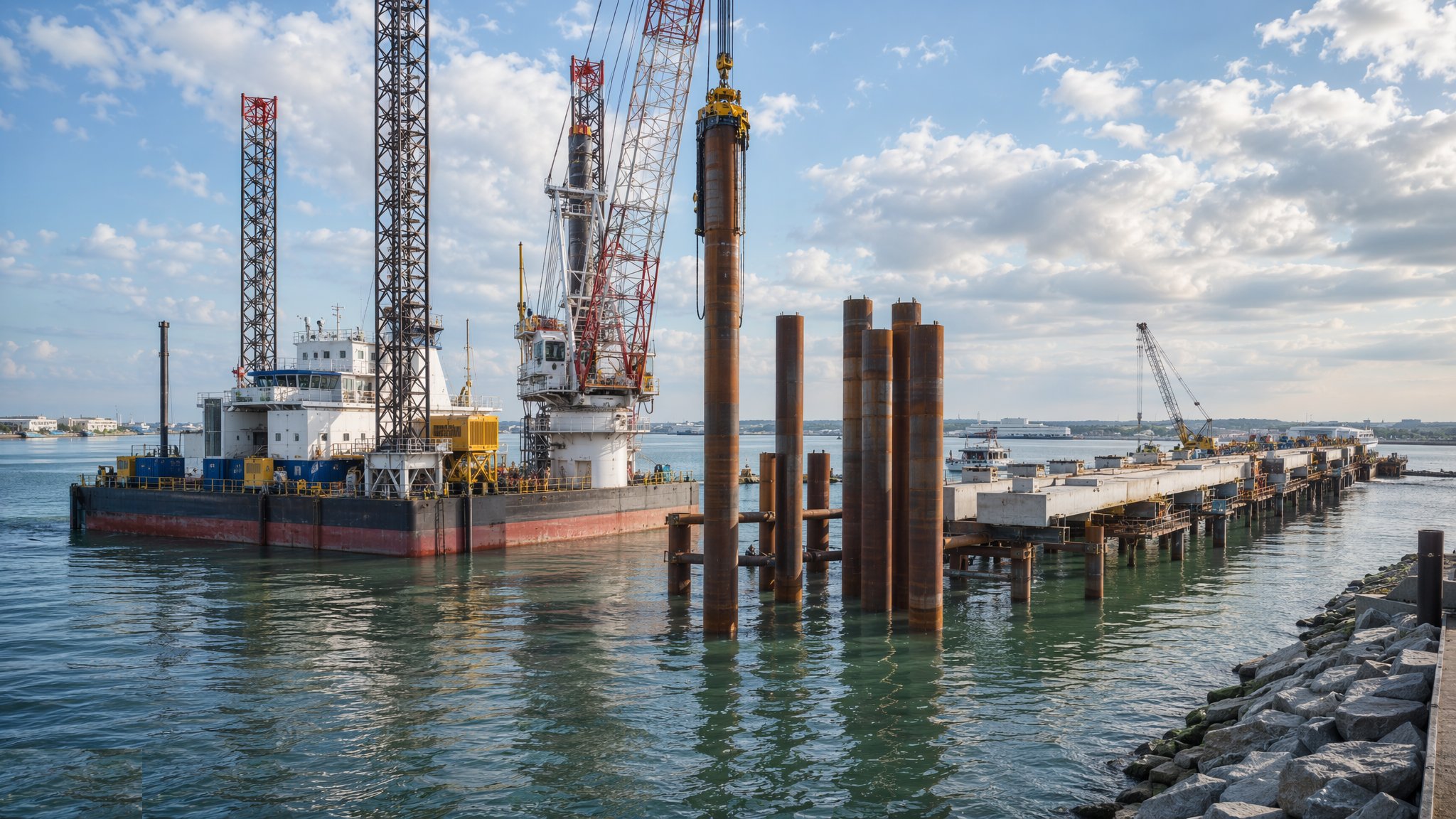
What is Piled jetties with precast decks?
A piled jetty with a precast deck is built the way it is because concrete cast over water is expensive, slow and hard to prove. Piles are driven in bents or rows, their heads are cut to level, and the deck is then assembled from units that were cast, cured and inspected in a casting yard on land. On most projects the sequence runs pile cap or headstock first, then precast beams landing on the caps, then precast deck planks or slabs spanning between the beams, then a small amount of in situ concrete stitching the whole thing together and providing continuity. The wet work over water is reduced to joints, stitches and a topping, which is exactly where the marine contractor wants it.
The advantage is repetition. A jetty is usually a long, uniform structure, so once the casting yard is producing units and the marine spread has found its rhythm, a bent can be completed in a fixed cycle and the programme becomes a matter of multiplication. Quality follows the same logic. Units cast on land can be vibrated properly, cured properly, inspected on all faces and rejected before they ever go to sea, which matters a great deal for a structure that will spend a hundred years in a chloride environment. The designer typically specifies a durable concrete and generous cover to reinforcement for marine exposure, and precasting is the most reliable way of actually achieving what is specified.
The trade is that precast removes flexibility. Every unit has to fit the piles that were actually driven, not the piles that were drawn, so setting out and survey discipline are absolute and the connection details have to carry a tolerance allowance the designer has thought about in advance. Lifting also becomes the governing constraint: unit sizes are usually chosen by what the available crane can lift at the required radius over water, not by what makes the neatest structure. On most projects the casting yard, the transport route, the load-out quay and the lifting plant are planned together at tender stage, because a deck unit that cannot be delivered and landed is worth nothing however well it was cast.
How does Piled jetties with precast decks work, step by step?
- 1
Step 1: Design the deck for the plant that will build it
Precast marine decks are designed around handling. The marine contractor and the designer agree unit sizes, weights and lifting arrangements against the crane that will actually be used, the radius it will work at, and the sea state it will lift in. Connection details, bearing arrangements and stitch dimensions are then developed with a realistic construction tolerance built in, because piles are never exactly where they were drawn. On most projects the tolerance philosophy is written down explicitly: what the piling has to achieve, what the deck can absorb, and what happens when a pile lands outside the allowance.
- 2
Step 2: Set up the casting yard and prove the first units
A casting yard is established with moulds, reinforcement fabrication, a batching supply, curing arrangements and storage laid out for a repeating cycle. The first units of each type are treated as trial units - checked for dimensional accuracy, cover to reinforcement, surface finish and the position of every cast-in item - and the mould and the method are adjusted before series production starts. Marine durability depends on cover and compaction far more than on anything else, so cover is measured rather than assumed, and units that fail are broken up rather than argued about.
- 3
Step 3: Drive the piles and survey what was actually built
The piles are installed as a separate campaign, driven in bents to the designer's founding criteria. As each bent is completed the pile heads are surveyed in three dimensions and the results are fed straight back to the precast designer and the casting yard. On most projects the headstock or pile cap is only detailed once its own piles have been surveyed, so the deck is built to the structure as constructed rather than as drawn. This feedback loop is the single most important control on the whole operation.
- 4
Step 4: Cut off the piles and form the caps or headstocks
Pile heads are cut to level from floating access, cut edges are made good, and the connection is prepared - commonly reinforcement projecting from a concreted pile plug, or a steel connection detail welded on. Caps are then either landed as precast units over the pile heads or cast in situ on hanging formwork supported off the piles themselves. Where in situ concrete is used it is placed from a barge-mounted or deck-mounted pump within the tidal window, and the concrete supply is planned so that no pour is left half-finished by a change in the sea state.
- 5
Step 5: Land the beams
Precast beams are transported out by barge, lifted by the marine crane and landed onto the prepared caps on bearings or on a mortar bed. The lift plan covers the load-out, the sea fastening, the approach, the tag lines and the sequence of release. Beams are checked for level and alignment as they land, then temporarily restrained so that they are stable against wind and accidental load before the next unit arrives. Restraint of a landed but unstitched unit is a permanent works and temporary works question at the same time, and it is designed rather than improvised.
- 6
Step 6: Place the deck units and complete the stitches
Deck planks or slab units are landed between the beams to make a working platform, which immediately transforms the safety and the productivity of everything that follows. Reinforcement is then threaded through the stitch zones, formwork is fixed to the underside where needed, and the in situ concrete is placed to tie the units into a continuous deck. On most projects the stitch pours are sequenced to control shrinkage and to keep the structure working as the designer intended at every stage rather than only when complete.
- 7
Step 7: Cure, protect and finish the deck
Marine concrete is vulnerable while it is young, so curing is protected against wind, spray and early loading, and the pour programme is planned around the tide so that fresh concrete is not washed. Once the deck is complete the surfacing, drainage, kerbs, service trenches and cast-in fixings are completed, and the crane rails, fender fixings, bollards and mooring equipment are set out from the as-built survey rather than from the drawing.
- 8
Step 8: Complete the marine fit-out and hand over
Fenders, bollards, ladders, lifesaving equipment, lighting, services and cathodic protection are fitted and tested, and the walkways and handrails are completed to give safe permanent access. The as-built record covers pile positions and founding levels, unit references and their cast records, stitch pour records, survey levels and the corrosion protection baseline. The port operator receives a structure with a documented history for every element, which is what makes long-term inspection meaningful.
What are the benefits of Piled jetties with precast decks?
- Wet concrete work over water is reduced to stitches and topping, which is where quality risk is smallest
- Casting on land gives measurable cover, proper compaction and curing - the things marine durability actually depends on
- Highly repetitive, so a long jetty settles into a fixed cycle and the programme becomes predictable
- Units can be rejected before they leave the yard, when replacement is cheap
- The deck becomes a safe working platform early, improving access for every following trade
- Casting can run in parallel with the piling campaign, compressing the overall programme
What are the limitations of Piled jetties with precast decks?
- Very sensitive to piling tolerance - a pile outside the allowance can stall a whole bent
- Unit size is limited by the crane and the sea state, not by structural efficiency
- Needs a casting yard, storage, load-out quay and marine transport, all of which cost money before any deck is built
- Late design changes are painful once moulds are made and units are cast
- Joints and stitches are the durability weak points and need careful detailing and workmanship
- Handling damage to edges and corners is common and has to be repaired to a marine standard
What is Piled jetties with precast decks best suited for?
What plant does Piled jetties with precast decks need?
- Casting yard with moulds, reinforcement shop, batching supply, curing and storage areas
- Load-out crane, transport barges and sea fastenings for the delivery of units
- Marine crane on a jack-up or barge, sized for the heaviest unit at the working radius
- Concrete pump and supply arrangement for stitch and topping pours over water
- Floating access platforms, hanging formwork systems and edge protection
- Survey equipment for as-built pile head positions and deck setting out
How is Piled jetties with precast decks quality-checked?
- Trial units dimensionally checked, with cover to reinforcement measured before series production
- Cast records for every unit, traceable by reference to its final position in the structure
- As-built survey of every pile head issued to the precast designer before caps are detailed
- Bearing and mortar bed inspection recorded before each unit is released from the crane
- Stitch and topping pour records including concrete supply, placing conditions and curing
- Final as-built survey of deck levels, fixings and marine fit-out handed over with the structure