Galvanising
Dipping fabricated steel in molten zinc so the corrosion protection is part of the metal rather than a film sitting on it.
Last updated 2026-09-05
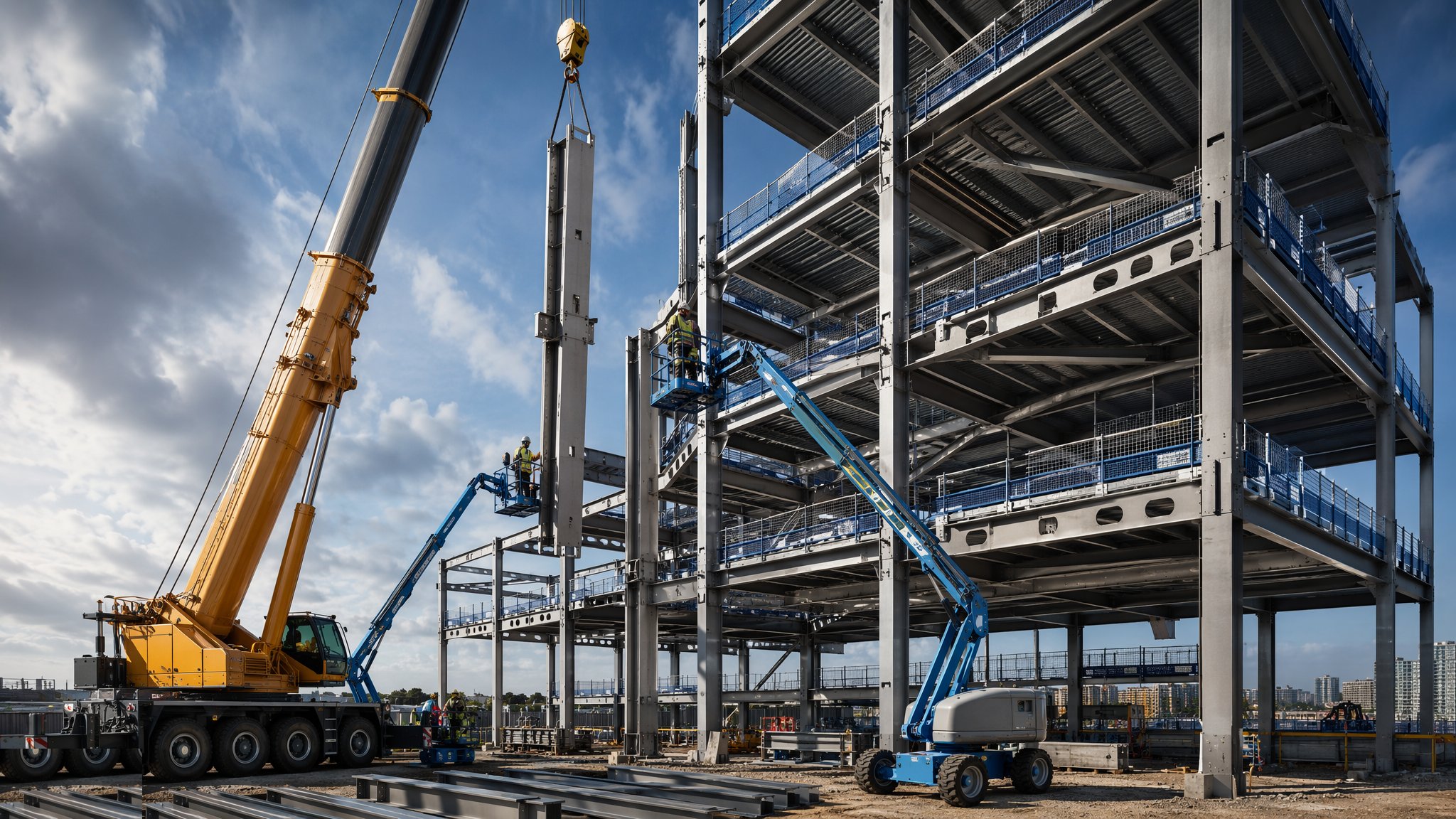
What is Galvanising?
Hot dip galvanising protects steel by immersing the finished fabrication in a bath of molten zinc, typically held at around 450 degrees Celsius. The zinc does not simply coat the surface. It reacts with the steel to form a series of zinc-iron alloy layers bonded metallurgically to the parent metal, with a layer of relatively pure zinc on the outside. That is the fundamental difference from paint. A paint film is applied to the surface and adheres to it, and once it is breached the steel beneath starts to corrode and the damage spreads under the film. A galvanised coating is part of the surface, it is harder than the steel in the alloy layers, and it protects in two ways at once - as a physical barrier, and sacrificially, because zinc corrodes in preference to steel and will continue to protect small areas of exposed steel around a scratch or a drilled hole.
The result is a durable, low-maintenance finish that is well suited to structural steelwork, secondary steelwork, balustrades, walkways, staircases, purlins, brackets and anything that will live outdoors or in a damp environment. Its working life depends on the environment - inland and sheltered conditions are far kinder to zinc than coastal or industrial ones - and the designer selects the protection to suit. Where a longer life or a specific colour is wanted, the galvanised steel is painted or powder coated over the zinc, which is known as a duplex system. The two protections together outlast the sum of the two used separately, because the paint protects the zinc and the zinc protects the steel wherever the paint is damaged. Duplex work needs the zinc surface prepared properly first, because paint applied straight onto new bright zinc without suitable preparation and a compatible primer is a well-known adhesion failure.
The point that catches designers out is that galvanising happens to a finished fabrication, in a bath, at high temperature - and every one of those facts is a design constraint. The bath has a length, width and depth, and anything longer than it has to be double-dipped or redesigned. Every hollow section and every enclosed pocket has to be able to fill, vent and drain, so vent and drain holes have to be designed in and detailed on the drawings, not chased later. Molten zinc trapped in a sealed section is a serious safety hazard as well as a quality problem. Heating a fabrication to bath temperature also relieves the locked-in stresses from cutting, welding and rolling, so slender, asymmetric or heavily welded assemblies can distort, and the design and fabrication sequence should anticipate that. On most projects the fabricator and the galvaniser discuss the steelwork before it is fabricated, not after it has been rejected at the bath.
How does Galvanising work, step by step?
- 1
Step 1: Design the fabrication for the bath
Galvanising is designed in. The size and shape of the fabrication have to suit the bath available, and where a member is longer than the bath the galvaniser is consulted about double dipping, which puts a visible line where the two immersions meet, or the member is split and jointed on site. Hollow sections, box members, sealed pockets and back-to-back angles need vent and drain holes sized and positioned so that zinc and gases can move freely and so that nothing is trapped. Assemblies of very different thicknesses, long slender members and heavily welded frames are reviewed for distortion risk. Lifting points, jigging points and the way the item will hang in the bath all affect the finish, because zinc drains downwards and the orientation decides where runs and pooling end up.
- 2
Step 2: Fabricate, then clean off everything that would stop the reaction
All cutting, drilling, welding and fabrication is completed before galvanising, because zinc cannot be cut or welded through afterwards without destroying it locally. Welds are made continuous where possible, and welding slag, flux residue and spatter are removed, since none of them will react with zinc and each will leave a bare patch. Paint, markings, oil, grease and heavy scale are removed. Identification is applied in a form that survives the process rather than in paint that will not. Anything applied to the surface that the pre-treatment cannot remove will show up as a defect in the finished coating, and by then the item is at the works and the fix is a re-clean and a re-dip.
- 3
Step 3: Degrease, pickle and flux
The pre-treatment is what makes the reaction possible. The steel is degreased to remove oils and greases, rinsed, then pickled in acid to strip the mill scale and rust and leave chemically clean steel, and rinsed again. It is then fluxed, which cleans the surface at a microscopic level and leaves a thin protective film that stops it oxidising again in the moments between the flux tank and the bath. The item is dried before immersion, because moisture entering molten zinc flashes to steam violently. Each stage has a purpose and none is optional. Most coating defects that appear at the bath are traced back to something that went wrong or was skipped in pre-treatment.
- 4
Step 4: Immerse in the zinc and let the alloy layers form
The dried, fluxed fabrication is lowered into the molten zinc at a controlled rate, held until it reaches bath temperature and the alloy layers have developed, then withdrawn slowly so the excess zinc drains cleanly rather than freezing as runs and icicles. Immersion times are a matter of minutes for light items and longer for heavy sections, and the galvaniser judges them from the mass and thickness of the work. The thickness of the coating that forms is largely a function of the steel itself, particularly its chemistry and its surface condition, and of the thickness of the section - which is why the coating on a heavy section behaves differently from the coating on thin sheet, and why the specification is agreed with the galvaniser rather than assumed.
- 5
Step 5: Cool, dress and inspect
The work is cooled in air or quenched, then dressed - runs, icicles, drips and rough edges are removed, and threads and machined faces that have to fit are cleaned out. Bolted assemblies are trial-fitted where tolerances matter, because the coating takes up clearance in holes and on faying surfaces and a hole that was a fit before galvanising may not be one after. The finish is inspected for bare patches, inclusions, ash and lumps, and the coating is checked against the specification. Appearance varies - some items come out bright and some matt grey, and both can be entirely sound, since the grey is a function of the steel chemistry rather than a fault.
- 6
Step 6: Handle, erect and make good on site
Galvanised steel is handled with fabric or soft slings rather than chains, stacked with spacers and stored so that water cannot sit between closely packed surfaces - newly galvanised steel left nested in the wet develops white storage staining, which is unsightly and consumes coating. On site, any damage, any site-welded connection and any hole cut or drilled after galvanising leaves bare steel that has to be made good, normally with a zinc-rich paint or a zinc spray applied to a prepared surface. The zinc around a small area of damage will protect it sacrificially for a while, but repair is still carried out and recorded. Where the steelwork is being painted or powder coated as a duplex system, the zinc surface is prepared as the paint system requires and a compatible primer is used.
What are the benefits of Galvanising?
- The coating is metallurgically bonded to the steel, so it does not peel or flake like a surface-applied film
- Protects sacrificially as well as by barrier, so small scratches and drilled holes do not become spreading corrosion
- Covers the whole fabrication inside and out, including internal faces of hollow sections and areas a brush could never reach
- Very low maintenance over a long service life, which is decisive on structures that are hard to access again
- The alloy layers are hard and abrasion resistant, so the coating survives handling and erection better than paint
- Can be overcoated as a duplex system for longer life or a specified colour, with the two protections reinforcing each other
What are the limitations of Galvanising?
- Item size is limited by the bath, and anything longer needs double dipping, which leaves a visible line, or redesign
- Fabrication must be complete before dipping, since cutting and welding afterwards destroys the coating locally
- Heating to bath temperature relieves fabrication stresses, so slender and heavily welded assemblies can distort
- Hollow and enclosed sections must be vented and drained, which is a safety requirement as well as a quality one
- Coating thickness and appearance depend heavily on the steel chemistry, so finish is not fully controllable and colour can vary between batches
- Adds a step and a transport leg to the fabrication programme, and rejected steel means going round the loop again
What is Galvanising best suited for?
What plant does Galvanising need?
- Galvanising plant with degreasing, pickling, rinsing and fluxing tanks and a drying stage
- Molten zinc bath with temperature control, and overhead cranage and jigging to lower and withdraw work at a controlled rate
- Fabrication shop equipment for completing all cutting, drilling and welding beforehand, with slag and spatter removal
- Dressing tools for removing runs and icicles and for cleaning threads and machined faces
- Coating thickness gauges and inspection equipment
- Soft slings, spacers, stillages and covered or ventilated storage for handling and stacking coated steel
How is Galvanising quality-checked?
- Design reviewed with the galvaniser for bath size, vent and drain provision and distortion risk before fabrication starts
- Fabrication complete and surfaces free of slag, spatter, paint, oil and markings before pre-treatment
- Pre-treatment stages carried out in full, with work dried before immersion
- Coating checked against the specification, with bare patches, inclusions and lumps rejected and re-worked
- Trial assembly of bolted connections where the coating could affect fit, and threads cleaned and checked
- Site damage, site welds and holes made after galvanising repaired to the specified method and recorded, with storage arranged so water cannot sit between stacked members