Underpinning support
Temporary support to a structure while its foundations are extended downward, with the work taken in short sequenced lengths.
Last updated 2026-09-05
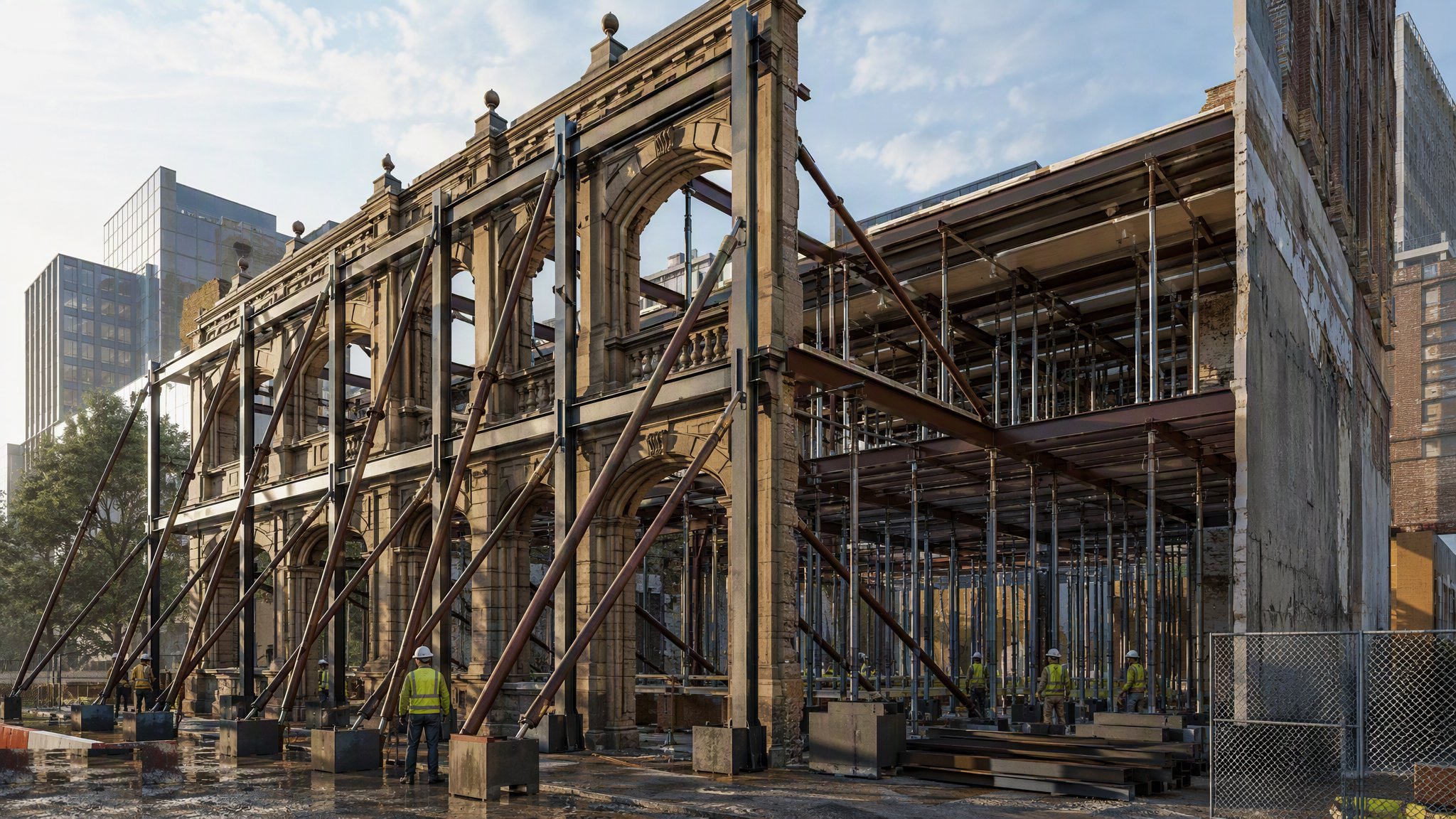
What is Underpinning support?
Underpinning extends a structure's foundations downward, either because they are inadequate, because the ground beneath them has moved, or because something is being built alongside or below that would otherwise undermine them. The difficulty is that the only way to get underneath a foundation is to take the ground out from under it, and a foundation with nothing beneath it is not a foundation. Underpinning support is the temporary work that manages that gap: it keeps the structure stable and the excavation safe while each part of the new foundation is built, and it is the reason the operation is carried out in a controlled sequence of short lengths rather than all at once.
The principle is that only a small proportion of the existing foundation is ever unsupported at any one time, and never two adjacent parts. Each length is excavated, the new foundation beneath it is built and made to bear against the underside of the existing structure, and only when that length is carrying load does the next one start. The lengths are worked in a sequence that keeps the unsupported portions apart. That sequence, the proportion of the foundation that may be open at once, and the order in which the lengths are taken are set by the temporary works designer for the specific structure and the specific ground. They are never adjusted on site to suit the programme, because the whole safety of the operation rests on them.
Two hazards run alongside each other on every underpinning project. The structure above can move, crack or in the worst case collapse if it loses support faster than the new foundation replaces it. The people in the excavation can be buried if the sides of a deep, narrow pit fail. Both are managed by design. The excavation for each length is supported as the temporary works designer requires, and nobody enters an excavation that is not supported or otherwise made safe. The structure is monitored throughout, with trigger levels and a defined response. Every length is inspected by a competent person before entry and again before it is concreted, the register carries the design and the checks, and work is released under permit. Underpinning is slow, repetitive and heavily controlled, and every one of those characteristics is deliberate.
How does Underpinning support work, step by step?
- 1
Step 1: Establish the structure, the foundation and the ground
The investigation establishes what the existing foundation is, what it bears on, what the structure above weighs and what condition it is in. Trial holes expose the foundation so it can be seen rather than assumed, and the ground below and beside it is investigated. Existing cracks and distortion are recorded, along with drains, services and anything else buried in the working zone. Where the cause of movement is what triggered the project in the first place, that cause is identified, because underpinning a structure without dealing with why it moved solves nothing.
- 2
Step 2: Design the underpinning and the temporary support together
The permanent design of the new foundation and the temporary works that make it buildable are designed together, because the sequence is part of both. The temporary works designer sets how much of the existing foundation may be unsupported at any time, the order in which the lengths are taken, how the excavation for each length is supported, and what support the structure above needs while the work proceeds. The design is independently checked at a level matching the risk and entered on the temporary works register.
- 3
Step 3: Support the structure above where the design requires it
Some structures need support in their own right during underpinning - propping, needles and shores, or restraint to walls that will be affected. Where the design calls for it, that support is installed, inspected and signed off before the ground beneath the foundation is touched. Where it does not, that is a decision the designer has made and recorded, not an omission. Either way, the structure's condition is understood before the first length is opened.
- 4
Step 4: Set out the lengths and mark the sequence on site
The lengths are set out and marked physically, and the sequence is displayed where the gang can see it. Each length is identified, and the record shows which lengths are open, which are cast and which are bearing. This is not administration for its own sake. The single most dangerous error in underpinning is opening the wrong length, and a numbered, visible, checked sequence is what prevents it. The supervisor confirms the previous length is complete and bearing before releasing the next.
- 5
Step 5: Excavate each length within a supported excavation
The excavation for each length is carried out with the support the design requires, installed as the dig proceeds so that the sides are never left unsupported. Nobody enters an unsupported excavation, at any depth, for any duration, for any reason. Access and egress are provided, spoil and plant are kept back from the edge as the design requires, and the excavation is inspected by a competent person before entry, at the start of every shift and after any event that could have affected it. Water is controlled as the design allows.
- 6
Step 6: Build the new foundation and make it bear
The new foundation for that length is built beneath the existing one to the permanent design. The connection to the underside of the existing foundation is the point of the whole exercise, so it is made as the designer requires and inspected before it is closed up. Load transfer to the new work is not left to chance or to settlement. The length is not treated as complete, and the next one is not released, until the new foundation is carrying as the design intended.
- 7
Step 7: Monitor the structure continuously through the works
Movement of the structure is monitored from before the first length is opened until after the last is complete, against trigger levels set by the designer. Existing cracks are monitored as well as levels and verticality. A named person receives the readings, an amber level prompts investigation and a red level stops work. Because underpinning proceeds length by length over weeks, monitoring is what shows whether the sequence is working as assumed while there is still time to change it.
- 8
Step 8: Backfill, reinstate and close out
Each length is backfilled and compacted as the design requires once the new foundation is bearing, and any temporary excavation support is removed to the designed method. Drainage and services disturbed by the work are reinstated. Monitoring continues for the period the designer sets after completion, because movement can appear after the works finish. Records of every length - inspection, sequence, and the monitoring data - are retained, and the temporary works register entry is closed out.
What are the benefits of Underpinning support?
- Allows foundations to be extended or replaced beneath a structure that stays standing and often stays occupied
- Deals with inadequate foundations, ground movement and adjacent excavation without demolition
- Works length by length, so the structure is never wholly dependent on temporary support
- Can be carried out in confined spaces and inside buildings where large plant cannot reach
- The sequence gives natural inspection and hold points at every stage
- Monitoring throughout gives early warning while the sequence can still be changed
What are the limitations of Underpinning support?
- Slow and labour-intensive - the sequence, not the excavation, sets the programme
- Deep narrow excavations beside a loaded structure are among the most dangerous places on any project
- Ground conditions and buried obstructions are only fully revealed as each length is opened
- Some structural movement is usually unavoidable, and sensitive structures may not tolerate it
- Water in the excavation complicates every stage and has to be managed within the design
- Underpinning treats the foundation, so the cause of any movement has to be dealt with separately
What is Underpinning support best suited for?
What plant does Underpinning support need?
- Small excavation plant and hand digging equipment suited to confined working
- Excavation support components as specified by the temporary works designer for each length
- Propping, needles and shores where the design requires support to the structure above
- Concrete supply and placing equipment able to reach a confined, sequenced excavation
- Pumping and water management equipment within the limits the design allows
- Monitoring instrumentation for levels, verticality and crack behaviour
How is Underpinning support quality-checked?
- Existing foundation exposed and inspected, and the ground investigated, before design
- Permanent and temporary designs produced together, independently checked and held on the register
- Sequence and permitted open lengths set by the designer, displayed on site and enforced by the supervisor
- Excavation for every length supported as designed, with nobody entering unsupported ground
- Competent person inspection of every excavation before entry, at the start of each shift and after any event
- Bearing connection to the existing foundation inspected before it is closed up
- Continuous monitoring against amber and red triggers, with a written response and a named recipient
- Records of sequence, inspections and monitoring retained and the register entry closed out